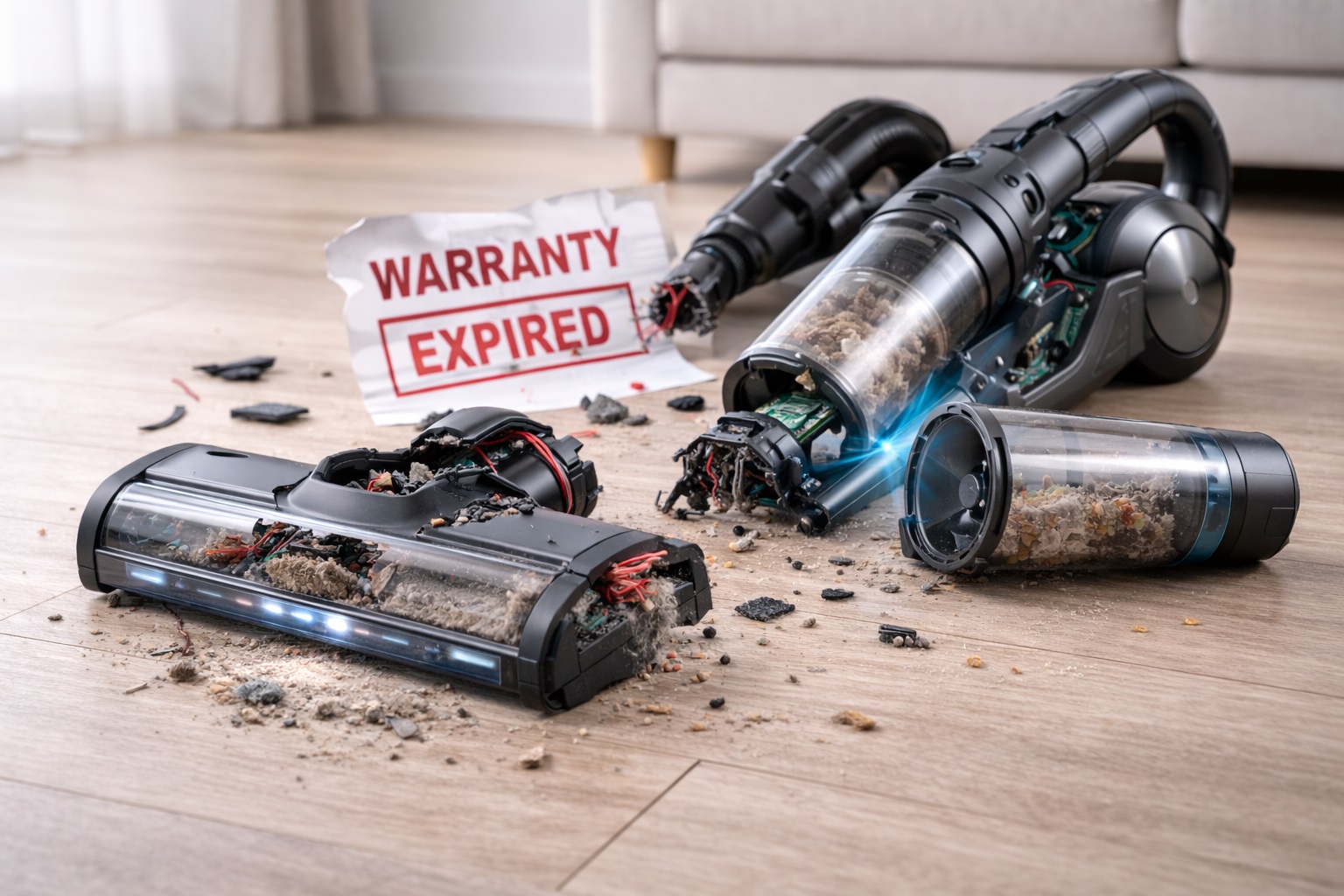
Coincidence — or Is There More to the Story?
If your vacuum died one month after the warranty expired…
You’re not alone.
Across forums, review platforms, and appliance discussions, one pattern appears repeatedly:
It feels intentional.
Is it?
Let’s separate conspiracy from engineering reality.
🔥 The Uncomfortable Truth About Modern Vacuum Design
Modern vacuums are optimized for:
They are NOT always optimized for 10-year durability.
That doesn’t automatically mean “planned failure.”
But it does mean trade-offs.
⚡ 1️⃣ High Suction Comes at a Mechanical Cost
Today’s High Suction Vacuum Cleaner models often operate at:
That’s extremely high rotational stress.
Higher RPM means:
Typical small appliance motors are designed for:
👉 500–800 operating hours
If you vacuum 3 times per week for 30 minutes:
That’s roughly 78 hours per year.
In 2 years, you may approach 150–200 hours.
Under heavy load, wear accelerates.
Marketing pushes suction higher.
Engineering margin becomes thinner.
🔋 2️⃣ The Battery Reality in Cordless & Portable Models
For cordless systems and Portable Vacuum for Travel units:
Lithium batteries typically last:
👉 300–500 charge cycles
After that:
If you use maximum power frequently:
Deep discharge increases
Heat cycles intensify
Degradation speeds up
After 18–24 months, performance drop becomes noticeable.
It feels sudden.
But chemically, it’s predictable.
🌪️ 3️⃣ HEPA Filtration: Protection That Adds Stress
A HEPA Filter Vacuum Cleaner protects your air.
But filtration adds resistance.
When users don’t maintain filters:
Airflow decreases
Motor current increases
Heat builds
Repeated overheating cycles weaken:
Insulation layers
Electronic components
PCB solder joints
Over time, internal damage accumulates silently.
The failure appears “random.”
It wasn’t.
🌊 4️⃣ Wet and Dry Vacuum Cleaner Complexity
A wet and dry vacuum cleaner handles:
That versatility increases internal complexity:
Additional seals
Moisture exposure
Pump or float mechanisms
Corrosion risk
Moisture + dust forms abrasive paste inside components.
If not dried properly, degradation accelerates.
Multi-function often means more stress points.
🔇 5️⃣ Energy-Saving Efficient Powerful Vacuum Cleaner Trade-Offs
Energy efficiency regulations push manufacturers to:
Reduce power consumption
Optimize airflow
Use lighter materials
To meet targets:
An Energy-Saving Efficient Powerful Vacuum Cleaner may be optimized for efficiency — not maximum lifespan.
Efficiency and durability are not always aligned.
🏗️ 6️⃣ Cost Optimization vs True Durability
Here’s where the controversy deepens.
Mass-market products are engineered to:
Premium, truly Multi-Functional Durable Vacuum Cleaner designs often include:
✔ Thicker motor windings
✔ Higher-grade bearings
✔ Better thermal protection
✔ Reinforced structural housing
✔ Sealed airflow systems
But those cost more.
Not all consumers are willing to pay for durability they cannot see.
📊 Why Failures Appear Right After Warranty
| Component | Year 1 | Year 2 | After Warranty |
|---|
| Motor bearings | Minimal wear | Moderate | Noise/failure |
| Battery cells | Stable | Declining | Sharp drop |
| HEPA airflow restriction | Minor | Accumulated | Chronic overheating |
| Seals (wet/dry systems) | Flexible | Aging | Leakage risk |
| PCB heat stress | Minimal | Micro fatigue | Sudden failure |
Failures are rarely instant.
They are cumulative stress crossing a visible threshold.
That threshold often aligns with warranty length — because warranty length is based on expected stress modeling.
That’s not conspiracy.
That’s statistical engineering.
🤔 Is This Planned Obsolescence?
Sometimes? Possibly in extreme cost-driven models.
But more often, it’s this:
Performance is prioritized over lifespan.
Consumers demand:
Stronger suction
Lighter body
Lower price
Smaller size
Quieter operation
Physics demands trade-offs.
🛠️ How to Avoid the “Post-Warranty Death”
If you want longer lifespan:
✔ Avoid continuous max-power use
✔ Clean HEPA filters frequently
✔ Allow cooling breaks
✔ Replace worn belts and brush rolls early
✔ Keep airflow unobstructed
✔ Fully dry wet and dry vacuum cleaner components
✔ Avoid full battery depletion regularly
These habits can extend lifespan by 2–3 years.
🧠 The Real Question
The real question isn’t:
“Are manufacturers designing vacuums to fail?”
It’s:
“Are we buying vacuums optimized for marketing performance instead of long-term durability?”
Whether you use a:
wet and dry vacuum cleaner
High Suction Vacuum Cleaner
Energy-Saving Efficient Powerful Vacuum Cleaner
HEPA Filter Vacuum Cleaner
Portable Vacuum for Travel
Multi-Functional Durable Vacuum Cleaner
The lifespan outcome depends on:
Engineering margin + user behavior.
The warranty didn’t cause the failure.
The stress curve reached its limit.
📌 Suitable Readers
Homeowners, pet owners, and consumers questioning modern vacuum durability and seeking honest insight into appliance lifespan realities.
📌 Hashtags
wet and dry vacuum cleaner, Multi-Functional Durable Vacuum Cleaner, High Suction Vacuum Cleaner, Energy-Saving Efficient Powerful Vacuum Cleaner, HEPA Filter Vacuum Cleaner, Portable Vacuum for Travel, vacuum breaks after warranty, planned obsolescence appliances, vacuum motor lifespan, cordless vacuum battery degradation, vacuum durability issues, home appliance engineering, vacuum overheating problem, cleaning equipment lifespan, residential appliance reliability, Lanxstar