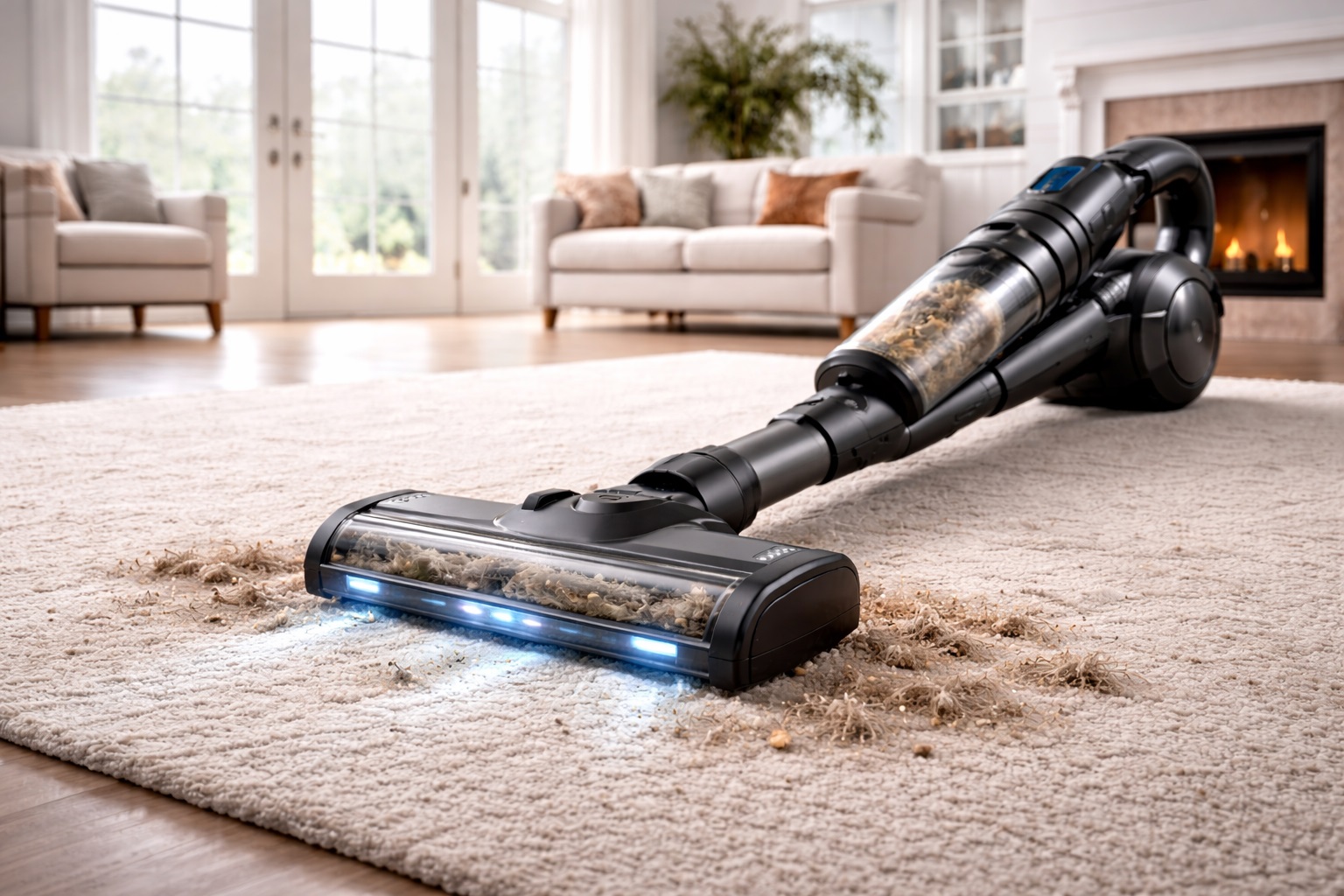
This Isn’t National Pride — It’s Physics
Let’s say it directly:
An average American suburban home demands more from a vacuum cleaner than a typical European apartment.
That statement sounds provocative.
But it’s not about superiority.
It’s about infrastructure.
It’s about architecture.
It’s about cleaning physics.
🏠 1️⃣ Size Changes Everything
Average living space comparison:
United States: ~2,000–2,500 sq ft
Many European apartments: 600–1,000 sq ft
That’s often 2–3× more surface area.
More surface area means:
A Cordless Vacuum Cleaner designed for a compact flat may complete a European apartment easily.
Try cleaning a 2,400 sq ft carpet-heavy U.S. home on one battery.
Runtime and torque stability become critical.
🧶 2️⃣ The Carpet Culture Divide
Here’s the real difference:
🇺🇸 U.S. homes commonly feature:
Wall-to-wall carpeting
Thick underpadding
Carpeted stairs
Plush high-pile fibers
🇪🇺 European apartments often feature:
Hardwood
Tile
Laminate
Thin area rugs
Carpet changes suction demand dramatically.
High-pile carpet can reduce effective airflow penetration by 30–50% compared to hard flooring.
That’s why High Suction Vacuum Cleaner models are heavily marketed in the U.S.
Hard floors require airflow.
Carpets require penetration + agitation.
These are different engineering challenges.
🐕 3️⃣ Bigger Homes, Bigger Dogs, Bigger Debris
Suburban American homes often include:
More space + larger animals = significantly more hair volume.
Pet hair embedded in thick carpet requires:
✔ Strong brush torque
✔ Stable airflow
✔ Durable roller systems
A Multi-Functional Durable Vacuum Cleaner built for multi-room carpet cleaning must handle sustained load.
Compact apartment-focused models are rarely engineered for that stress.
🚗 4️⃣ Garages & Basements: The Hidden Factor
Many American homes include:
Garages
Basements
Mudrooms
Workshops
These generate:
Sand
Leaves
Concrete dust
Moisture
Heavy debris
This is where a Large-Capacity Wet Dry Vacuum Cleaner becomes practical — almost necessary.
European apartments rarely require garage-level debris management inside the home.
Different environments demand different power levels.
⚡ 5️⃣ Voltage & Power Regulation Differences
European electrical systems:
U.S. systems:
European regulations once limited maximum vacuum wattage to improve energy efficiency.
That influenced design philosophy:
Meanwhile, U.S. consumers often prioritize strong suction performance.
The engineering mindset evolved differently.
🔋 6️⃣ Runtime Reality: 20 Minutes vs 60 Minutes
In a 700 sq ft apartment:
In a 2,500 sq ft house:
Cordless Vacuum Cleaner systems must maintain:
Many compact designs optimized for smaller spaces struggle under sustained load.
Stronger endurance becomes necessary in larger homes.
🌪️ 7️⃣ Air Volume & Filtration Demand
American homes often include:
More air volume = more circulating dust.
A HEPA Filter Vacuum Cleaner becomes increasingly important during long cleaning sessions to prevent re-dispersing fine particles.
In larger enclosed spaces, filtration stability matters more.
📊 Side-by-Side Environmental Comparison
| Factor | American Home | European Apartment |
|---|
| Average Size | Large | Compact |
| Carpet Coverage | High | Low |
| Pet Size | Larger breeds common | Smaller breeds common |
| Garage/Basement | Common | Rare |
| Runtime Need | Long | Short |
| Debris Volume | High | Moderate |
| Wet/Dry Demand | Frequent | Limited |
This isn’t about “better.”
It’s about environmental load.
🔄 When Stronger Is NOT Better
Let’s balance the debate.
In small apartments:
Oversized motors are unnecessary
Noise matters more
Energy efficiency matters more
Compact storage is essential
A powerful High Suction Vacuum Cleaner may be overkill in a small flat.
In fact, it may:
Engineering should match environment.
🧠 The Real Debate
The real debate isn’t:
“Are American vacuums better?”
It’s:
“Are we designing vacuums for the environments they’re actually used in?”
A wet and dry vacuum cleaner built for garage + carpet + pet hair + 2,500 sq ft load must be stronger.
An apartment vacuum optimized for hardwood + compact storage must be efficient.
Different physics.
Different needs.
🏁 Final Conclusion
American homes often require stronger vacuum systems because of:
European apartments require:
Compact efficiency
Smart airflow
Noise control
Space optimization
Whether you choose a:
wet and dry vacuum cleaner
High Suction Vacuum Cleaner
Large-Capacity Wet Dry Vacuum Cleaner
Cordless Vacuum Cleaner
HEPA Filter Vacuum Cleaner
Multi-Functional Durable Vacuum Cleaner
The key question is:
Does the vacuum match your environment?
Stronger isn’t always better.
But in larger, carpet-heavy American homes — stronger is often necessary.
That’s not nationalism.
That’s physics.
📌 Suitable Readers
Homeowners, pet owners, and consumers comparing vacuum performance across U.S. and European markets, especially those living in large suburban homes with carpets and multi-zone cleaning needs.
📌 Hashtags
wet and dry vacuum cleaner, Multi-Functional Durable Vacuum Cleaner, High Suction Vacuum Cleaner, Large-Capacity Wet Dry Vacuum Cleaner, Cordless Vacuum Cleaner, HEPA Filter Vacuum Cleaner, American home cleaning needs, European apartment vacuum design, carpet heavy home cleaning, garage cleaning vacuum system, suburban home vacuum power, large house cleaning equipment, powerful suction debate, regional vacuum engineering difference, residential cleaning comparison, Lanxstar