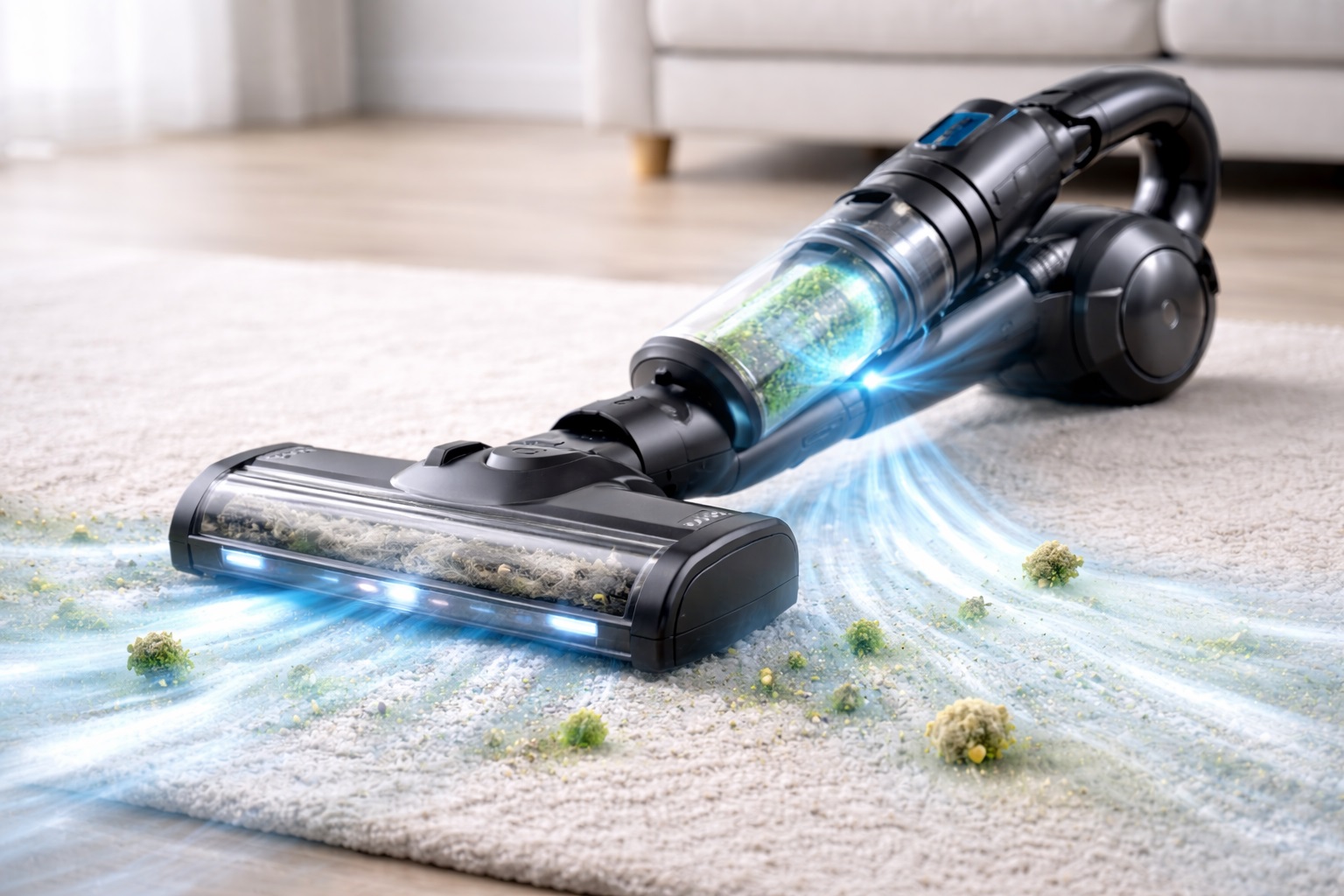
What Science, Airflow Physics, and Real Homes Tell Us
If someone in your home suffers from:
Seasonal allergies
Dust mite sensitivity
Pet dander reactions
Asthma
Chronic sinus issues
You’ve probably seen one common recommendation:
“Use a HEPA vacuum.”
But are HEPA Filter Vacuum Cleaner systems truly necessary — or just marketing?
Let’s examine this properly, using airflow science and real indoor conditions.
🌬️ First: What Actually Triggers Indoor Allergies?
Common indoor allergens include:
Many of these particles measure:
For comparison:
Human hair ≈ 70 microns
Dust mite waste ≈ 10 microns
Fine allergen particles ≈ 0.3–2.5 microns
Standard vacuum filters often fail to trap particles below 5 microns effectively.
This is where HEPA filtration matters.
🔬 What Is a True HEPA Filter?
A True HEPA filter captures:
99.97% of particles at 0.3 microns.
Why 0.3 microns?
Because it’s the most difficult particle size to trap.
If a filter captures that, it performs even better at larger and smaller sizes.
A HEPA Filter Vacuum Cleaner doesn’t just pick up dust.
It prevents microscopic particles from being released back into the air.
🌀 The Problem with Standard Vacuums
Without sealed HEPA filtration:
Fine particles escape through exhaust vents
Dust becomes airborne again
Allergens circulate indoors
You vacuum — but you may also be redistributing microscopic allergens.
This is especially problematic in:
Carpeted apartments
Homes with pets
Low-ventilation spaces
An Apartment Vacuum Cleaner without sealed filtration can actually worsen indoor air quality temporarily.
🌪️ HEPA Filter vs Non-HEPA Comparison
| Feature | Standard Filter | HEPA Filter Vacuum Cleaner |
|---|
| Captures large debris | Yes | Yes |
| Captures fine dust | Partial | Yes |
| Captures allergens (0.3 micron) | Limited | 99.97% |
| Reduces airborne re-circulation | No | Yes |
| Suitable for asthma families | Not ideal | Recommended |
For allergy-sensitive households, this difference is significant.
🏢 Are HEPA Vacuums Necessary in Apartments?
In apartments:
Fine dust accumulates faster.
An Apartment Vacuum Cleaner with sealed HEPA filtration reduces:
Small living spaces amplify the impact of filtration quality.
🐾 What About Pet Owners?
Pet dander is lightweight and microscopic.
Even after visible pet hair is removed:
A Multi-Functional Durable Vacuum Cleaner without HEPA filtration may remove hair but fail to trap microscopic dander.
For pet-allergy families, HEPA is strongly recommended.
🌊 Do Wet and Dry Vacuum Cleaners Help with Allergies?
A wet and dry vacuum cleaner is excellent for:
Spills
Heavy debris
Mixed cleaning tasks
However:
Wet/dry systems are not automatically allergy-optimized.
Unless equipped with sealed HEPA exhaust systems, they may:
If allergy control is the priority, verify that the wet/dry system includes a true HEPA stage.
🔇 Quiet Vacuum Cleaner and Allergy Considerations
A Quiet Vacuum Cleaner reduces stress for sensitive households.
But noise reduction alone does not equal filtration quality.
Some quiet models focus on insulation — not exhaust sealing.
For allergy families, look for:
✔ Sealed airflow system
✔ Certified HEPA filtration
✔ Low particle leakage rating
Quietness is comfort.
Filtration is health.
⚡ Does an Energy-Saving Efficient Powerful Vacuum Cleaner Help?
Energy-efficient models use optimized airflow rather than excessive motor speed.
This can:
An Energy-Saving Efficient Powerful Vacuum Cleaner with sealed HEPA design provides:
Efficiency and filtration work together.
🧪 When HEPA Is Truly Necessary
HEPA filtration is strongly recommended if:
✔ Someone has asthma
✔ You have pets
✔ Home has wall-to-wall carpet
✔ You live in high-pollen regions
✔ You suffer from chronic sinus sensitivity
It may be less critical if:
But for allergy families, HEPA significantly reduces airborne irritants.
⚠️ Important: HEPA Only Works If Maintained
Even the best HEPA Filter Vacuum Cleaner fails if:
Filter is clogged
Filter is not replaced
Seals are broken
Dust bin overflows
Maintenance schedule:
✔ Wash filters (if washable) every 2–4 weeks
✔ Replace non-washable filters every 3–6 months
✔ Empty bin before 75% full
Filtration is only as good as its condition.
🏁 Final Expert Conclusion
Are HEPA vacuums really necessary for allergy families?
If allergies are present — yes.
Because:
Standard filters cannot trap microscopic allergens effectively
Re-circulated dust worsens symptoms
Apartments amplify air quality issues
Pet dander requires fine filtration
Whether you use a:
wet and dry vacuum cleaner
Multi-Functional Durable Vacuum Cleaner
Quiet Vacuum Cleaner
Energy-Saving Efficient Powerful Vacuum Cleaner
HEPA Filter Vacuum Cleaner
Apartment Vacuum Cleaner
If allergy control is your priority, sealed HEPA filtration is not a luxury.
It’s a health-focused decision.
📌 Suitable Readers
Allergy-sensitive families, apartment residents, pet owners, and households seeking improved indoor air quality through proper vacuum filtration.
📌 Hashtags
wet and dry vacuum cleaner, Multi-Functional Durable Vacuum Cleaner, Quiet Vacuum Cleaner, Energy-Saving Efficient Powerful Vacuum Cleaner, HEPA Filter Vacuum Cleaner, Apartment Vacuum Cleaner, allergy vacuum solution, asthma friendly vacuum, indoor air quality improvement, sealed filtration system, pet dander removal vacuum, dust mite vacuum cleaner, HEPA vs standard filter, home air health solutions, allergy family cleaning guide, residential cleaning equipment, Lanxstar