Hi, message us with any questions.
We're happy to help!





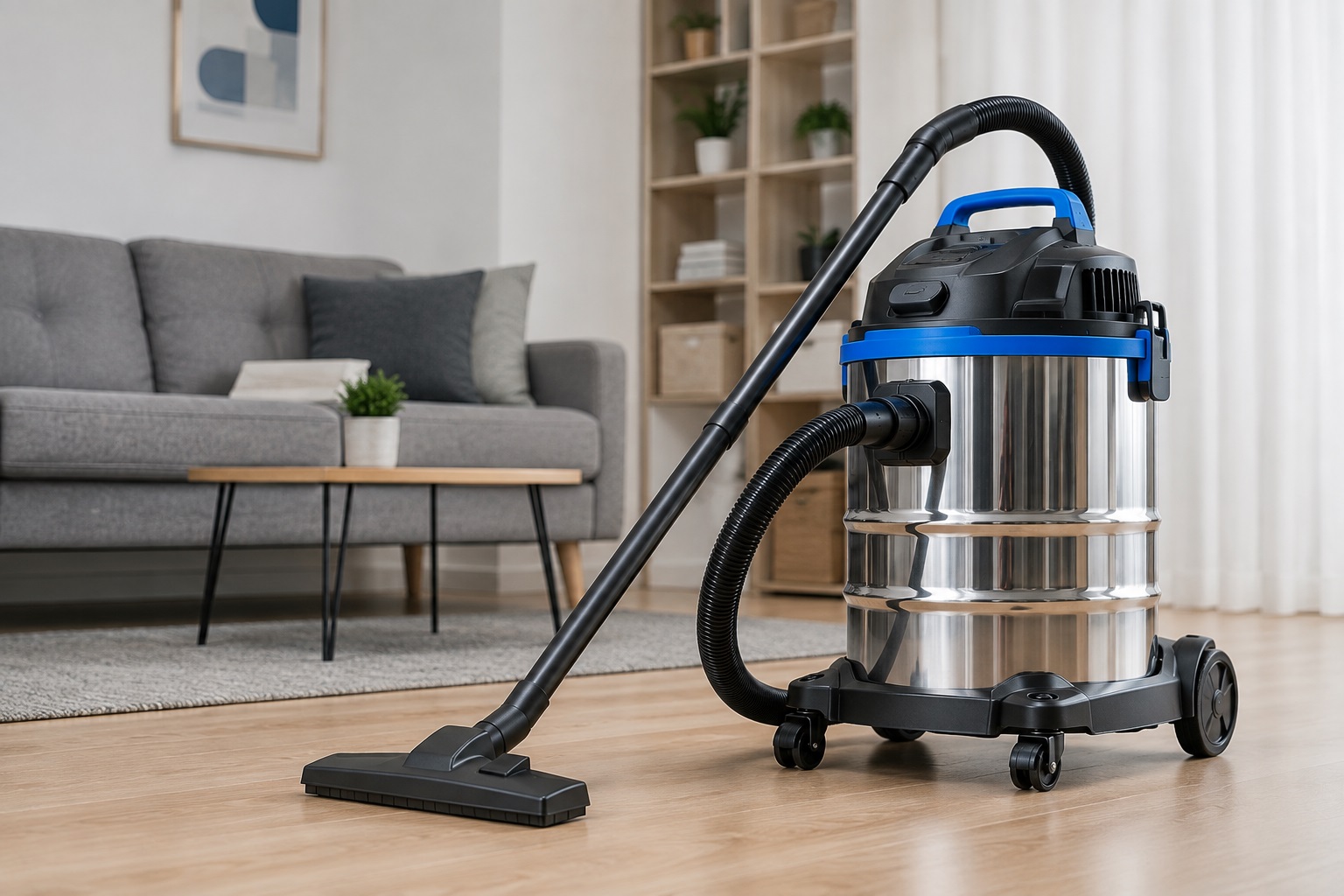
1. Why Suction Power Matters in a Wet and Dry Vacuum Cleaner
When buyers compare a wet and dry vacuum cleaner, one specification usually attracts immediate attention: suction power.
It sounds simple—the stronger the suction, the better the vacuum.
In reality, professional vacuum performance is more complicated.
A High Suction Vacuum Cleaner may be useful for collecting heavy debris, wet materials, sand, dust, and workshop waste, but maximum suction alone does not determine cleaning efficiency.
A vacuum cleaner also depends on:
airflow;
vacuum pressure;
motor efficiency;
hose diameter;
filtration;
tank design;
sealing;
floor tools;
operating conditions.
🏭 For an industrial vacuum cleaner, these factors determine whether the machine can maintain useful suction in demanding environments.
🏨 For a commercial vacuum cleaner, the goal may be different. Buyers may prefer a balance between suction, noise, portability, energy efficiency, and daily operating comfort.
Therefore, the better question is not simply:
“How powerful should my vacuum cleaner be?”
It is:
“How much usable suction does my application actually require?”
2. What Does “Suction Power” Actually Mean?
“Suction power” is often used as a general marketing term, but vacuum performance is usually described using several different measurements.
The most important are vacuum pressure and airflow.
Vacuum Pressure
Vacuum pressure describes the machine's ability to create negative pressure and lift material.
This is important when collecting:
liquids;
heavier particles;
dense debris;
material from narrow openings;
dirt through longer hoses.
A machine with strong vacuum pressure can often pull difficult debris more effectively.
Airflow
Airflow describes how much air moves through the vacuum system.
Higher airflow helps transport collected material through the hose and into the tank.
🌬️ A machine may have strong vacuum pressure but limited airflow, or high airflow but only moderate pressure.
The best performance comes from the right balance for the application.
This is why a high suction power vacuum cleaner cannot be properly evaluated from one number alone.
3. Motor Wattage Is Not the Same as Suction Power
One of the biggest mistakes in vacuum cleaner purchasing is assuming that motor wattage equals cleaning performance.
It does not.
Motor wattage tells you how much electrical power the motor consumes under defined conditions. It does not directly tell you how much useful suction reaches the floor tool.
For example, two machines may both use 1,400-watt motors.
Machine A may have:
efficient airflow channels;
tight seals;
optimized hose connections;
low-restriction filtration.
Machine B may have:
narrow airflow passages;
poor sealing;
inefficient filtration;
unnecessary internal resistance.
Even with similar electrical power, their real cleaning performance can be different.
⚡ This is especially important when buyers are looking for an Energy-Saving Efficient Powerful Vacuum Cleaner.
A well-engineered machine may deliver strong cleaning performance without simply increasing electrical consumption.
4. How Much Suction Does Commercial Cleaning Need?
A commercial environment usually requires a combination of reliable suction and easy operation.
Typical applications include:
hotels;
offices;
restaurants;
schools;
retail stores;
commercial cleaning services;
car detailing businesses;
facility management.
A commercial grade vacuum cleaner used in these environments does not always need the highest possible suction.
Instead, buyers should prioritize consistent performance.
For example, a commercial vacuum cleaner for hotel use may need to collect:
dust;
crumbs;
small debris;
hair;
occasional liquid spills.
🏨 In this case, a Portable Quiet Vacuum Cleaner with moderate-to-high suction may be more practical than a very large industrial model.
Strong suction is useful, but low noise, portability, cable reach, filter maintenance, and easy storage may create more value for the hotel cleaning team.
5. How Much Suction Does an Industrial Vacuum Cleaner Need?
Industrial environments often require greater performance.
An industrial vacuum cleaner may need to handle:
sawdust;
sand;
metal particles;
packaging debris;
factory dust;
production waste;
water;
workshop debris;
warehouse dirt.
A heavy duty vacuum cleaner should therefore maintain strong suction under higher debris loads.
For this type of application, buyers should evaluate both pressure and airflow.
📦 An industrial wet and dry vacuum cleaner for warehouse cleaning supplier may recommend a machine with stronger airflow for collecting larger amounts of dry debris across large floor areas.
🏗️ A wet dry vacuum cleaner for construction site applications may require both strong vacuum pressure and robust airflow because the machine may encounter dense dust and coarse particles.
The correct specification depends on the actual debris rather than simply the size of the building.
6. Suction Requirements for Liquid Pickup
Wet pickup creates different performance requirements from ordinary dry vacuuming.
A wet and dry suction system needs enough pressure to move liquid through the hose while protecting the motor from collected water.
The system also needs an effective shut-off mechanism to prevent overfilling.
🌊 For wet cleaning, buyers should consider:
hose diameter;
hose length;
liquid shut-off design;
tank capacity;
drainage outlet;
motor protection;
sealing.
A Large-Capacity Wet Dry Vacuum Cleaner can be particularly useful where frequent liquid pickup is required.
However, suction should remain stable as the tank fills.
Buyers should also remember that large volumes of liquid significantly increase machine weight.
That means wheels, handles, trolley design, and drainage systems are just as important as suction.
7. Airflow vs Vacuum Pressure: Which Matters More?
Neither one is universally more important.
They serve different functions.
Higher Vacuum Pressure Is Useful For:
lifting heavier debris;
liquid pickup;
working through narrow tools;
pulling material through resistance;
cleaning difficult corners.
Higher Airflow Is Useful For:
moving large volumes of dust;
transporting light debris;
cleaning wide floor areas;
warehouse cleaning;
collecting dry particles.
💡 A professional wet dry vacuum cleaner should therefore be evaluated as a complete airflow system.
This includes:
Motor → filter → internal air path → tank → hose → tool.
Any restriction in that path can reduce performance.
That is also why filter maintenance matters so much.
A powerful motor cannot compensate indefinitely for a heavily clogged filter.
8. Single Motor vs Dual Motor Vacuum Cleaner
A dual motor vacuum cleaner is often marketed as the obvious choice for maximum suction.
For demanding applications, dual motors can provide important benefits.
Potential advantages include:
stronger overall airflow;
higher suction capacity;
better performance for large debris volumes;
greater flexibility in some machine designs.
However, dual motors can also increase:
electricity consumption;
weight;
operating noise;
purchase price;
maintenance cost.
🔧 Therefore, a dual motor system is not automatically the best choice for every buyer.
A hotel may achieve better productivity with a lighter single-motor machine.
A large warehouse or factory may benefit from the additional performance of a dual-motor configuration.
Procurement teams should match motor configuration to the real duty cycle.
9. Hose Diameter and Length Affect Suction
The hose can significantly change real-world performance.
A longer hose provides better reach but can increase resistance.
A smaller-diameter hose can improve access to narrow spaces but may restrict airflow.
A larger-diameter hose can handle bigger debris but may require sufficient airflow to work effectively.
This is particularly important for:
factory floor cleaning;
logistics warehouse cleaning;
construction site cleaning equipment;
car detailing vacuum cleaner applications.
🚗 A car detailing vacuum cleaner may benefit from a narrower flexible hose because access is more important than moving large debris.
🏭 A factory vacuum may require a larger hose because operators collect heavier material and greater debris volumes.
The correct hose should be selected as part of the vacuum system, not treated as a simple accessory.
10. Filtration Can Reduce or Preserve Suction
Filters protect the motor and help control discharged particles.
However, filtration also creates resistance.
As filters become loaded with dust, airflow can decrease.
This is why professional buyers should examine:
filter area;
filter material;
cleaning method;
replacement interval;
cost;
availability.
A HEPA filter vacuum cleaner may be appropriate where higher filtration efficiency is required.
However, adding a high-efficiency filter without a properly designed airflow system can affect performance.
🌬️ Good engineering balances filtration and airflow.
For commercial and industrial procurement, buyers should ask suppliers how suction changes as filters collect dust and how the filter should be maintained.
11. Case Study: Warehouse Buyer Comparing Two Vacuum Cleaners
Consider a hypothetical warehouse operator evaluating two machines.
Machine A
higher motor wattage;
smaller airflow path;
compact filter;
narrow hose;
lower purchase price.
Machine B
slightly lower motor wattage;
optimized airflow path;
larger filter area;
wider hose;
more robust accessories.
At first, the procurement team assumes Machine A will perform better because the wattage is higher.
After testing both machines in a realistic warehouse environment, Machine B collects packaging debris and floor dust faster.
📊 Why?
Because the complete system maintains better airflow.
The buyer ultimately selects Machine B because it offers better productivity despite having a lower headline wattage.
The lesson is simple:
Do not compare vacuum cleaners by wattage alone.
12. Suction Power for Construction Site Cleaning
Construction cleaning can be demanding because debris varies significantly.
A vacuum may need to collect:
sawdust;
dry dust;
sand;
small stones;
water;
renovation debris.
A wet dry vacuum cleaner for construction site use generally benefits from strong suction and robust airflow.
🏗️ However, durability is equally important.
A machine with excellent laboratory suction numbers may still perform poorly if:
the hose damages easily;
wheels cannot handle rough surfaces;
filters clog quickly;
switches fail under heavy use;
the tank is difficult to empty.
For construction buyers, a Multi-Functional Durable Vacuum Cleaner should combine performance with mechanical robustness.
13. Suction Power for Warehouse Cleaning
Warehouses usually involve large floor areas.
A good warehouse cleaning solution requires more than strong pressure.
High airflow can be especially important because operators often need to move relatively large volumes of lightweight debris.
For logistics warehouse cleaning, buyers should consider:
tank size;
airflow;
pressure;
hose length;
cable length;
machine mobility;
wheel durability;
drainage;
filter capacity.
📦 A Large-Capacity Wet Dry Vacuum Cleaner can reduce interruptions.
However, if the machine is too heavy or difficult to maneuver, productivity may decrease.
That means suction performance must always be considered together with ergonomics.
14. Suction Power for Hotel and Commercial Cleaning
Hotels have different needs.
A commercial vacuum cleaner for hotel use typically requires enough suction to clean efficiently without creating unnecessary noise or energy consumption.
For hospitality applications, useful features may include:
low noise;
compact design;
strong but controlled suction;
smooth wheels;
long cable;
flexible hose;
convenient accessory storage.
🔇 A low noise vacuum cleaner can be especially important when cleaning is performed near guest rooms or public areas.
This is one reason a Fast Lightweight Vacuum Cleaner may be better than a heavy industrial model for many hotels.
Commercial productivity often depends on how easily operators can move and use the machine.
15. Energy Efficiency vs Maximum Suction
Some buyers automatically choose the highest-power machine available.
That approach can create unnecessary operating costs.
An energy efficient vacuum cleaner should provide enough suction for the task without consuming significantly more electricity than required.
⚡ The most useful question is:
How much energy does the machine use to complete the cleaning job?
Not:
How many watts does the motor consume?
For cleaning companies operating large fleets, efficiency becomes especially important.
A small difference in power consumption multiplied across hundreds of machines and thousands of operating hours can materially affect operating costs.
That is why an Energy-Saving Efficient Powerful Vacuum Cleaner should combine strong real-world performance with sensible energy use.
16. How Buyers Should Compare Vacuum Cleaner Specifications
When contacting an industrial vacuum cleaner supplier, ask for more than one headline specification.
Request information on:
airflow;
vacuum pressure;
motor input power;
motor quantity;
tank capacity;
hose diameter;
hose length;
filtration;
noise;
voltage;
cable length;
machine weight;
accessories.
If possible, ask how the machine was tested.
Different manufacturers may use different conditions.
🔍 A professional vacuum cleaner manufacturer should be able to explain how its performance data was measured.
For large purchases, buyers should also request samples and perform application-based testing before confirming the final model.
17. What Procurement Teams Should Test Before Bulk Orders
Before placing a bulk vacuum cleaner purchase, professional buyers can perform several practical tests.
Dry Debris Test
Use materials similar to the customer's actual environment.
Measure cleaning speed and whether the vacuum blocks easily.
Wet Pickup Test
Evaluate liquid pickup, shut-off function, tank sealing, and drainage.
Filter Loading Test
Run the machine with fine debris and monitor suction reduction.
Mobility Test
Move the vacuum across realistic floors and obstacles.
Noise Test
Check whether operating noise is acceptable for the application.
Continuous Operation Test
Test the machine under the expected workload.
📋 These evaluations are far more useful than simply comparing catalogue claims.
18. How Much Suction Is “Enough”?
There is no universal number that is correct for every wet/dry vacuum.
Instead, suction should be matched to the task.
For lighter commercial cleaning, buyers often need:
moderate-to-high suction + low noise + portability.
For warehouse cleaning:
strong airflow + sufficient pressure + larger capacity.
For factory cleaning:
strong suction + durability + suitable filtration.
For construction work:
strong pressure + airflow + robust accessories and filtration.
For car detailing:
controlled strong suction + flexible hose + specialized accessories.
✅ The correct machine provides enough performance without unnecessary weight, noise, cost, or energy consumption.
19. Choosing a Supplier for High-Suction Vacuum Cleaners
For importers searching for an industrial vacuum cleaner supplier or vacuum cleaner supplier China, product performance is only part of the decision.
Evaluate:
manufacturing consistency;
motor quality;
airflow system design;
quality control;
testing methods;
spare parts;
filter availability;
customization capability;
export documentation;
engineering support.
For an OEM industrial vacuum cleaner manufacturer, communication is particularly important.
An OEM project may involve changes to:
motor configuration;
hose specification;
tank size;
accessories;
branding;
packaging;
filters;
cable length;
plug type.
🏭 A reliable industrial vacuum cleaner factory should help buyers understand how these changes affect performance and cost.
20. OEM and Private-Label Suction Specifications
Distributors developing an OEM vacuum cleaner, ODM vacuum cleaner, or private label vacuum cleaner should define performance targets clearly.
Do not simply request:
“We need a very powerful vacuum.”
Instead, specify:
target airflow;
target vacuum pressure;
motor configuration;
tank volume;
filter type;
hose dimensions;
target noise level;
intended application;
test method.
This creates a more objective development process.
For a wholesale vacuum cleaner program, it also helps ensure consistent product positioning across different markets.
21. Common Suction Power Mistakes to Avoid
Mistake 1: Looking Only at Wattage
Electrical consumption is not the same as usable suction.
Mistake 2: Ignoring Airflow
Strong pressure without enough airflow may reduce cleaning productivity.
Mistake 3: Using the Wrong Hose
Hose diameter and length can significantly affect performance.
Mistake 4: Ignoring Filter Condition
Clogged filters reduce airflow.
Mistake 5: Buying Excessive Power
More suction can mean more noise, energy consumption, weight, and cost.
Mistake 6: Not Testing the Actual Application
Real-world tests often reveal differences that catalogue specifications do not show.
22. Final Buying Checklist
Before you buy industrial vacuum cleaner products, confirm these points:
⚙️ Suction: Is vacuum pressure sufficient for the target material?
🌬️ Airflow: Can the machine transport the expected debris efficiently?
🔌 Motor: Does the motor configuration match the workload?
🧹 Filtration: Is the filter appropriate for the debris?
🛢️ Capacity: Is the tank large enough for practical operation?
🔇 Noise: Is the machine suitable for the working environment?
⚡ Efficiency: Does performance justify energy consumption?
🏭 Supplier: Can the manufacturer provide consistent production, parts, documentation, and engineering support?
Conclusion
So, how much suction power does a wet and dry vacuum cleaner really need?
There is no single universal answer.
A hotel, construction contractor, warehouse, car detailing business, and factory all have different cleaning requirements.
A High Suction Vacuum Cleaner can be valuable for demanding debris, but strong cleaning performance depends on much more than motor wattage.
The best machine combines:
vacuum pressure + airflow + filtration + hose design + tank capacity + durability + efficiency.
A commercial buyer may benefit from a Portable Quiet Vacuum Cleaner, while warehouse operators may require a Large-Capacity Wet Dry Vacuum Cleaner with stronger sustained airflow.
Factories and construction buyers may need a heavy duty vacuum cleaner with robust components and appropriate filtration.
For wholesalers, importers, and private-label brands, testing the complete machine is more useful than comparing isolated catalogue numbers.
When working with a vacuum cleaner manufacturer in China, buyers should provide clear application requirements and request measurable performance data before finalizing a large order.
Lanxstar supports commercial and industrial wet/dry vacuum cleaner sourcing for different B2B cleaning applications. More product information is available at www.lxvacuum.com.
If you are interested, please feel free to contact us.
50 Related SEO Keywords
wet and dry vacuum cleaner, wet dry vacuum cleaner, wet dry vacuum suction power, vacuum cleaner suction power, High Suction Vacuum Cleaner, high suction power vacuum cleaner, industrial vacuum cleaner, commercial vacuum cleaner, commercial wet dry vacuum cleaner, industrial wet dry vacuum cleaner, heavy duty vacuum cleaner, dual motor vacuum cleaner, single motor vacuum cleaner, Portable Quiet Vacuum Cleaner, Multi-Functional Durable Vacuum Cleaner, Fast Lightweight Vacuum Cleaner, Energy-Saving Efficient Powerful Vacuum Cleaner, Large-Capacity Wet Dry Vacuum Cleaner, low noise vacuum cleaner, energy efficient vacuum cleaner, wet and dry suction system, HEPA filter vacuum cleaner, commercial grade vacuum cleaner, industrial dust extractor, industrial cleaning equipment, commercial cleaning equipment, construction site cleaning equipment, warehouse cleaning solution, hotel cleaning equipment, factory floor cleaning, logistics warehouse cleaning, car detailing vacuum cleaner, commercial cleaning service equipment, facility management cleaning equipment, industrial vacuum cleaner supplier, vacuum cleaner supplier, cleaning equipment supplier, vacuum cleaner manufacturer in China, industrial vacuum cleaner factory, wholesale vacuum cleaner, bulk vacuum cleaner purchase, OEM vacuum cleaner, ODM vacuum cleaner, private label vacuum cleaner, factory direct vacuum cleaner, buy industrial vacuum cleaner, OEM industrial vacuum cleaner manufacturer, Lanxstar, vacuum manufacturer, vacuum cleaner maker



