Hi, message us with any questions.
We're happy to help!





1. Why Wet Dry Vacuum Capacity Matters
When buyers compare a wet and dry vacuum cleaner, tank capacity is often one of the first specifications they notice.
A 15L vacuum looks compact and portable. A 60L machine looks powerful and industrial.
But bigger does not automatically mean better.
The right capacity depends on how much debris the machine will collect, how frequently operators can empty the tank, how far the vacuum must be moved, and whether the application involves dry debris, liquid pickup, or both.
A Large-Capacity Wet Dry Vacuum Cleaner may be ideal for a warehouse or factory, while the same machine could be inconvenient in a hotel corridor or car detailing shop.
📌 For commercial buyers, the best capacity is usually the one that gives the highest productivity without creating unnecessary weight, storage difficulty, or operating cost.
That means buyers should evaluate:
cleaning area;
debris volume;
liquid volume;
operator mobility;
machine weight;
tank emptying frequency;
drainage system;
floor conditions;
storage space;
duty cycle.
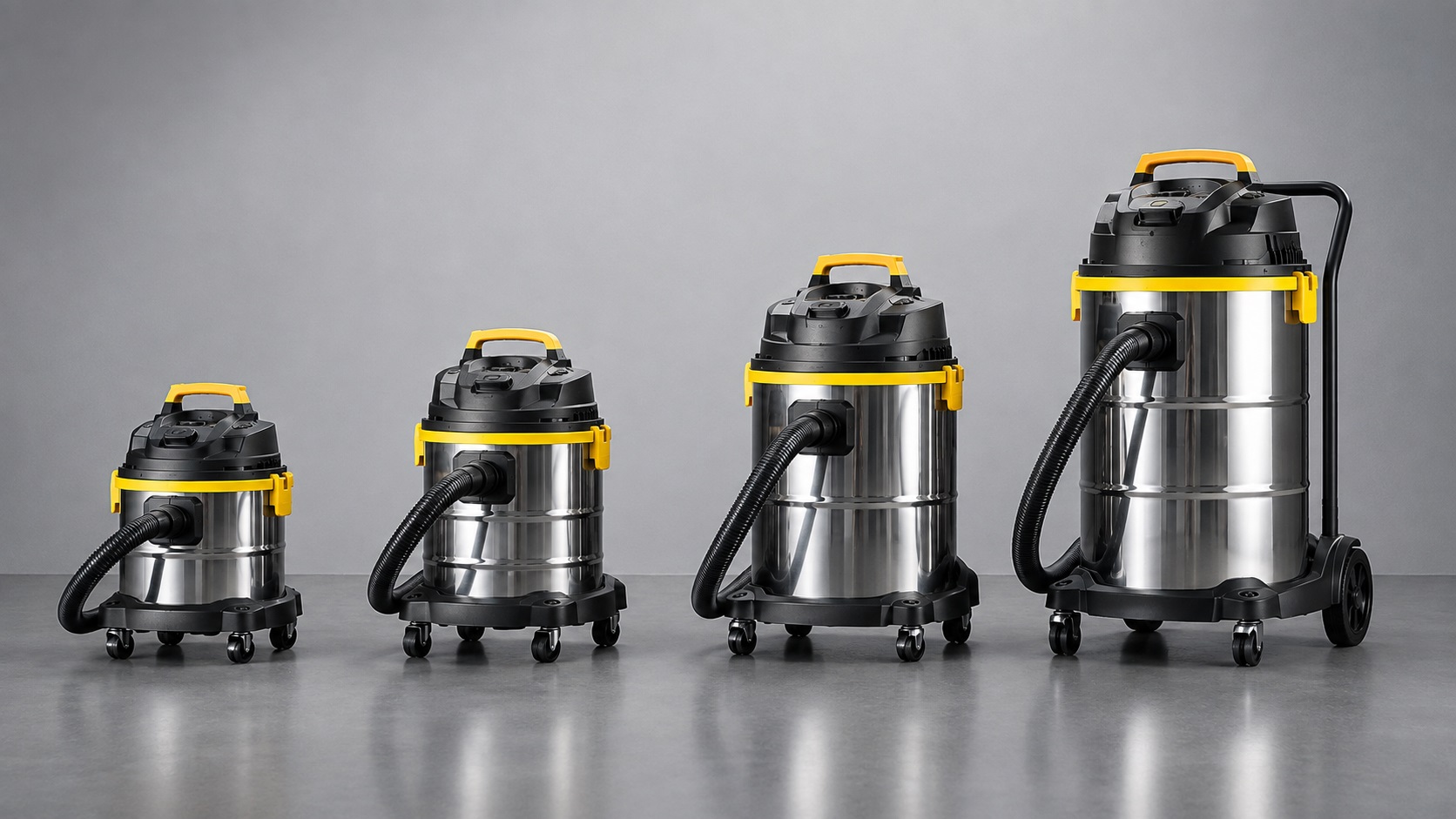
The most common commercial and industrial capacities include 15L, 20L, 30L, and 60L, and each has a different ideal use case.
2. What Does Vacuum Tank Capacity Actually Mean?
Tank capacity usually refers to the nominal internal volume of the collection container.
However, buyers should understand one important point:
Nominal tank capacity is not always the same as usable collection capacity.
The machine may require space for:
filters;
float shut-off mechanisms;
internal airflow;
motor protection components;
liquid safety margin.
Therefore, a 30L tank may not always hold exactly 30 liters of collected liquid during normal operation.
This matters especially for buyers comparing multiple suppliers.
When sourcing from a vacuum cleaner manufacturer, ask whether the stated capacity refers to:
gross tank volume or usable collection volume.
🌊 This is particularly important for liquid pickup because overfilling can activate the shut-off system before the tank reaches its theoretical maximum volume.
3. 15L Wet Dry Vacuum: Best for Portability
A 15L wet dry vacuum cleaner is usually one of the most compact choices for professional wet and dry cleaning.
It is often suitable for:
car detailing;
small retail stores;
offices;
hotel rooms;
workshops;
residential service businesses;
mobile cleaning services.
The biggest advantage is mobility.
A Fast Lightweight Vacuum Cleaner in the 15L category is easier to carry upstairs, move between rooms, load into a service vehicle, and store in compact spaces.
🚗 For a car detailing vacuum cleaner, 15L can be a highly practical size because operators usually prioritize hose flexibility, compact dimensions, accessory access, and portability.
The downside is capacity.
If the machine is used for large-volume debris or frequent liquid pickup, operators may need to empty it repeatedly.
For a small workspace, this may not matter.
For a large warehouse, it can significantly reduce productivity.
4. When Should You Choose a 15L Vacuum?
A 15L machine makes sense when:
cleaning areas are relatively small;
debris volume is low to moderate;
portability is important;
stairs are common;
storage space is limited;
operators frequently transport the machine;
liquid pickup is occasional rather than high-volume.
A Portable Quiet Vacuum Cleaner with a 15L tank can be especially suitable for hospitality and mobile cleaning applications.
🏨 In hotel use, cleaners may need to move between floors and around furniture. A compact machine often provides better practical productivity than a large industrial unit.
A 15L capacity is less suitable when operators must collect large amounts of dust, construction debris, factory waste, or water.
5. 20L Wet Dry Vacuum: A Balanced Commercial Choice
A 20L wet dry vacuum sits between ultra-portable models and larger professional machines.
For many commercial applications, this size provides a good balance of:
mobility;
tank capacity;
storage convenience;
operating weight;
cleaning range.
A 20L commercial vacuum cleaner can work well in:
hotels;
offices;
restaurants;
retail stores;
schools;
car detailing shops;
small workshops;
commercial cleaning companies.
💡 This size is often attractive to wholesalers because it can serve a broad range of customers.
A Multi-Functional Durable Vacuum Cleaner with a 20L tank can be positioned as a general-purpose commercial product rather than a highly specialized machine.
For distributors, this versatility may make 20L models easier to sell across multiple channels.
6. Why 20L Can Be a Good “Middle Ground”
A 20L model gives operators more capacity than a 15L machine without becoming too bulky.
For professional cleaners, that can mean fewer interruptions.
For retailers, it can provide a stronger perceived value.
For hotel or restaurant cleaning, a 20L machine may still be easy to maneuver while offering enough tank space for routine wet and dry tasks.
🔇 If noise is a concern, buyers should also look for a low noise vacuum cleaner rather than assuming capacity determines acoustic performance.
Motor design, airflow, housing construction, and insulation affect noise more than tank volume alone.
7. 30L Wet Dry Vacuum: The Commercial and Light-Industrial Sweet Spot
A 30L wet and dry vacuum cleaner is one of the most versatile capacities for professional use.
It offers significantly more collection volume while remaining manageable for most operators.
Common applications include:
commercial cleaning companies;
large retail spaces;
workshops;
warehouses;
maintenance departments;
hotels;
construction renovation projects;
light industrial facilities.
A 30L model can often serve as a bridge between commercial and industrial categories.
🏭 For factory floor cleaning, a 30L unit may be appropriate when debris volume is moderate but durability requirements are higher than in normal commercial environments.
📦 For logistics warehouse cleaning, it can also work well when the facility does not require extremely large-capacity equipment.
8. When Is 30L Better Than 20L?
The jump from 20L to 30L becomes valuable when operators need to clean larger areas without frequent emptying.
A 30L model is often better when:
debris volume is moderate to high;
cleaning sessions are longer;
liquid pickup is more frequent;
the machine remains on one floor;
operators do not need to carry it often.
For distributors, 30L models are also useful because they can appeal to both commercial and light-industrial customers.
⚙️ When combined with a High Suction Vacuum Cleaner design, the 30L category can offer strong performance without the bulk of a 60L machine.
9. 60L Wet Dry Vacuum: Best for Heavy-Duty Applications
A 60L vacuum is clearly aimed at larger-scale cleaning.
Typical applications include:
warehouses;
factories;
large workshops;
construction sites;
industrial maintenance;
manufacturing plants;
logistics centers.
A Large-Capacity Wet Dry Vacuum Cleaner reduces the need to stop and empty the tank.
This can improve productivity in high-volume environments.
A 60L industrial vacuum cleaner may also feature:
larger wheels;
robust trolley frames;
heavy-duty hoses;
drain systems;
dual motors;
stainless steel tanks;
industrial accessories.
🏭 For buyers searching for a heavy duty vacuum cleaner, 60L is often one of the most relevant capacity categories.
10. When Should You Choose 60L?
A 60L vacuum makes sense when:
cleaning areas are large;
debris volume is high;
the machine remains mainly on one level;
liquid collection is frequent;
downtime for emptying should be minimized;
industrial durability is important.
However, there are trade-offs.
A 60L tank filled with liquid can become extremely heavy.
That means buyers should pay close attention to:
drain hose design;
rear wheel size;
caster quality;
handle position;
trolley stability;
tank emptying method.
🌊 A large capacity is useful only when operators can manage the collected material safely and efficiently.
11. 15L vs 20L vs 30L vs 60L: Quick Comparison
| Capacity | Best For | Main Advantage | Main Limitation |
|---|---|---|---|
| 15L | Cars, offices, small hotels | Lightweight and portable | Frequent emptying |
| 20L | Hotels, retail, commercial cleaning | Balanced size and mobility | Limited for heavy debris |
| 30L | Workshops, warehouses, light industry | Strong versatility | Heavier than compact models |
| 60L | Factories, warehouses, construction | High productivity and capacity | Bulky and heavy when full |
📌 Capacity should be matched to cleaning volume, not chosen simply because a larger tank looks more professional.
12. Does a Larger Tank Mean More Suction Power?
No.
Tank capacity and suction power are separate specifications.
A 60L machine is not automatically more powerful than a 20L vacuum.
Suction depends on:
motor design;
airflow;
vacuum pressure;
filtration;
hose size;
system sealing.
A compact high suction power vacuum cleaner may outperform a larger machine if it has a more efficient airflow system.
Likewise, a large 60L model may prioritize capacity rather than maximum suction.
⚡ Buyers should therefore compare tank size and suction separately.
This is particularly important when evaluating a dual motor vacuum cleaner.
Dual motors may increase performance, but they also increase energy consumption, noise, weight, and cost.
13. Dry Debris vs Liquid Pickup: Capacity Changes the Decision
Tank capacity matters differently for dry and wet cleaning.
Dry Debris
Dry debris usually weighs less, so larger tanks can be easier to manage.
A 30L or 60L vacuum can be highly efficient in warehouses and workshops where operators collect:
dust;
packaging debris;
sawdust;
dirt;
dry particles.
Liquid Pickup
Water is heavy.
This changes everything.
A 60L tank filled with liquid may be difficult to move even if the machine itself has excellent wheels.
🌊 For liquid applications, buyers should prioritize a good drainage system.
A wet and dry suction system with a convenient drain hose can make a large tank practical.
Without effective drainage, a smaller machine may actually be easier to use.
14. Case Study: Four Buyers, Four Different Capacities
Consider four hypothetical buyers sourcing from the same vacuum cleaner manufacturer.
Buyer A: Car Detailing Shop 🚗
The shop needs to clean vehicle interiors.
It chooses a 15L vacuum because portability and accessory access matter more than capacity.
Buyer B: Hotel Group 🏨
The hotel cleaning team needs machines for corridors, public areas, and occasional spills.
It selects a 20L Portable Quiet Vacuum Cleaner because it balances capacity, noise, and mobility.
Buyer C: Warehouse Operator 📦
The warehouse needs to clean packaging debris and floor dust.
It chooses a 30L wet dry vacuum because it provides sufficient capacity without becoming too difficult to move.
Buyer D: Factory Maintenance Team 🏭
The factory needs frequent wet and dry cleaning across large production areas.
It chooses a 60L heavy duty vacuum cleaner with a robust trolley and drainage system.
The lesson is clear:
The right capacity depends on workflow, not simply floor area.
15. Capacity for Construction Site Cleaning
A wet dry vacuum cleaner for construction site applications often requires higher capacity because debris volume can be significant.
Construction crews may collect:
sawdust;
dust;
sand;
water;
renovation debris.
A 30L model may be sufficient for smaller renovation projects.
A 60L model may be better for larger job sites.
🏗️ But durability is critical.
Buyers should evaluate:
hose strength;
wheel construction;
tank durability;
filter capacity;
motor protection;
accessory quality.
A large tank alone does not make a machine suitable for construction.
16. Capacity for Warehouse Cleaning
Warehouse cleaning often favors 30L or 60L machines.
A warehouse cleaning solution should reduce unnecessary downtime.
If operators are constantly emptying a 15L tank, productivity suffers.
For logistics warehouse cleaning, 30L may be ideal for moderate debris.
A 60L model may be more efficient for larger facilities.
📦 Buyers should also consider cable length and hose reach.
A large tank does not help productivity if the operator constantly needs to move between power outlets.
17. Capacity for Hotels and Facility Management
For hotel cleaning, portability often matters more than maximum capacity.
A commercial vacuum cleaner for hotel use should be easy to move through corridors, elevators, and service areas.
A 15L or 20L model can often provide better usability.
For broader facility management cleaning equipment, 20L or 30L models may offer greater flexibility because they can handle multiple applications.
🔇 A low noise vacuum cleaner can also be more valuable than a larger tank in customer-facing environments.
18. Capacity and Filter Performance
Tank capacity also affects filter maintenance indirectly.
Larger machines are often used for heavier cleaning, meaning filters may encounter more dust.
A HEPA filter vacuum cleaner may be useful where higher filtration efficiency is required.
However, buyers should evaluate:
filter surface area;
dust loading;
replacement frequency;
filter cleaning method;
spare-parts availability.
A 60L machine with a small, easily clogged filter may perform worse in practice than a 30L unit with better filtration design.
🌬️ Tank capacity should therefore never be evaluated independently from airflow and filtration.
19. Capacity and Energy Efficiency
Bigger machines often come with larger or multiple motors, but that is not always necessary.
An energy efficient vacuum cleaner should match power consumption to the workload.
A hotel does not necessarily need a 60L dual-motor machine.
A factory may.
⚡ The best Energy-Saving Efficient Powerful Vacuum Cleaner is one that completes the required cleaning task efficiently without using excessive energy.
For large cleaning fleets, correct capacity selection can also reduce energy waste.
Smaller machines may be more efficient in compact environments.
Larger machines may improve productivity in high-volume environments.
20. Which Capacity Is Best for Wholesale Buyers?
Wholesalers often ask which capacity has the broadest market potential.
There is no single answer, but product positioning can help.
15L
Best for portability-focused retail and detailing markets.
20L
Strong general-purpose commercial option.
30L
Excellent bridge between commercial and industrial demand.
60L
Best for industrial and heavy-duty product lines.
For a wholesale vacuum cleaner business, carrying several capacities can help serve multiple market segments.
A distributor might position:
15L = compact
20L = commercial
30L = professional
60L = industrial
This creates a clearer product ladder.
21. OEM and Private-Label Capacity Planning
Importers developing an OEM vacuum cleaner, ODM vacuum cleaner, or private label vacuum cleaner range should think about capacity as part of product architecture.
Instead of offering four unrelated machines, a brand can create a structured family.
For example:
15L compact series;
20L commercial series;
30L professional series;
60L industrial series.
🎨 This makes product positioning easier for wholesalers and retailers.
An OEM industrial vacuum cleaner manufacturer may also support customization involving:
tank material;
color;
logo;
accessories;
cable length;
filtration;
motor configuration;
packaging.
22. How to Compare Vacuum Cleaner Suppliers
When sourcing from an industrial vacuum cleaner supplier, buyers should ask whether different capacities share the same platform or use different motor and filtration designs.
Important questions include:
Is tank capacity gross or usable?
What motor options are available?
Are 30L and 60L models available with dual motors?
What filter systems are used?
Is a drain hose included?
Are spare parts available?
What is the MOQ?
Can branding be customized?
Are different voltage versions available?
What quality-control tests are performed?
🏭 A professional vacuum cleaner manufacturer in China should be able to explain the differences between each capacity rather than simply quoting four prices.
23. Common Capacity Selection Mistakes
Mistake 1: Choosing the Largest Tank Automatically
Large tanks reduce emptying frequency but increase bulk and weight.
Mistake 2: Ignoring Liquid Weight
Water can make large tanks difficult to move.
Mistake 3: Confusing Capacity with Suction
Tank size does not determine vacuum performance.
Mistake 4: Ignoring Storage Space
A 60L unit may not fit easily into hotel storage areas or service vehicles.
Mistake 5: Not Considering Operator Workflow
The best machine should reduce total cleaning time, not simply hold more debris.
24. Final Capacity Buying Guide
Choose 15L if you need:
🚗 portability, car detailing, compact storage, light commercial cleaning.
Choose 20L if you need:
🏨 balanced capacity, hotel cleaning, retail, offices, commercial services.
Choose 30L if you need:
📦 larger commercial areas, workshops, warehouses, light industrial cleaning.
Choose 60L if you need:
🏭 factories, construction, large warehouses, heavy-duty cleaning, high debris volume.
The best capacity depends on how the machine is actually used.
Conclusion
So, should you choose a 15L, 20L, 30L, or 60L wet dry vacuum cleaner?
For portable cleaning and car detailing, 15L is often the most convenient choice.
For hotels, retail environments, and commercial cleaning services, 20L offers an excellent balance of capacity and mobility.
For workshops, warehouses, and professional cleaning, 30L provides strong versatility.
For factories, construction sites, and large-scale industrial applications, a 60L Large-Capacity Wet Dry Vacuum Cleaner can reduce downtime and improve productivity.
The key is to match capacity with debris volume, liquid pickup, operator mobility, suction requirements, filtration, and cleaning frequency.
For wholesalers and importers, capacity also plays an important role in product positioning. A well-designed product range can serve compact, commercial, professional, and industrial markets with different tank sizes.
When evaluating a vacuum cleaner supplier China or industrial vacuum cleaner factory, buyers should compare not only tank volume but also motors, filtration, drainage, wheels, accessories, and quality-control systems.
Lanxstar provides commercial and industrial wet/dry vacuum cleaner solutions for different B2B applications and capacity requirements. More information is available at www.lxvacuum.com.
If you are interested, please feel free to contact us.
50 Related SEO Keywords
wet and dry vacuum cleaner, wet dry vacuum cleaner, 15L wet dry vacuum, 20L wet dry vacuum, 30L wet dry vacuum, 60L wet dry vacuum, wet dry vacuum capacity, commercial vacuum cleaner, industrial vacuum cleaner, High Suction Vacuum Cleaner, Portable Quiet Vacuum Cleaner, Multi-Functional Durable Vacuum Cleaner, Fast Lightweight Vacuum Cleaner, Energy-Saving Efficient Powerful Vacuum Cleaner, Large-Capacity Wet Dry Vacuum Cleaner, high suction power vacuum cleaner, heavy duty vacuum cleaner, dual motor vacuum cleaner, stainless steel vacuum tank, low noise vacuum cleaner, energy efficient vacuum cleaner, wet and dry suction system, HEPA filter vacuum cleaner, commercial grade vacuum cleaner, industrial dust extractor, industrial cleaning equipment, commercial cleaning equipment, construction site cleaning equipment, warehouse cleaning solution, hotel cleaning equipment, factory floor cleaning, logistics warehouse cleaning, car detailing vacuum cleaner, facility management cleaning equipment, retail cleaning equipment, industrial vacuum cleaner supplier, vacuum cleaner supplier, cleaning equipment supplier, vacuum cleaner manufacturer in China, industrial vacuum cleaner factory, wholesale vacuum cleaner, bulk vacuum cleaner purchase, OEM vacuum cleaner, ODM vacuum cleaner, private label vacuum cleaner, factory direct vacuum cleaner, OEM industrial vacuum cleaner manufacturer, Lanxstar, vacuum manufacturer, vacuum cleaner maker



