Hi, message us with any questions.
We're happy to help!





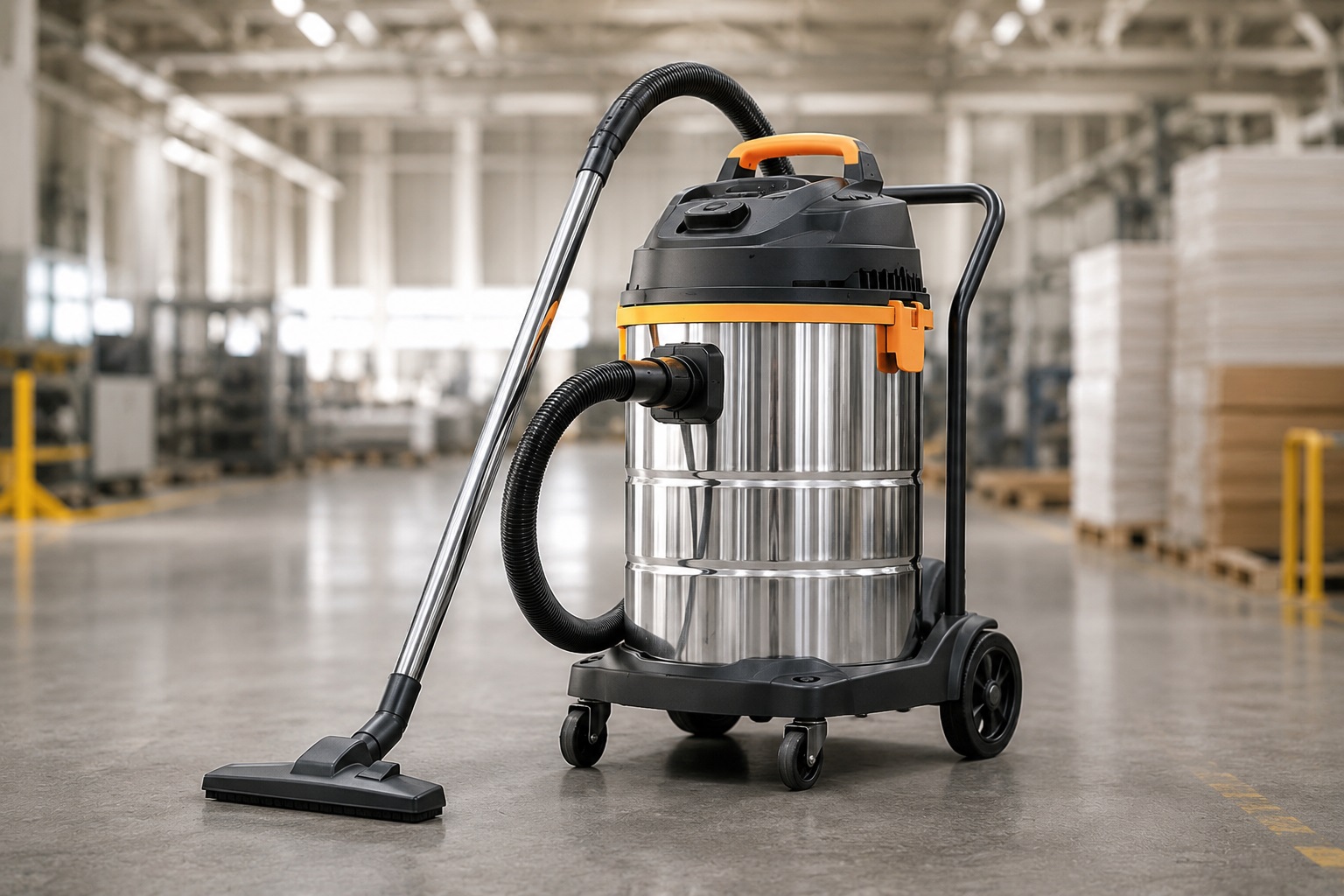
1. Commercial vs Industrial Wet and Dry Vacuum Cleaners: Why the Difference Matters
When sourcing a wet and dry vacuum cleaner, buyers frequently encounter two descriptions: “commercial” and “industrial.”
At first glance, the machines may look almost identical. Both can feature large tanks, wheels, flexible hoses, powerful motors, and a wet and dry suction system. However, appearance alone does not tell you whether a machine is suitable for cleaning hotel corridors or collecting heavy debris from a factory floor.
🏨 A commercial vacuum cleaner is typically designed for professional cleaning environments such as hotels, offices, retail stores, restaurants, schools, car detailing businesses, and general facility maintenance.
🏭 An industrial vacuum cleaner, by contrast, is generally intended for more demanding environments such as factories, warehouses, workshops, manufacturing facilities, and some construction applications.
The difference is not simply “small versus large” or “weak versus powerful.”
For professional procurement, the real distinction involves duty cycle, suction requirements, debris type, filtration, durability, capacity, mobility, maintenance, and total cost of ownership.
Understanding these factors can prevent both overbuying and under-specifying equipment.
2. What Is a Commercial Wet and Dry Vacuum Cleaner?
A commercial wet dry vacuum cleaner is built for professional cleaning tasks that require greater reliability and capacity than a typical household vacuum.
These machines are commonly used as:
hotel cleaning equipment;
retail cleaning equipment;
office and school cleaning machines;
restaurant cleaning equipment;
car detailing vacuum cleaner equipment;
commercial cleaning service equipment;
facility management cleaning equipment.
A well-designed commercial model usually balances suction performance with portability, operating noise, easy maintenance, and competitive cost.
For example, a Portable Quiet Vacuum Cleaner can be more useful in a hotel than an oversized machine with extremely high power consumption.
Likewise, a Fast Lightweight Vacuum Cleaner may improve productivity in retail facilities where employees frequently move the machine between cleaning zones.
💡 Commercial cleaning is often about efficiency per cleaning hour—not maximum machine size.
This distinction is particularly important for cleaning contractors purchasing dozens or hundreds of machines.
3. What Is an Industrial Wet and Dry Vacuum Cleaner?
An industrial machine is generally designed for tougher environments, heavier debris loads, longer or more demanding operating cycles, or specialized cleaning requirements.
Typical applications include:
factory floor cleaning;
logistics warehouse cleaning;
workshops;
production facilities;
maintenance departments;
industrial storage areas;
selected construction applications.
An industrial wet and dry vacuum cleaner for warehouse cleaning supplier, for example, may offer models with larger tanks, robust trolley structures, heavy-duty wheels, higher-capacity motors, and accessories intended for demanding environments.
🏗️ A wet dry vacuum cleaner for construction site use may need to handle sand, sawdust, dust, water, and coarse debris while being transported over relatively rough surfaces.
This is where features such as a stainless steel vacuum tank, robust hose, reinforced wheels, durable accessories, and appropriate motor protection become increasingly valuable.
However, “industrial” should never be treated as an automatic guarantee of performance.
Professional buyers should always evaluate the specifications and intended application behind the label.
4. Suction Power: Does Industrial Always Mean More Powerful?
Not necessarily.
Many buyers assume an industrial model must automatically be a High Suction Vacuum Cleaner and that motor wattage alone determines performance.
This can lead to poor purchasing decisions.
Vacuum performance is influenced by several factors, including:
Airflow: how much air moves through the system.
Vacuum pressure: the machine's ability to create suction and lift material.
Motor design: efficiency and performance characteristics of the motor.
Air path: restrictions in hoses, filters, bends, and internal channels.
Filtration condition: clogged filters can significantly reduce practical airflow.
System sealing: air leakage can reduce useful suction.
A high suction power vacuum cleaner therefore needs a well-designed system rather than simply a large wattage number printed on a specification sheet.
⚡ A dual motor vacuum cleaner may provide additional performance for demanding applications, but two motors can also mean higher electricity consumption, increased noise, additional weight, and greater cost.
Commercial buyers should ask: How much suction do we actually need for the job?
Industrial buyers should ask: Can this performance be maintained under our expected workload?
5. Tank Capacity: Productivity vs Portability
Tank size is another major distinction.
Commercial machines frequently prioritize mobility. Depending on the application, a moderate-capacity vacuum can be easier for cleaning staff to maneuver around furniture, elevators, corridors, guest rooms, and retail displays.
Industrial environments often benefit from larger collection capacities.
A Large-Capacity Wet Dry Vacuum Cleaner can reduce the number of times operators stop to empty the machine when cleaning warehouses, workshops, or factory floors.
But capacity creates a trade-off.
🌊 Remember: collected liquid is heavy.
A large tank filled with liquid can quickly become difficult to handle. Therefore, buyers should also consider:
drainage hose or drain outlet;
wheel diameter;
trolley design;
handle position;
tank geometry;
machine stability;
emptying method.
A 70-liter machine is not automatically better than a 30-liter machine. The best capacity is the one that supports the workflow without unnecessarily reducing mobility.
6. Durability and Construction
Commercial cleaning equipment can operate every day, so durability matters in both categories.
However, industrial environments can impose additional physical stress.
An industrial machine may encounter rougher floors, heavier debris, longer travel distances, frequent hose movement, impacts, and harsher storage conditions.
A Multi-Functional Durable Vacuum Cleaner should therefore be evaluated as a complete system.
Look beyond the tank material and inspect:
hose thickness and flexibility;
hose connectors;
caster construction;
rear-wheel size;
motor head housing;
switches;
handles;
cable quality;
seals;
latches;
floor tools;
accessory connections.
🔧 A heavy duty vacuum cleaner is only as reliable as its weakest frequently used component.
For wholesalers and distributors, this matters because broken wheels, switches, hoses, and connectors can create more after-sales problems than the headline motor specification.
7. Filtration Requirements Can Be Very Different
Filtration is an area where application should determine the specification.
A general commercial machine collecting ordinary floor debris may have relatively straightforward filtration requirements.
Fine industrial dust can demand significantly more attention.
A HEPA filter vacuum cleaner can provide improved fine-particle filtration, but buyers need to distinguish between a vacuum containing a HEPA-rated filter and a complete system designed and tested for a particular filtration requirement.
🏥 This is especially important when selecting hospital cleaning equipment or machines for environments where airborne particle control is critical.
Likewise, an industrial dust extractor should not automatically be treated as interchangeable with an ordinary wet/dry vacuum.
Where hazardous, combustible, explosive, toxic, or otherwise regulated dust is involved, appropriate certified equipment should be selected according to the applicable regulations and standards.
Never choose a standard commercial wet/dry vacuum solely because it has strong suction when the material itself creates a specific safety requirement.
8. Noise: A Major Commercial Purchasing Factor
Industrial facilities can sometimes tolerate higher noise levels than hotels, offices, schools, and customer-facing retail spaces.
That makes noise particularly important for commercial procurement.
🔇 A low noise vacuum cleaner may allow hotel cleaning teams to operate while guests are nearby. It can also reduce disruption in offices, retail environments, and public buildings.
A commercial vacuum cleaner for hotel use should therefore be evaluated not only for suction and capacity but also for acoustic performance, maneuverability, appearance, and ease of storage.
Industrial applications may prioritize performance and durability more heavily, although lower noise remains beneficial for operators.
When comparing supplier specifications, buyers should also check whether noise measurements were performed under comparable conditions.
9. Energy Efficiency and Operating Cost
Energy consumption becomes increasingly important when a company operates a large fleet.
An Energy-Saving Efficient Powerful Vacuum Cleaner should provide enough cleaning performance without consuming unnecessary electricity.
Suppose a commercial cleaning contractor operates 100 vacuum cleaners for several hours every day. Even relatively small differences in average energy use can become meaningful over the fleet's lifetime.
⚡ However, buyers should avoid evaluating energy efficiency in isolation.
A lower-power machine that takes significantly longer to complete the same task may not deliver lower total operating costs.
A more useful metric is:
Cleaning productivity + energy consumption + maintenance cost + machine lifespan.
This provides a more realistic basis for comparing commercial cleaning equipment.
10. Commercial vs Industrial Wet Dry Vacuum Cleaner: Quick Comparison
| Factor | Commercial Vacuum Cleaner | Industrial Vacuum Cleaner |
|---|---|---|
| Typical use | Hotels, retail, offices, cleaning services | Factories, warehouses, workshops |
| Main priority | Mobility, efficiency, noise, convenience | Durability, workload, debris handling |
| Tank capacity | Usually application-oriented | Often larger for high-volume cleaning |
| Suction requirement | Moderate to high | Often higher or more application-specific |
| Noise | Frequently important | Depends on environment |
| Mobility | Very important | Important, but robustness may take priority |
| Filtration | General to advanced | Application-specific, sometimes specialized |
| Duty cycle | Regular professional use | Potentially more demanding |
| Accessories | General commercial tools | More robust/specialized tools may be needed |
| Purchase decision | Productivity and lifecycle value | Performance, durability and lifecycle value |
📌 The exact specification varies by manufacturer and model. “Commercial” and “industrial” are product categories, not universal performance standards.
11. Case Study: Hotel Group vs Logistics Warehouse
Consider two hypothetical buyers sourcing from the same vacuum cleaner manufacturer.
Buyer A: International Hotel Group 🏨
The hotel procurement team needs machines for corridors, service areas, restaurants, and occasional liquid spills.
Its priorities are:
relatively low noise;
easy maneuverability;
moderate tank capacity;
professional appearance;
convenient accessory storage;
reliable wet pickup;
easy filter replacement;
manageable machine weight.
The team selects a commercial wet/dry model rather than the largest industrial unit.
Why?
Because moving a heavy machine through elevators and guest corridors would reduce cleaning efficiency.
Buyer B: Logistics Warehouse 📦
The second buyer operates a large distribution center where workers need to collect floor dust, packaging fragments, dirt, and occasional liquids.
Its priorities include:
stronger sustained suction;
larger collection capacity;
durable wheels;
long cleaning range;
robust hose and floor tools;
convenient liquid drainage;
reliable replacement parts.
For this application, an industrial configuration provides a better warehouse cleaning solution.
The Key Lesson
Neither machine is universally “better.”
The hotel machine is better for the hotel.
The industrial model is better for the warehouse.
That is why professional buyers should compare equipment according to application fit, not simply price, wattage, or tank size.
12. Price Differences: Is an Industrial Vacuum Worth More?
Buyers researching industrial vacuum cleaner cost or vacuum cleaner price wholesale will encounter a wide range of quotations.
Several factors influence the final price:
motor configuration;
tank material and capacity;
filtration;
accessories;
cable and hose specifications;
electronic components;
packaging;
certifications;
production quantity;
customization;
spare-parts package;
destination market requirements.
For consumers searching for the best vacuum on a budget, price may be the primary comparison.
B2B buyers need a different approach.
The best affordable vacuum for a distributor is not necessarily the unit with the lowest factory price. Returns, warranty claims, replacement parts, shipping volume, packaging damage, and product lifespan can significantly affect profitability.
For a bulk vacuum cleaner purchase, calculate landed and lifecycle costs instead of comparing quotations solely by FOB or EXW unit price.
13. How Distributors Should Evaluate a Vacuum Cleaner Manufacturer
Finding the right machine is only half of a successful B2B purchase.
Finding the right industrial vacuum cleaner supplier is equally important.
🌍 When evaluating a vacuum cleaner manufacturer in China, importers should investigate:
manufacturing capabilities;
production capacity;
quality-control procedures;
motor and component sourcing;
incoming material inspection;
assembly testing;
finished-product inspection;
compliance documentation;
traceability;
spare-parts availability;
warranty support;
export experience.
If possible, buyers placing a significant bulk order vacuum cleaner project should conduct factory audits or use qualified third-party inspection services.
A reliable industrial vacuum cleaner factory should also be able to explain its testing procedures rather than simply providing attractive catalogue specifications.
14. OEM, ODM, and Private-Label Procurement
Wholesalers and distributors often need more than standard products.
An OEM vacuum cleaner project may involve custom branding, color, labels, packaging, manuals, accessories, and market-specific configurations.
An ODM vacuum cleaner project may involve deeper customization or development depending on supplier engineering capabilities.
A private label vacuum cleaner program allows importers and retailers to build their own brand positioning rather than competing exclusively on identical generic products.
🎨 Buyers should define customization requirements before requesting a final quotation.
Changes that appear minor—such as packaging dimensions, cable length, plug type, accessory combinations, or tank finish—can influence costs and production planning.
When selecting an OEM industrial vacuum cleaner manufacturer, evaluate engineering communication, sample development, quality consistency, documentation, and after-sales support alongside unit price.
15. Commercial or Industrial: Which Should You Buy?
Choose a commercial vacuum cleaner when your priorities include:
hotels and hospitality;
offices;
retail environments;
schools;
restaurants;
general facility cleaning;
car detailing;
professional cleaning services;
portability and lower operating noise.
Choose an industrial vacuum cleaner when your priorities include:
warehouses;
factories;
workshops;
manufacturing facilities;
heavier debris;
higher collection volumes;
demanding operating conditions;
more robust construction.
For some applications, the categories overlap.
A high-quality commercial grade vacuum cleaner may perform perfectly in a light industrial warehouse, while an industrial model can also be used by a commercial cleaning contractor handling demanding projects.
The important point is to match specifications to actual conditions.
16. What Specifications Should Buyers Send to Suppliers?
If you are contacting a vacuum cleaner supplier China, providing a detailed request can significantly improve quotation accuracy.
Instead of writing:
“Send me your best industrial vacuum cleaner price.”
Provide:
Target application
Dry debris type
Liquid pickup requirements
Desired tank capacity
Required suction performance
Expected operating hours
Filtration requirements
Voltage and frequency
Plug type
Noise expectations
Cable length
Hose and accessories
Destination market
Required certifications
Initial order quantity
Annual forecast quantity
OEM/private-label requirements
Packaging requirements
📋 This information allows the vacuum cleaner supplier to recommend an appropriate model instead of simply quoting whichever machine has the highest wattage.
17. Five Common Procurement Mistakes to Avoid
Mistake 1: Choosing Only by Motor Wattage
Higher electrical input does not automatically mean better real-world cleaning.
Mistake 2: Buying the Largest Tank Available
Large capacity can improve productivity but reduce portability when the machine is full.
Mistake 3: Ignoring Replacement Parts
Filters, hoses, wheels, brushes, and other wear parts influence long-term ownership cost.
Mistake 4: Treating “Industrial” as a Technical Standard
Ask for measurable specifications and relevant test documentation rather than relying on marketing terminology.
Mistake 5: Choosing a Supplier Only by Price
For a factory direct vacuum cleaner order, quality consistency, compliance, lead time, communication, and after-sales support can be more important than a small difference in unit price.
18. Final Buying Checklist
Before you buy industrial vacuum cleaner products or place a commercial vacuum order, check five core areas.
🔍 Application: What exactly will the machine collect?
⚙️ Performance: Does suction performance match the debris and cleaning area?
🛢️ Capacity: Is the tank large enough without compromising mobility?
🌬️ Filtration: Is the filtration system appropriate for the environment?
🏭 Supplier: Can the manufacturer consistently deliver the required quality, documentation, spare parts, and volume?
For wholesalers, retailers, and distributors, add a sixth factor: marketability.
The product must not only clean effectively. Its price positioning, appearance, features, packaging, accessories, warranty strategy, and replacement-parts availability should also fit the target market.
Conclusion
The difference between commercial and industrial wet and dry vacuum cleaners is not defined by one specification.
Commercial models generally emphasize professional cleaning efficiency, portability, lower noise, and convenient daily operation. Industrial models typically place greater emphasis on durability, demanding workloads, higher debris volumes, and application-specific performance.
A hotel may benefit from a Portable Quiet Vacuum Cleaner, while a large distribution center may need a Large-Capacity Wet Dry Vacuum Cleaner. A workshop may prioritize a High Suction Vacuum Cleaner, while a cleaning contractor managing multiple customer sites may prefer a flexible Multi-Functional Durable Vacuum Cleaner.
For global importers and distributors, supplier selection deserves equal attention. Whether sourcing a commercial vacuum cleaner for sale, negotiating wholesale orders, or developing an OEM product line, buyers should compare real specifications, quality-control systems, compliance documentation, lifecycle costs, and manufacturing support.
Lanxstar provides commercial and industrial vacuum cleaner solutions for buyers seeking different configurations, applications, and B2B sourcing options. More product and manufacturing information is available at www.lxvacuum.com.
If you are interested, please feel free to contact us.
50 Related SEO Keywords
wet and dry vacuum cleaner, wet dry vacuum cleaner, industrial vacuum cleaner, commercial vacuum cleaner, commercial wet dry vacuum cleaner, industrial wet dry vacuum cleaner, High Suction Vacuum Cleaner, Portable Quiet Vacuum Cleaner, Multi-Functional Durable Vacuum Cleaner, Fast Lightweight Vacuum Cleaner, Energy-Saving Efficient Powerful Vacuum Cleaner, Large-Capacity Wet Dry Vacuum Cleaner, high suction power vacuum cleaner, heavy duty vacuum cleaner, dual motor vacuum cleaner, stainless steel vacuum tank, low noise vacuum cleaner, energy efficient vacuum cleaner, wet and dry suction system, HEPA filter vacuum cleaner, commercial grade vacuum cleaner, industrial dust extractor, industrial cleaning equipment, commercial cleaning equipment, construction site cleaning equipment, warehouse cleaning solution, hotel cleaning equipment, hospital cleaning equipment, factory floor cleaning, logistics warehouse cleaning, car detailing vacuum cleaner, commercial cleaning service equipment, facility management cleaning equipment, retail cleaning equipment, industrial vacuum cleaner supplier, vacuum cleaner supplier, cleaning equipment supplier, industrial equipment supplier, vacuum cleaner manufacturer in China, industrial vacuum cleaner factory, wholesale vacuum cleaner, bulk vacuum cleaner purchase, OEM vacuum cleaner, ODM vacuum cleaner, private label vacuum cleaner, factory direct vacuum cleaner, heavy duty vacuum cleaner supplier China, OEM industrial vacuum cleaner manufacturer, Lanxstar, vacuum manufacturer, vacuum cleaner maker



