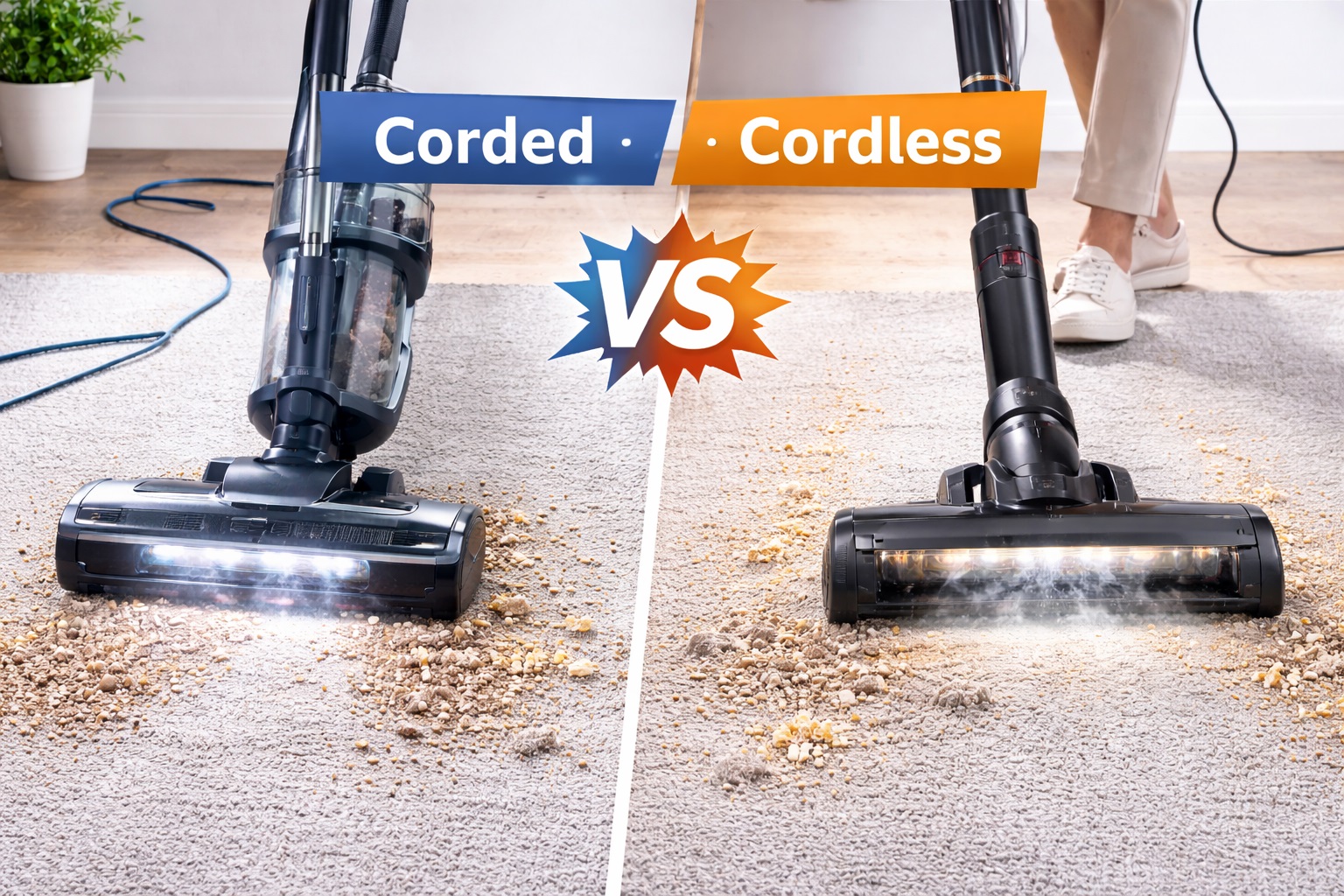
A B2B-Level Performance Comparison Beyond Marketing Claims
“Corded or cordless?”
This question appears simple, yet it remains one of the most misunderstood sourcing decisions in the vacuum cleaner industry.
For EU & Middle East vacuum cleaner buyers, distributors, and product engineers, this choice directly impacts:
Real cleaning performance
Energy efficiency perception
Return and complaint rates
Product positioning across apartments, households, and semi-commercial use
This article delivers a real performance comparison between corded and cordless vacuum cleaners—based on system behavior, airflow stability, filtration efficiency, and long-term reliability, not brochure claims.
🧭 Step 1: Power Source ≠ Cleaning Power
One of the biggest misconceptions is equating:
Corded = powerful
Cordless = weak
In reality, cleaning performance depends on system efficiency, not just power input.
A High Suction Vacuum Cleaner can exist in both formats. The difference lies in:
Buyer insight:
Peak suction numbers mean little if they cannot be maintained under load.
🌀 Step 2: Sustained Suction Test — Where Corded Systems Still Dominate
In continuous cleaning scenarios (15–30 minutes):
This is why corded systems still excel in:
A Multi-Functional Durable Vacuum Cleaner with corded power delivers:
⚡ Step 3: Energy Efficiency — Not All Power Is Wasted Power
Corded vacuums are often labeled as “energy-hungry,” but real-world tests show a different story.
An Energy-Saving Efficient Powerful Vacuum Cleaner:
Converts grid power directly into airflow
Avoids energy loss from battery charging/discharging cycles
Delivers higher work-per-watt efficiency
Cordless models trade efficiency for convenience:
Engineering reality:
Energy efficiency is about output per unit of energy, not cord presence.
📍 Case Snapshot 1: Cordless Returns Misdiagnosed as “Battery Quality”
Market: EU distributors
Complaint: “Battery gets weaker after months”
Actual Cause:
High-resistance filters and airflow restrictions increased power draw
Correction:
Repositioned cordless models for quick tasks; corded units for deep cleaning
Outcome:
Lower return rates and better buyer satisfaction
B2B takeaway:
Misuse causes more complaints than hardware failure.
🏠 Step 4: Apartment Reality — Why Cordless Often Wins Perception
In Apartment Vacuum Cleaner scenarios, performance is judged differently:
Short cleaning sessions
Noise sensitivity
Storage limitations
Cordless vacuums perform well because:
They enable fast, frequent cleaning
Users rarely operate them at max power continuously
Convenience outweighs peak performance
This is why cordless models often outscore corded units in satisfaction, despite lower raw suction.
🌬️ Step 5: Filtration & Air Quality — Size Still Matters
A HEPA Filter Vacuum Cleaner benefits from:
Corded systems typically:
Support larger HEPA filters
Maintain filtration efficiency longer
Handle clogging without immediate performance collapse
Cordless systems require:
🔄 Step 6: Wet & Dry Scenarios — Power Consistency Matters More Than Mobility
In wet and dry vacuum cleaner use cases:
Corded wet & dry units outperform cordless ones in:
Cordless wet & dry models work best for:
📍 Case Snapshot 2: Wet Cleaning Complaints Reduced by Format Separation
Market: Middle East distributors
Issue:
Cordless wet & dry units underperformed in utility cleaning
Adjustment:
Offered corded wet & dry units for heavy use, cordless for daily upkeep
Result:
Fewer performance complaints and clearer buyer expectations
Strategic insight:
Corded vs cordless is a use-case decision, not a technology competition.
🧠 Step 7: Noise, Heat & User Confidence
Noise increase is often the first sign of inefficiency.
Cordless units:
Corded units:
For a High Suction Vacuum Cleaner, stable noise equals stable airflow.
📈 Strategic Takeaways for EU & Middle East Buyers
Corded vacuums dominate sustained, deep-clean performance
Cordless models win in convenience-driven environments
Energy efficiency depends on system design, not power source
HEPA filtration benefits from size and airflow stability
The best portfolios offer both, clearly positioned
📌 Hashtags
wet and dry vacuum cleaner, Multi-Functional Durable Vacuum Cleaner, High Suction Vacuum Cleaner, Energy-Saving Efficient Powerful Vacuum Cleaner, Apartment Vacuum Cleaner, HEPA Filter Vacuum Cleaner, corded vs cordless vacuum, vacuum performance testing
B2B vacuum sourcing, vacuum cleaner distributor, vacuum cleaner importer, vacuum cleaner OEM, vacuum cleaner ODM, cleaning equipment business, EU vacuum market, Middle East vacuum market
vacuum product engineering, airflow efficiency vacuum, sustained suction performance, energy efficiency strategy, filtration system design
apartment cleaning solutions, commercial cleaning equipment, vacuum after-sales strategy, product positioning strategy
professional cleaning tools, B2B cleaning solutions, vacuum buyer guide, product performance comparison, Lanxstar