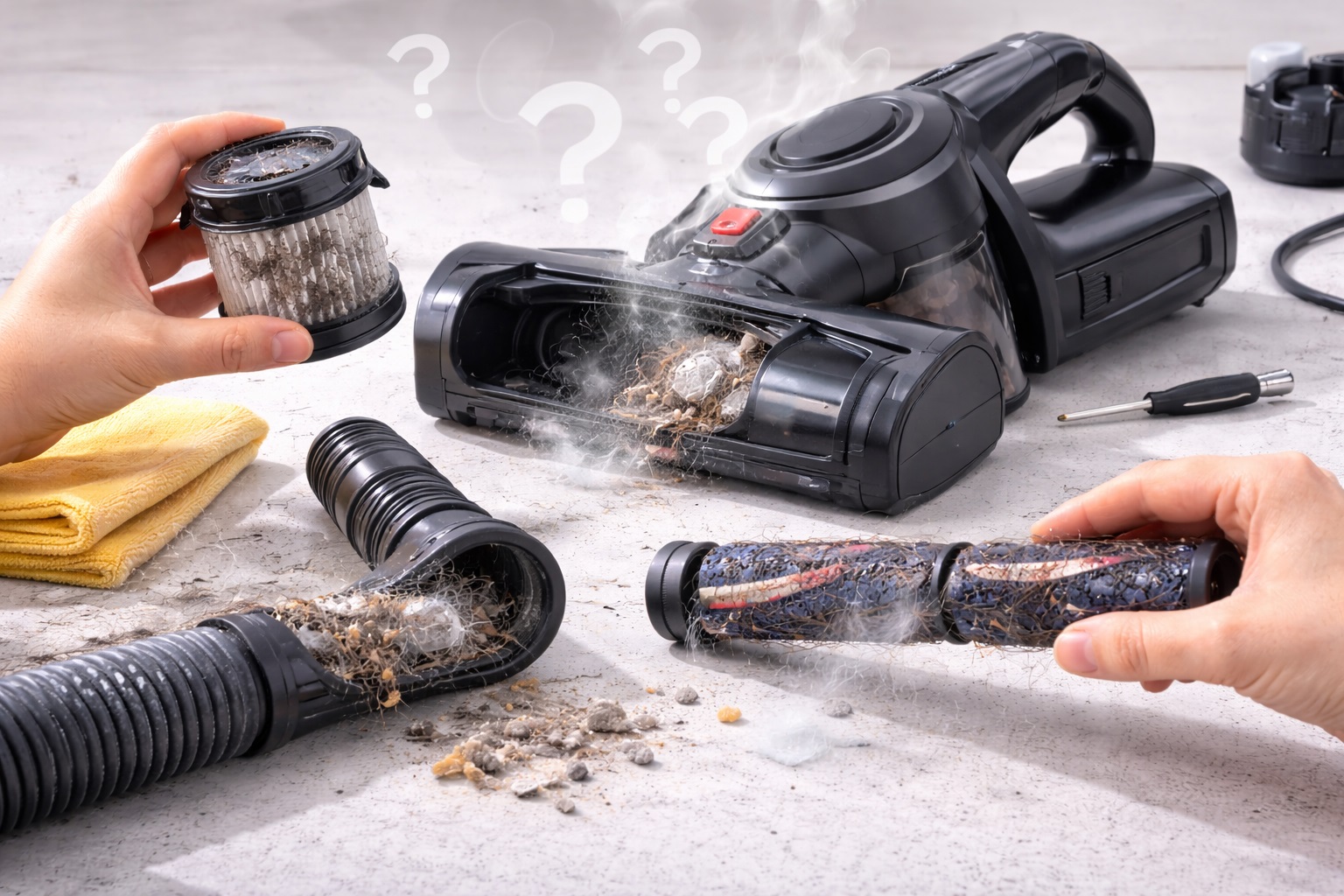
A B2B Diagnostic Framework for Identifying the True Cause of Suction Loss
“Suction is not strong enough.”
This is one of the most frequently reported vacuum cleaner complaints—and also one of the most misdiagnosed.
For EU & Middle East vacuum cleaner buyers, distributors, and product engineers, suction complaints directly impact:
This guide explains how to diagnose suction loss correctly, step by step, across different system architectures—wet & dry, large-capacity, pet-focused, and noise-optimized designs—so decision-makers can separate real defects from system misuse or design mismatch.
🧭 Step 1: Redefine “Suction” — It’s a System Outcome, Not a Single Spec
Most people equate suction with:
Motor power
Wattage
Marketing labels
In reality, suction is the result of four interdependent factors:
Airflow path efficiency
System sealing
Filtration resistance
Load condition at the nozzle
A Multi-Functional Durable Vacuum Cleaner may appear “weak” if any one of these factors fails—even with a strong motor.
Buyer insight:
90% of suction complaints are system-level issues, not motor failures.
🌀 Step 2: Check Airflow Path — The Most Common Root Cause
Before suspecting the motor, inspect the airflow path.
Critical checkpoints:
Hose bends and joints
Nozzle inlets
Tool-to-hose connections
In Vacuum Cleaner for Pet Hair scenarios, hair accumulation often:
Reality check:
Partial blockage can reduce effective suction by 30–50% without a full clog.
📍 Case Snapshot 1: “Weak Suction” Caused by Invisible Pet Hair Build-Up
Market: EU pet-owning households
Complaint: Sudden loss of suction
Root Cause:
Pet hair compacted at hose bend, not visible externally
Resolution:
Simple airflow inspection + cleaning
Outcome:
No motor replacement needed
B2B takeaway:
Airflow inspection should always come before component replacement.
💧 Step 3: Wet Mode Changes the Rules — Diagnose Differently
In a wet and dry vacuum cleaner, suction behavior differs between modes.
Wet mode introduces:
In a Large-Capacity Wet Dry Vacuum Cleaner, suction may feel weaker because:
The system is designed to prioritize stable recovery, not peak airflow
Overfilled liquid tanks increase resistance
Procurement insight:
Wet-mode suction must be evaluated by recovery efficiency, not dry suction feel.
🌬️ Step 4: Filtration Resistance — When “Clean” Still Means Restricted
Filters are a silent suction killer.
Even when they look clean:
Fine dust can block pores
Moisture can increase resistance
Improper seating causes leakage
In wet and dry vacuum cleaner systems, using the wrong filter configuration:
Reduces airflow
Increases motor load
Triggers noise increase
A Quiet Vacuum Cleaner often loses its quietness first—before users notice suction loss.
📍 Case Snapshot 2: Noise Increase Revealed the Real Suction Problem
Market: Middle East apartment users
Initial Complaint: Reduced suction
Observed Symptom:
Increased operating noise
Root Cause:
Filter resistance causing airflow turbulence
Fix:
Correct filter maintenance protocol
Result:
Restored suction and noise stability
Strategic insight:
Noise change is an early diagnostic signal.
⚡ Step 5: Capacity Misuse — Bigger Is Not Always Better
Large dust or liquid capacity is often misunderstood.
In Large-Capacity Wet Dry Vacuum Cleaner systems:
Overfilling disrupts airflow
Heavy debris shifts internal pressure balance
Liquid splash-back increases resistance
If suction drops only when the tank is near full, the issue is usage behavior, not design.
🏠 Step 6: Nozzle & Surface Mismatch — The Hidden Performance Trap
Suction is always felt at the surface, not at the motor.
Common mismatch examples:
Carpet nozzle on hard floor
Hard-floor tool on thick rugs
Pet hair nozzle on fine upholstery
A Multi-Functional Durable Vacuum Cleaner requires:
Correct tool selection
Clear user guidance
Many suction complaints disappear instantly when the right accessory is used.
🔇 Step 7: Quiet Design Does Not Mean Weak Performance
A Quiet Vacuum Cleaner often uses:
Optimized airflow channels
Noise-dampening materials
Balanced pressure distribution
These designs may sound weaker but often deliver more consistent suction over time.
Buyer reminder:
Perceived power ≠ actual cleaning performance.
📈 Strategic Takeaways for EU & Middle East Buyers
Suction loss is usually systemic, not mechanical
Airflow inspection should be the first diagnostic step
Wet mode requires different evaluation logic
Filters affect suction long before they look dirty
Capacity misuse creates false performance complaints
📌 Hashtags
wet and dry vacuum cleaner, Multi-Functional Durable Vacuum Cleaner, Quiet Vacuum Cleaner, Large-Capacity Wet Dry Vacuum Cleaner, Vacuum Cleaner for Pet Hair, Wet and Dry Vacuum Cleaner, suction loss diagnosis, vacuum airflow issues
B2B vacuum sourcing, vacuum cleaner distributor, vacuum cleaner importer, vacuum cleaner OEM, vacuum cleaner ODM, cleaning equipment business, EU vacuum market, Middle East vacuum market
vacuum product engineering, airflow optimization vacuum, filtration resistance control, noise and suction balance, wet dry vacuum troubleshooting
apartment cleaning equipment, professional cleaning tools, vacuum after-sales strategy, product reliability strategy
B2B cleaning solutions, vacuum buyer guide, technical troubleshooting guide, vacuum performance analysis, Lanxstar