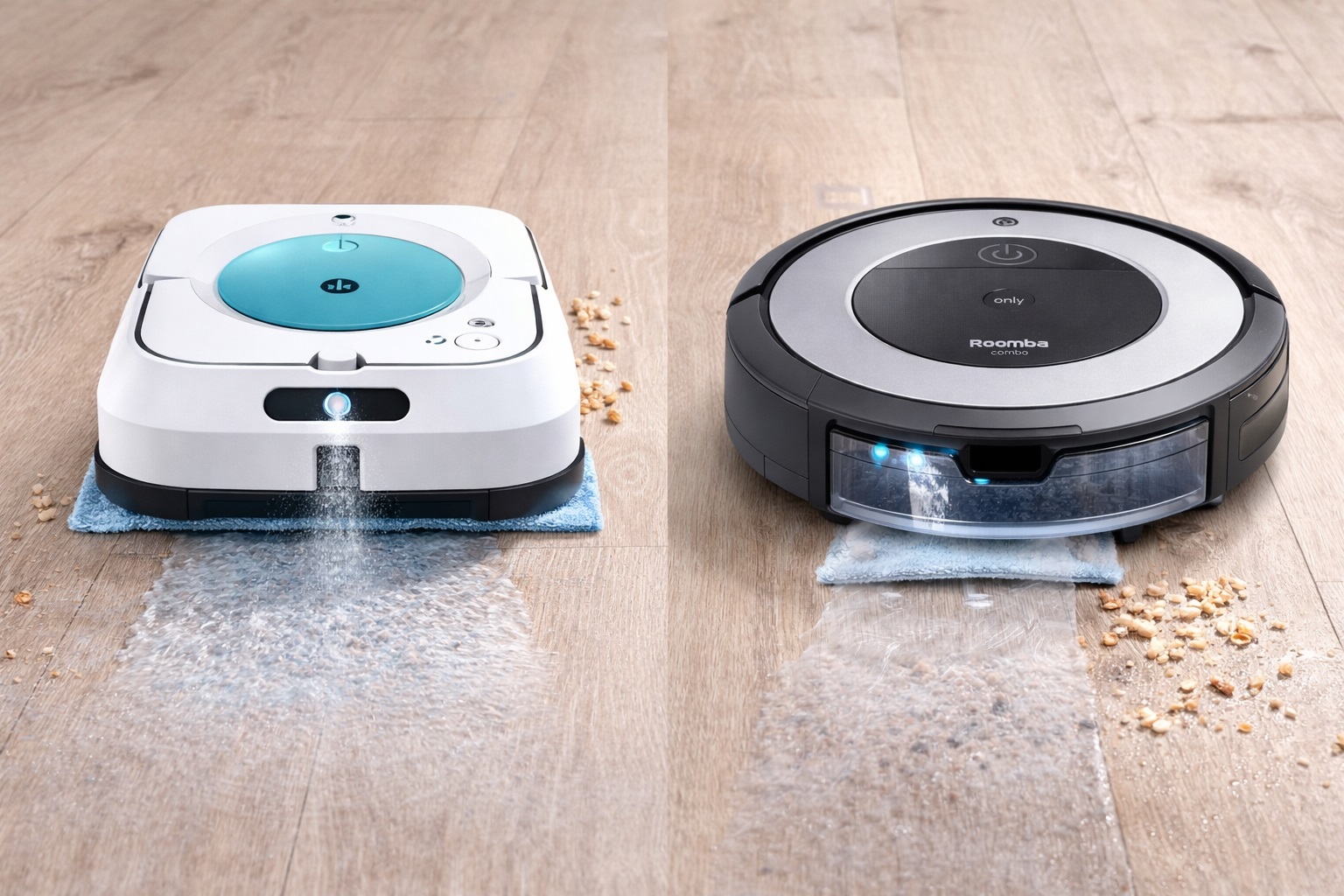
A B2B-Level Analysis Beyond Specs, Marketing & Brand Perception
Robot vacuum-mop products are often evaluated as consumer gadgets.
For B2B buyers, they are long-term systems involving software stability, cleaning logic, maintenance cost, and user expectation management.
iRobot (the company) and Roomba (its flagship product line) are frequently mentioned together—but in sourcing conversations, they are often misunderstood, overgeneralized, or incorrectly benchmarked.
This article provides a deep, decision-oriented comparison of iRobot / Roomba vacuum-mop robots, clarifying where these systems perform well, where they hit structural limits, and what B2B buyers should realistically expect when positioning them against multi-functional, wet & dry, cordless, or pet-focused vacuum solutions.
🧭 Step 1: Clarifying the Basics — iRobot vs Roomba Is Not a “Brand vs Brand” Battle
First, a critical clarification:
Most market comparisons fail here and treat “iRobot” and “Roomba” as competitors—which they are not.
From a B2B perspective, the real comparison should be:
Roomba vacuum-mop robots vs alternative cleaning system architectures
This includes:
Traditional wet and dry vacuum cleaner systems
Hybrid robot + handheld ecosystems
Manual multi-functional cleaning platforms
🌀 Step 2: Core Cleaning Logic — Robot Coverage vs Manual Control
Roomba vacuum-mop robots are built around:
They excel in:
However, compared to a Multi-Functional Durable Vacuum Cleaner, robots face inherent constraints:
Limited suction relative to upright or handheld systems
Inability to handle stairs, corners, or vertical surfaces
Reduced effectiveness on embedded debris and heavy pet hair
Buyer insight:
Robots maintain cleanliness; they rarely restore it.
🧠 Step 3: Suction, Filtration & Pet Hair — Where Expectations Often Break
From a filtration standpoint, most Roomba models rely on:
While some models use HEPA-grade filters, a HEPA Filter Vacuum Cleaner in traditional form still outperforms robots in:
For Vacuum Cleaner for Pet Hair scenarios:
This distinction is crucial for markets with high pet ownership and allergy sensitivity.
📍 Case Snapshot 1: Robot Satisfaction Dropped in Pet-Heavy Households
Market: EU distributors, pet-owning customers
Initial Positioning: “Robot replaces manual vacuuming”
Issue:
Pet hair buildup persisted in corners and upholstery
Adjustment:
Repositioned robot as daily maintenance, paired with manual vacuum
Outcome:
Fewer complaints and better expectation alignment
B2B takeaway:
Robots perform best as part of a system, not as a standalone solution.
⚡ Step 4: Battery, Runtime & Charging Logic — Autonomy Has Trade-Offs
Roomba robots optimize battery life through:
Compared to a Cordless Vacuum Cleaner, robots:
This works well for:
Apartments
Daily dust control
But it underperforms in:
Spill cleanup
High-traffic zones
Spot cleaning
A cordless manual vacuum offers instant, high-intensity cleaning, while robots trade power for autonomy.
🚗 Step 5: Mobility Limits — Why Robots Can’t Replace Portable Systems
Robot vacuum-mop units are floor-bound.
They cannot:
That’s where a Car Vacuum Cleaner or handheld system remains irreplaceable.
From a B2B portfolio perspective, robots expand coverage, but do not replace portable or manual products.
🔄 Step 6: Maintenance Reality — Convenience Has a Cost
Robots are marketed as “hands-off,” but real-world maintenance includes:
Dust bin emptying
Mop pad washing
Sensor cleaning
Software updates
In contrast, traditional wet and dry vacuum cleaner systems:
For distributors, robot after-sales support often requires:
📍 Case Snapshot 2: Higher Support Load for Robot Products
Market: Middle East distributors
Observation:
Robot vacuum customers generated more support tickets
Reason:
App pairing, navigation errors, maintenance confusion
Mitigation:
Added onboarding education + bundled manual backup vacuum
Result:
Improved customer satisfaction and reduced negative reviews
Strategic insight:
Convenience shifts cost from labor to support.
🏠 Step 7: Positioning Robots in Apartment & Urban Markets
In Apartment Vacuum Cleaner scenarios, robots perform best when positioned as:
Daily floor maintenance tools
Noise-tolerant, scheduled cleaners
Supplements to manual cleaning
They struggle when marketed as:
Correct positioning protects brand trust.
📈 Strategic Takeaways for EU & Middle East Buyers
iRobot / Roomba robots excel at daily maintenance, not deep cleaning
HEPA performance is limited by size and airflow constraints
Pet hair control requires manual backup systems
Robots increase support complexity, not reduce it
Best results come from hybrid cleaning ecosystems
📌 Hashtags
wet and dry vacuum cleaner, Multi-Functional Durable Vacuum Cleaner, Cordless Vacuum Cleaner, HEPA Filter Vacuum Cleaner, Vacuum Cleaner for Pet Hair, Car Vacuum Cleaner, robot vacuum comparison, vacuum mop robot
B2B vacuum sourcing, vacuum cleaner distributor, vacuum cleaner OEM, vacuum cleaner ODM, cleaning equipment business, EU vacuum market, Middle East vacuum market
robot vacuum positioning, hybrid cleaning systems, vacuum product strategy, after sales support strategy, cleaning technology analysis
apartment cleaning solutions, pet cleaning technology, indoor air quality equipment, product portfolio planning
vacuum market insights, B2B cleaning solutions, vacuum buyer guide, product comparison analysis, Lanxstar