Hi, message us with any questions.
We're happy to help!





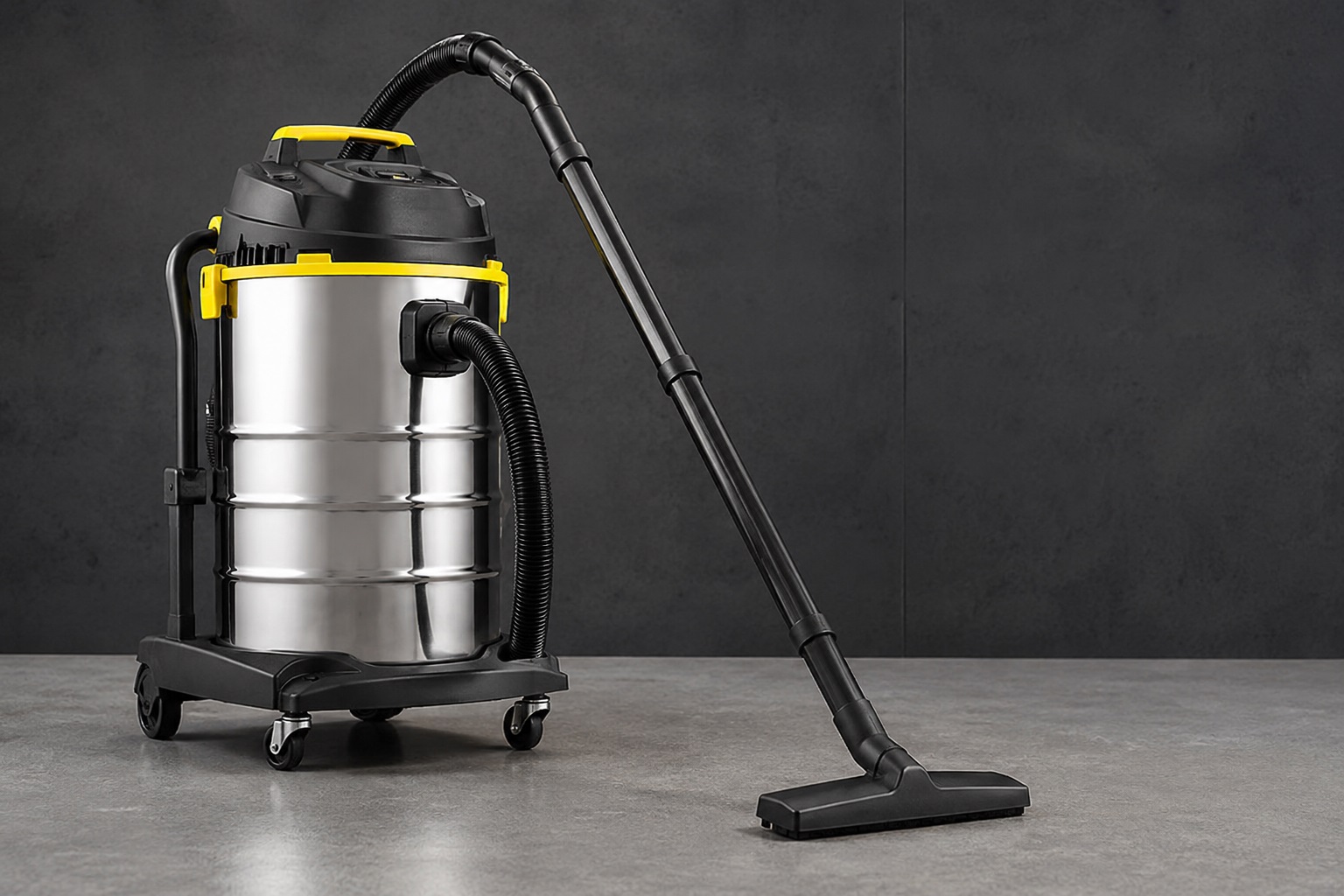
1. Why Commercial Buyers Need the Right Wet and Dry Vacuum Cleaner
A wet and dry vacuum cleaner is designed to collect both dry debris and liquid spills, making it considerably more versatile than a conventional dry-only vacuum. In commercial environments, that versatility can reduce the number of machines required for daily cleaning and unexpected cleanup tasks.
🏨 A hotel may need to collect dust from corridors in the morning and handle spilled liquids in service areas later in the day. A warehouse may encounter packaging debris, fine dust, dirt, and occasional water. Construction contractors face an even wider mixture of coarse particles and job-site debris.
This is why selecting a commercial vacuum cleaner should begin with the actual application rather than simply choosing the machine with the largest motor.
For professional buyers, the key questions are:
What materials will the vacuum collect?
How many hours will it operate each day?
How large is the cleaning area?
Is low noise important?
Is fine-dust filtration required?
How frequently can operators empty the tank?
Does the equipment need to move between floors or locations?
The answers establish a practical specification before you compare models or request quotations from a vacuum cleaner manufacturer.
2. Start with the Commercial Cleaning Environment
There is no single machine that is ideal for every commercial application. A good purchasing decision matches the vacuum architecture to the working environment.
Warehouses and Logistics Centers 📦
A warehouse cleaning solution typically requires strong suction, good mobility, a practical hose length, and enough tank capacity to reduce interruptions.
For large logistics facilities, buyers may prefer a Large-Capacity Wet Dry Vacuum Cleaner because operators can cover more floor area before emptying collected material.
When sourcing an industrial wet and dry vacuum cleaner for warehouse cleaning supplier, also consider wheel durability and maneuverability. A large tank has limited value if the machine becomes difficult to move when loaded.
Construction Sites 🏗️
A wet dry vacuum cleaner for construction site applications may encounter sawdust, sand, dirt, small debris, and water. Durability becomes particularly important.
Construction buyers should examine the tank, hose, accessories, motor protection, filtration system, and overall structure rather than judging equipment only by rated wattage.
For demanding environments, a stainless steel vacuum tank can be attractive because of its durability and professional appearance, although material thickness and construction quality still matter.
Hotels and Commercial Properties 🏨
A commercial vacuum cleaner for hotel use has different priorities. Cleaning teams often operate close to guests, so noise, mobility, appearance, and convenient accessory storage can be as important as suction.
A Portable Quiet Vacuum Cleaner or low noise vacuum cleaner may therefore deliver more operational value than an unnecessarily large machine.
Factories and Workshops 🏭
For factory floor cleaning, buyers should identify the type and volume of debris before selecting equipment. Continuous heavy dust collection can require specifications different from those of an ordinary commercial wet/dry vacuum.
Where hazardous, combustible, or regulated dust is present, buyers should use equipment specifically certified for that hazard and market rather than assuming a standard vacuum is suitable.
3. Evaluate Suction Performance—Not Wattage Alone
One of the most common procurement mistakes is treating motor wattage as a direct measurement of cleaning performance.
A High Suction Vacuum Cleaner needs an effective combination of airflow, vacuum pressure, motor design, hose diameter, filtration, seals, and airflow-path efficiency.
In practical terms:
Airflow influences how effectively the machine transports dust and debris.
Vacuum pressure influences its ability to lift or pull material.
Motor input power tells you about electrical consumption but does not independently prove cleaning effectiveness.
💡 When comparing a high suction power vacuum cleaner, ask suppliers for standardized performance data and test conditions whenever available. Comparing two headline numbers measured under different conditions can produce misleading conclusions.
A dual motor vacuum cleaner can provide additional performance for demanding jobs, but it may also increase energy consumption, noise, weight, and cost. The correct configuration depends on duty cycle and application rather than the assumption that more motors are always better.
4. Choose the Right Tank Capacity
Tank capacity directly influences productivity.
Small tanks make a Fast Lightweight Vacuum Cleaner easier to transport, especially in offices, retail stores, vehicle detailing businesses, and buildings with stairs. However, operators may spend more time emptying them.
Large tanks reduce emptying frequency and can suit:
warehouses;
factories;
workshops;
construction projects;
large commercial facilities.
But bigger is not automatically better. A large tank filled with liquid can become very heavy.
For this reason, commercial buyers should consider usable capacity, drainage design, trolley construction, wheel size, center of gravity, and emptying method together.
A well-designed 30-liter unit may be more productive in a hotel than a cumbersome 70-liter unit, while a larger machine could be far more appropriate for warehouse cleaning.
5. Examine the Wet and Dry Suction System
The central advantage of this equipment category is its wet and dry suction system.
For dry cleaning, the vacuum must efficiently collect debris while protecting the motor and maintaining airflow. For liquid pickup, the machine needs a reliable mechanism to prevent collected liquid from reaching the motor.
🌊 Buyers should investigate:
liquid shut-off mechanism;
filter configuration for wet versus dry operation;
drainage outlet on larger models;
tank sealing;
corrosion-resistant components;
hose connection design.
A Multi-Functional Durable Vacuum Cleaner should make transitions between tasks straightforward for operators.
Always follow the manufacturer's instructions regarding filters and wet pickup. Not every filter configuration should be used for every material.
6. Pay Attention to Filtration
Filtration is especially important when a machine handles fine particles.
A HEPA filter vacuum cleaner can be valuable in applications where improved fine-particle filtration is required. However, professional buyers should not assume that the presence of a HEPA-labelled filter automatically makes the entire machine HEPA compliant.
Filter grade, sealing, bypass leakage, system design, and applicable testing standards all matter.
This distinction is particularly relevant when evaluating hospital cleaning equipment, healthcare environments, sensitive facilities, and certain professional dust-control applications.
For ordinary commercial environments, buyers should balance filtration efficiency with airflow, maintenance requirements, filter replacement cost, and the type of debris collected.
7. Consider Noise, Energy Consumption, and Operator Comfort
Cleaning performance matters, but so does the person using the equipment for several hours.
A commercial grade vacuum cleaner should be easy to move, stable when pulled by the hose, convenient to empty, and simple to maintain.
🔇 For hotels, schools, offices, retail spaces, and other occupied buildings, a low noise vacuum cleaner can help cleaning teams work with less disruption.
⚡ An Energy-Saving Efficient Powerful Vacuum Cleaner should also be evaluated on productivity rather than wattage alone. A machine that completes the same cleaning task faster with lower power consumption can reduce operating costs across a large fleet.
Ergonomic factors worth checking include handle position, wheel quality, cable length, hose flexibility, accessory storage, machine weight, and drainage convenience.
These details often determine whether a specification that looks good on paper performs well in real commercial use.
8. Match Accessories to the Job
Accessories can significantly change the usefulness of an industrial or commercial vacuum.
A car detailing vacuum cleaner, for example, benefits from crevice tools and flexible hoses for seats and narrow spaces. Construction applications may require robust floor tools and hoses capable of handling coarse debris.
Facility management cleaning equipment often needs a broader accessory set because one machine may serve several areas.
Before placing a bulk vacuum cleaner purchase, ask whether replacement hoses, filters, brushes, floor tools, and other wear components will remain available.
For distributors, spare-parts availability can be just as important as the initial vacuum cleaner price wholesale.
9. Calculate Total Cost of Ownership, Not Just Purchase Price
When buyers search for the best vacuum on a budget, best affordable vacuum, or best value hoover, it is tempting to compare purchase prices first.
Commercial procurement requires a broader calculation.
A low-cost machine can become expensive if filters need frequent replacement, wheels fail prematurely, spare parts are difficult to obtain, or operators lose time because of insufficient capacity.
A basic total-cost model can include:
Purchase price + consumables + electricity + maintenance + downtime + replacement parts + expected replacement cost.
For wholesalers and importers, add logistics, duties, warranty reserves, inventory costs, packaging, certification requirements, and after-sales support.
Therefore, the best industrial vacuum cleaner is not necessarily the cheapest or most powerful. It is the model that provides the best operational value for its intended application.
10. Case Study: Choosing Vacuums for a Distribution Warehouse
Consider a hypothetical European distributor evaluating equipment for a logistics customer operating a large warehouse.
The facility primarily collects packaging fragments, ordinary floor dust, tracked-in dirt, and occasional liquid spills. Management initially considers purchasing the highest-powered model available.
After reviewing the application, the procurement team changes its criteria.
Instead of focusing exclusively on peak motor power, it prioritizes:
sufficient wet/dry suction performance;
larger practical tank capacity;
durable wheels for long travel distances;
convenient liquid drainage;
long power cable and hose reach;
readily available filters and accessories;
manageable noise levels;
documented electrical and product compliance for the destination market.
The distributor then requests samples and tests them in representative warehouse zones.
📊 Result: the preferred machine is not simply the model with the largest motor. The team selects the configuration that offers the best balance of suction, mobility, capacity, maintenance, and total cost.
This illustrates an important principle for procurement teams: specify the application first and the vacuum second.
11. What Should Importers Ask a Vacuum Cleaner Supplier?
When buyers want to buy industrial vacuum cleaner products in volume, evaluating the supplier is as important as evaluating the machine.
A professional industrial vacuum cleaner supplier should be able to discuss specifications, production capacity, quality-control processes, customization, packaging, spare parts, and applicable compliance documentation.
Importers considering a vacuum cleaner supplier China should ask questions such as:
Are you a manufacturer or trading company?
Which components are produced or assembled in-house?
What quality-control procedures are used?
What testing is performed before shipment?
What certifications or test reports are available for the target market?
What are the MOQ and production lead time?
Can you support spare parts after shipment?
Can you provide OEM branding and packaging?
What engineering changes are possible?
How are warranty issues handled?
For an OEM industrial vacuum cleaner manufacturer, engineering communication is particularly important because customization can affect performance, compliance, tooling, packaging, cost, and lead time.
12. OEM, ODM, and Private-Label Options for Distributors
Many international distributors do not simply purchase standard machines. They want products aligned with their own market positioning.
An OEM vacuum cleaner program may include logos, colors, labels, manuals, cartons, accessory combinations, and other agreed specifications.
An ODM vacuum cleaner project can involve deeper product or configuration development depending on the manufacturer's capabilities.
A private label vacuum cleaner program can be useful for wholesalers and retailers seeking a differentiated product portfolio.
🌍 Before committing to a wholesale vacuum cleaner order, confirm intellectual-property responsibilities, packaging specifications, required language versions, destination-market compliance, sample approval procedures, inspection standards, and production tolerances in writing.
For a vacuum cleaner distributor Europe, regulatory requirements should be reviewed for the specific product and destination market before importation. The same principle applies to buyers serving North America, Asia-Pacific, the Middle East, and other regions.
13. Commercial vs Industrial: Know What You Actually Need
The terms commercial and industrial are sometimes used loosely in product marketing.
A commercial vacuum cleaner generally serves professional environments such as hotels, offices, retail stores, restaurants, and cleaning-service operations.
A heavy duty vacuum cleaner or industrial model may be designed for more demanding environments, greater debris loads, longer duty cycles, or specialized applications.
An industrial dust extractor can represent a different category altogether, especially where equipment is integrated with dust-producing machinery or must meet specific dust-control requirements.
⚠️ Buyers should therefore compare actual specifications, test data, certifications, and intended use rather than relying solely on words such as “industrial,” “professional,” or “heavy duty.”
14. A Practical Commercial Vacuum Procurement Checklist
Before requesting a quotation from an industrial vacuum cleaner factory or cleaning equipment supplier, prepare a clear specification.
Include the intended debris and liquids, cleaning area, operating hours, tank capacity range, suction requirements, filtration expectations, noise limits, voltage/frequency, cable and hose length, accessories, destination country, certification requirements, quantity, packaging, branding, and expected delivery schedule.
For a bulk order vacuum cleaner project, request production samples or pre-production samples when appropriate.
🔍 Importers can also establish an inspection checklist covering appearance, electrical operation, suction function, liquid shut-off, accessory quantity, cable and plug specifications, labeling, packaging, and agreed safety tests.
A structured procurement process makes quotations easier to compare and reduces misunderstandings between buyer and manufacturer.
15. How to Make the Final Choice
Choosing the right wet dry vacuum cleaner for commercial use comes down to matching specifications to real working conditions.
Prioritize:
Performance: adequate airflow and vacuum pressure for the target debris.
Capacity: enough usable volume without making the unit unnecessarily difficult to move.
Filtration: appropriate for the material and environment.
Durability: suitable tank, hose, wheels, accessories, and construction.
Usability: manageable noise, weight, mobility, drainage, and maintenance.
Efficiency: productivity and energy consumption considered together.
Supply reliability: stable production, replacement parts, QC, documentation, and communication.
Commercial viability: competitive landed cost and realistic total cost of ownership.
For distributors and procurement professionals, selecting a vacuum cleaner manufacturer in China should therefore involve much more than asking, “What is your lowest price?”
The better question is:
“Which configuration provides the right performance, reliability, compliance, and lifecycle value for my market?”
That approach helps wholesalers, retailers, cleaning contractors, facility managers, and engineers select commercial cleaning equipment based on measurable requirements instead of marketing claims.
Whether you need a portable machine for hotel cleaning, a large-capacity model for logistics facilities, or a heavy duty vacuum cleaner supplier China for an OEM project, a detailed application specification is the best starting point.
For more information about commercial and industrial vacuum cleaner solutions, visit www.lxvacuum.com.
If you are interested, please feel free to contact us.
50 Related SEO Keywords
wet and dry vacuum cleaner, wet dry vacuum cleaner, commercial vacuum cleaner, industrial vacuum cleaner, commercial wet dry vacuum, industrial wet dry vacuum, High Suction Vacuum Cleaner, Portable Quiet Vacuum Cleaner, Multi-Functional Durable Vacuum Cleaner, Fast Lightweight Vacuum Cleaner, Energy-Saving Efficient Powerful Vacuum Cleaner, Large-Capacity Wet Dry Vacuum Cleaner, high suction power vacuum cleaner, heavy duty vacuum cleaner, dual motor vacuum cleaner, stainless steel vacuum tank, low noise vacuum cleaner, energy efficient vacuum cleaner, wet and dry suction system, HEPA filter vacuum cleaner, commercial grade vacuum cleaner, industrial dust extractor, industrial cleaning equipment, commercial cleaning equipment, warehouse cleaning solution, construction site cleaning equipment, hotel cleaning equipment, factory floor cleaning, logistics warehouse cleaning, car detailing vacuum cleaner, facility management cleaning equipment, retail cleaning equipment, industrial vacuum cleaner supplier, vacuum cleaner supplier, cleaning equipment supplier, industrial equipment supplier, vacuum cleaner manufacturer in China, industrial vacuum cleaner factory, wholesale vacuum cleaner, bulk vacuum cleaner purchase, OEM vacuum cleaner, ODM vacuum cleaner, private label vacuum cleaner, factory direct vacuum cleaner, bulk order vacuum cleaner, commercial vacuum cleaner for sale, best affordable vacuum, best value hoover, Lanxstar, vacuum manufacturer, vacuum cleaner maker



