Hi, message us with any questions.
We're happy to help!





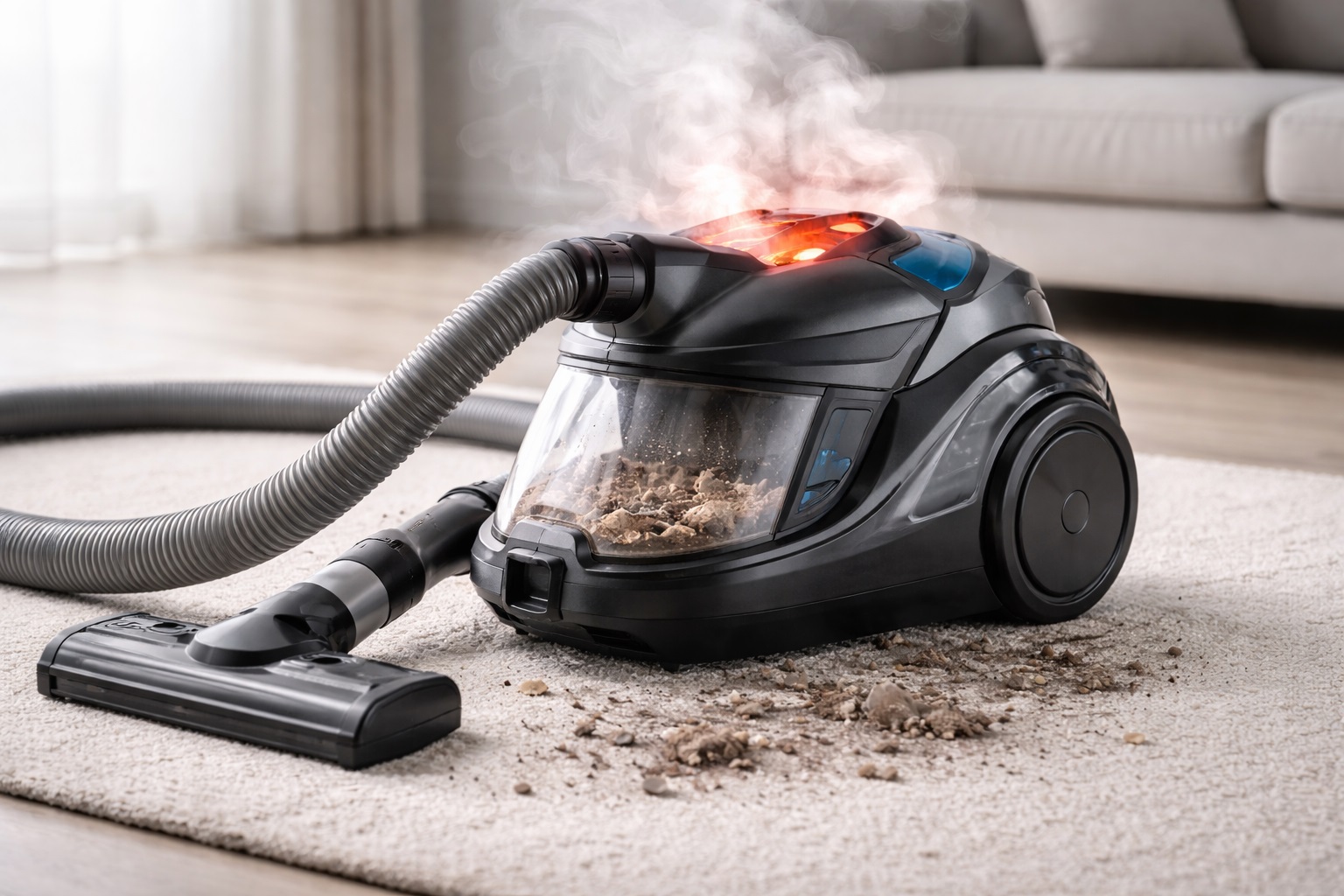
The Engineering Truth Most Users Don’t Realize
You start cleaning.
Ten minutes later, your vacuum feels unusually hot.
Fifteen minutes later, it shuts off.
You assume:
The motor is failing.
The battery is defective.
The vacuum quality is poor.
Stop.
In most cases, overheating is not a defect.
It is a direct result of airflow restriction and motor load imbalance.
Understanding this single principle will change how you maintain — and judge — your vacuum cleaner.
Whether you use a wet and dry vacuum cleaner, a Quiet Vacuum Cleaner, or a Portable Vacuum for Travel, overheating follows predictable mechanical rules.
Let’s break them down.
🔬 First: How Vacuum Heat Is Generated
Every vacuum motor converts electrical energy into mechanical rotation.
But not all energy becomes suction.
A portion converts into:
Electrical resistance heat
Friction heat
Air compression heat
When airflow is stable, moving air carries heat away from the motor.
When airflow drops by 20%, motor current can increase by up to 30%.
That increase accelerates heat buildup exponentially.
This is why airflow—not wattage—is the key to temperature control.
🌀 1️⃣ Clogged HEPA Filters: Small Restriction, Big Temperature Rise
A HEPA Filter Vacuum Cleaner captures particles as small as 0.3 microns.
But HEPA filtration increases airflow resistance by design.
When partially clogged:
Air velocity decreases
Motor compensates by drawing more current
Internal temperature rises rapidly
Engineering Reality
Even a thin dust layer can reduce airflow by 15–25%.
That airflow loss may increase motor winding temperature by 10–18°C within minutes.
Why Quiet Models Heat Faster
A Quiet Vacuum Cleaner uses insulated motor housing to reduce sound.
Less noise insulation = better heat escape.
More insulation = more heat retention.
Clogged HEPA + insulated housing = faster overheating.
Fix
✔ Clean filters every 2–4 weeks
✔ Replace regularly
✔ Ensure full drying before reinstalling
🌪️ 2️⃣ Blocked Air Path: The Hidden Motor Load Multiplier
Airflow is the cooling system.
When hose bends, floor heads, or cyclone chambers are partially blocked:
Pressure increases
Motor torque rises
Electrical current spikes
Heat output increases
A partial blockage can raise internal motor load by 20–35%.
In a Multi-Functional Durable Vacuum Cleaner, additional attachments create more airflow turns and resistance points.
More functions = more potential restriction.
Symptom Pattern
High-pitched motor sound
Warm exhaust
Reduced suction
Sudden automatic shutdown
Modern vacuums include thermal protection that cuts power before permanent damage occurs.
If your vacuum shuts off and restarts after cooling, thermal protection is doing its job.
🌊 3️⃣ Wet and Dry Configuration Errors
A wet and dry vacuum cleaner changes airflow density during liquid pickup.
Water increases internal resistance.
Common overheating triggers:
HEPA filter left installed during wet mode
Float valve partially blocking airflow
Liquid debris drying inside hose
Moist air carries heat differently than dry air.
If airflow becomes turbulent, cooling efficiency drops.
Engineering Trade-Off
Waterproof motor housing improves durability —
but reduces passive heat escape.
That’s why proper mode switching is critical.
🔋 4️⃣ Battery & Compact Design Constraints (Portable Units)
A Portable Vacuum for Travel prioritizes:
Lightweight construction
Compact body
High suction for size
But smaller body means:
Smaller cooling chamber
Tighter motor space
Faster heat accumulation
Battery-powered models face dual heat sources:
Motor heat
Battery discharge heat
When both occur in a compact housing, overheating risk increases.
These units are designed for short bursts (10–20 minutes), not deep cleaning sessions.
🔇 5️⃣ The Quiet Vacuum Paradox
Many consumers believe:
Quieter vacuum = better design.
Not always.
A Quiet Vacuum Cleaner often uses:
Acoustic foam insulation
Sealed motor housing
Reduced ventilation openings
While noise decreases, heat retention increases.
This creates a design balance challenge:
Noise reduction vs heat dissipation.
Premium Energy-Saving Efficient Powerful Vacuum Cleaner systems address this by:
Optimizing airflow channels
Using brushless motors with lower friction
Improving thermal management
Cheaper quiet models simply insulate — trapping heat inside.
📊 What Happens If You Ignore Overheating?
Ignoring frequent overheating can cause:
Motor insulation breakdown
Reduced motor lifespan (up to 40% shorter)
Battery cell swelling (cordless models)
Degraded suction performance
Permanent winding damage
Thermal protection prevents immediate failure — but repeated overheating shortens lifespan.
🏗️ Traditional vs Quiet Design Heat Comparison
| Feature | Traditional Vacuum | Quiet Vacuum Cleaner |
|---|---|---|
| Noise Level | Higher | Lower |
| Ventilation | More open | More sealed |
| Heat Escape | Faster | Slower |
| Overheat Risk (Clogged Filter) | Moderate | Higher |
Maintenance discipline matters more with quieter systems.
🛠️ Preventive Maintenance Strategy
✔ Clean HEPA filters regularly
✔ Empty dust bin before 75% capacity
✔ Inspect hose monthly
✔ Use correct wet/dry configuration
✔ Avoid exceeding recommended runtime
✔ Allow cooling breaks during long sessions
Proper maintenance can extend motor lifespan by 2–3 years.
🏁 Final Expert Conclusion
Vacuum cleaners overheat quickly when:
Airflow drops
Motor load increases
Heat cannot dissipate efficiently
It is rarely about raw power.
It is about balance.
Whether you own a:
wet and dry vacuum cleaner
Multi-Functional Durable Vacuum Cleaner
Quiet Vacuum Cleaner
HEPA Filter Vacuum Cleaner
Portable Vacuum for Travel
Energy-Saving Efficient Powerful Vacuum Cleaner
The key principle remains the same:
Stable airflow equals stable temperature.
Before replacing your vacuum, restore airflow.
Most overheating problems are preventable.
📌 Suitable Readers
Homeowners, apartment residents, pet owners, and users of modern cordless and multifunction vacuum cleaners seeking expert-level understanding of overheating causes and prevention.
📌 Hashtags
wet and dry vacuum cleaner, Multi-Functional Durable Vacuum Cleaner, Energy-Saving Efficient Powerful Vacuum Cleaner, Quiet Vacuum Cleaner, HEPA Filter Vacuum Cleaner, Portable Vacuum for Travel, vacuum overheating problem, motor load increase, airflow restriction vacuum, thermal protection shutdown, vacuum heat dissipation, cordless vacuum overheating, battery heat buildup, home cleaning appliance care, vacuum troubleshooting guide, cyclone airflow system, washable HEPA filter maintenance, vacuum motor lifespan, quiet cleaning technology, residential cleaning equipment, powerful suction maintenance, vacuum cooling system design, indoor air cleaning devices, appliance safety tips, advanced cleaning technology, vacuum performance diagnostics, durable vacuum systems, smart cleaning habits, modern home appliances, suction efficiency guide, vacuum maintenance checklist, Lanxstar



