Hi, message us with any questions.
We're happy to help!





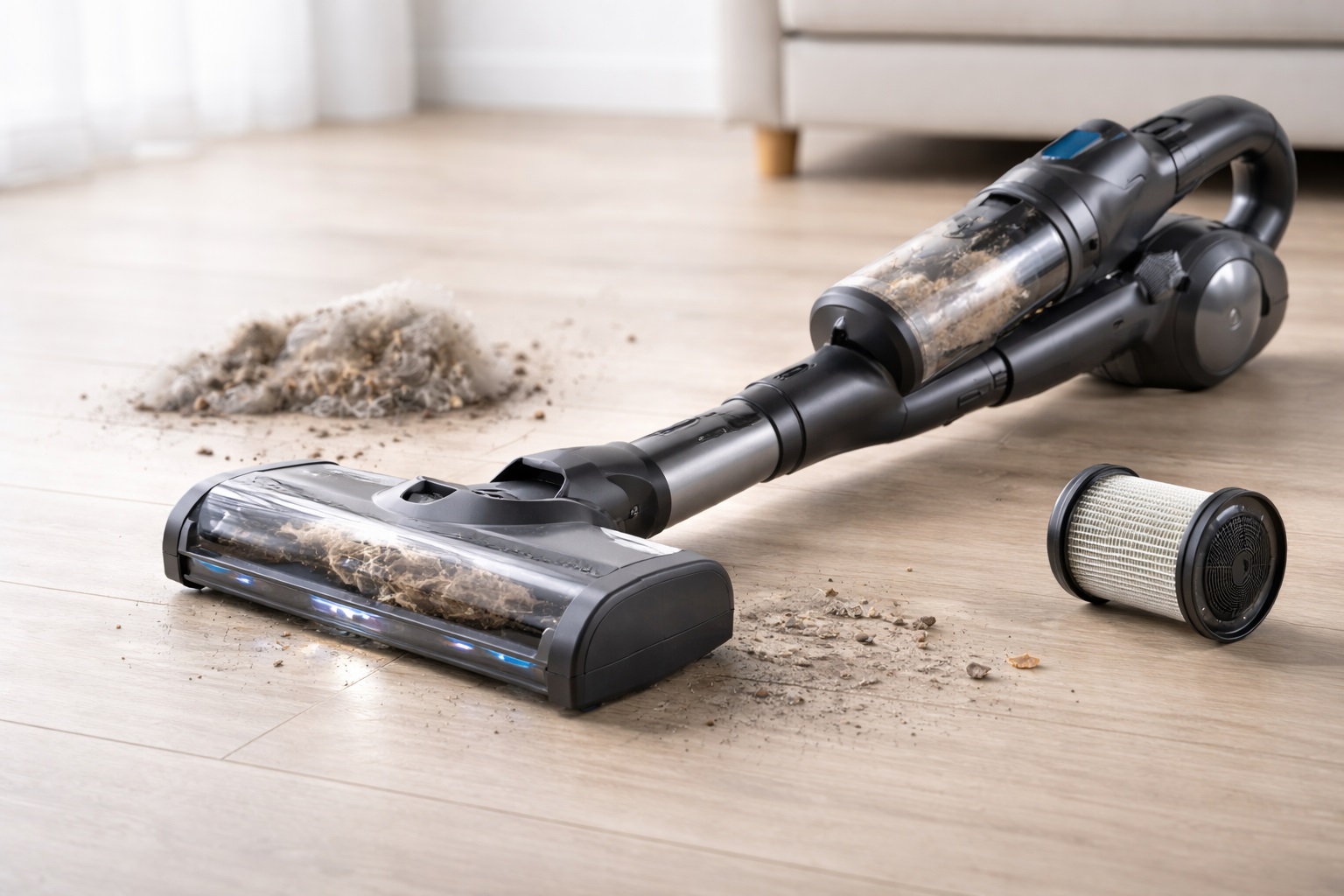
You bought a High Suction Vacuum Cleaner because you wanted power.
At first, it worked perfectly.
Then gradually:
Carpets feel only lightly cleaned
Pet hair stays embedded
Debris is pushed around instead of lifted
Your wet and dry vacuum cleaner struggles with liquid pickup
Most users immediately assume:
“The motor is weak.”
“The battery is dying.”
“The vacuum quality is poor.”
Here’s the truth:
In over 80% of cases, suction loss is caused by airflow restriction — not motor failure.
Understanding suction physics will help you restore performance in minutes instead of replacing your machine unnecessarily.
🧠 First: How Suction Actually Works (Most People Don’t Know This)
A vacuum doesn’t “pull dirt” with raw strength.
It creates pressure difference:
Motor spins → creates low-pressure zone
Outside air pushes debris toward low pressure
Airflow carries debris into dust bin
If airflow is restricted anywhere in the system, suction drops — even if the motor is still powerful.
Think of it like breathing through a straw.
Your lungs may be strong, but airflow is limited.
Now let’s examine the five real causes.
🌀 1️⃣ Clogged HEPA Filters (Up to 25% Suction Loss)
A HEPA Filter Vacuum Cleaner traps microscopic particles:
Fine dust
Allergens
Pet dander
But HEPA filters naturally create airflow resistance.
When clogged:
Airflow drops 15–25%
Internal pressure rises
Motor strains
Suction at floor head weakens
Why This Is Ignored
Filters don’t always “look dirty.”
Fine particles block microscopic pores before visible dust appears.
Fix
✔ Wash filters every 2–4 weeks (if washable).
✔ Replace non-washable HEPA every 3–6 months.
✔ Let filter dry completely (minimum 24 hours).
If your High Suction Vacuum Cleaner suddenly feels weak, check the filter first.
🧱 2️⃣ Hose or Internal Blockage (Up to 30–40% Loss)
In both an Apartment Vacuum Cleaner and a Multi-Functional Durable Vacuum Cleaner, airflow path matters more than motor wattage.
Common hidden blockage points:
Hose bends
Elbow joints
Brush head neck
After wet pickup in a wet and dry vacuum cleaner
Symptoms
Higher motor pitch
Whistling noise
Uneven suction
Head lifting from carpet
Why It’s Serious
Even a partial obstruction can reduce suction by 30–40%.
Fix
✔ Detach hose and inspect with flashlight.
✔ Push flexible cleaning rod through tube.
✔ Rinse hose after liquid pickup (for wet and dry vacuum cleaner models).
🗑️ 3️⃣ Overfilled Dust Bin or Tank (Cyclone Disruption)
Many owners of a Large-Capacity Wet Dry Vacuum Cleaner assume bigger tank = fewer emptying cycles.
But cyclone systems rely on air circulation space.
When bin exceeds 75% capacity:
Cyclone separation weakens
Fine dust re-enters filter
Airflow becomes turbulent
Suction efficiency drops 15–20%
In wet mode:
Float valve may partially restrict airflow
Liquid turbulence increases resistance
Fix
✔ Empty bin before 75% full.
✔ Clean tank interior monthly.
✔ Check float valve movement in wet mode.
Large capacity improves convenience — not unlimited airflow.
🔄 4️⃣ Brush Roll & Floor Head Performance (Agitation vs Suction)
Users often confuse agitation failure with suction failure.
A High Suction Vacuum Cleaner still needs brush roll agitation to lift embedded dirt.
If:
Hair wraps around brush
Bristles wear down
Belt loosens
Motorized head stops spinning
Then carpet cleaning performance drops — even if suction is normal.
How to Test
Remove floor head.
Place hand directly on suction inlet.
If suction feels strong there, problem is brush system.
Fix
✔ Remove hair monthly.
✔ Replace worn brush annually.
✔ Check belt tension.
This is especially important in apartments with pets.
🌊 5️⃣ Incorrect Wet/Dry Configuration (Mode Mistake)
With a wet and dry vacuum cleaner, airflow configuration changes between modes.
Common user mistakes:
Leaving HEPA filter installed during wet pickup
Forgetting dry filter when switching back
Using wrong nozzle type
Blocking vent unintentionally
Wet mode increases airflow density.
If components are misconfigured:
Air resistance spikes
Suction weakens
Motor overheats
Fix
✔ Follow mode-switch instructions carefully.
✔ Use correct filter for each mode.
✔ Dry all parts before switching back to dry mode.
Multi-Functional Durable Vacuum Cleaner systems require correct configuration.
📊 Quick Diagnosis Table
| Problem | Estimated Suction Loss | Fix Time | Replacement Needed? |
|---|---|---|---|
| Clogged HEPA | 15–25% | 10–20 min | No |
| Hose blockage | 30–40% | 10 min | No |
| Overfilled tank | 15–20% | 5 min | No |
| Brush roll issue | 20–50% carpet only | 15 min | Rarely |
| Mode misconfiguration | 20–35% | 5–10 min | No |
Notice something?
Most suction issues require maintenance, not replacement.
🏢 Apartment vs Large-Capacity Systems
Apartment Vacuum Cleaner
Smaller dust bin
Faster clogging
Needs more frequent filter cleaning
Large-Capacity Wet Dry Vacuum Cleaner
Slower clogging
Heavier airflow load
Requires float valve inspection
Maintenance frequency should match environment size.
⚠️ When It’s Actually a Motor Problem
Real motor failure is uncommon.
Warning signs:
Burning smell
Grinding sound
Sudden shutdown
Smoke
If none of these occur, your motor is likely fine.
🧾 Preventive Maintenance Schedule
✔ Filter cleaning: Every 2–4 weeks
✔ Hose inspection: Monthly
✔ Brush roll cleaning: Monthly
✔ Full airflow inspection: Every 3 months
✔ HEPA replacement: 3–6 months
Following this routine can extend your vacuum lifespan by 2–3 years.
🏁 Final Expert Conclusion
If your vacuum is losing suction, stop blaming the motor.
In most cases, airflow restriction — not power loss — is the problem.
Whether you use a:
HEPA Filter Vacuum Cleaner
Apartment Vacuum Cleaner
High Suction Vacuum Cleaner
Large-Capacity Wet Dry Vacuum Cleaner
Multi-Functional Durable Vacuum Cleaner
Restoring airflow restores performance.
And if suction remains weak after checking all five causes?
Then — and only then — consider hardware failure.
Most vacuums don’t need replacement.
They need maintenance.
📌 Suitable Readers
Homeowners, apartment residents, pet owners, and everyday users of wet and dry vacuum cleaner systems seeking expert-level troubleshooting guidance and long-term maintenance advice.
📌 Hashtags
wet and dry vacuum cleaner, Multi-Functional Durable Vacuum Cleaner, High Suction Vacuum Cleaner, Large-Capacity Wet Dry Vacuum Cleaner, HEPA Filter Vacuum Cleaner, Apartment Vacuum Cleaner, vacuum losing suction, vacuum airflow problem, clogged vacuum filter, vacuum hose blockage, vacuum troubleshooting guide, suction power recovery, vacuum maintenance checklist, cyclone vacuum system, washable HEPA filter care, vacuum brush roll cleaning, apartment cleaning tools, powerful vacuum maintenance, vacuum tank cleaning tips, home cleaning appliances, pet hair vacuum solution, deep carpet cleaning vacuum, vacuum repair advice, cleaning technology insights, household cleaning equipment, suction optimization guide, residential cleaning equipment, vacuum cleaner care tips, efficient home cleaning, vacuum airflow design, vacuum performance restoration, durable vacuum systems, smart cleaning habits, allergy friendly vacuum cleaner, vacuum filter replacement guide, indoor dust control, vacuum performance diagnostics, vacuum care schedule, home hygiene solutions, advanced cleaning technology, Lanxstar



