Hi, message us with any questions.
We're happy to help!





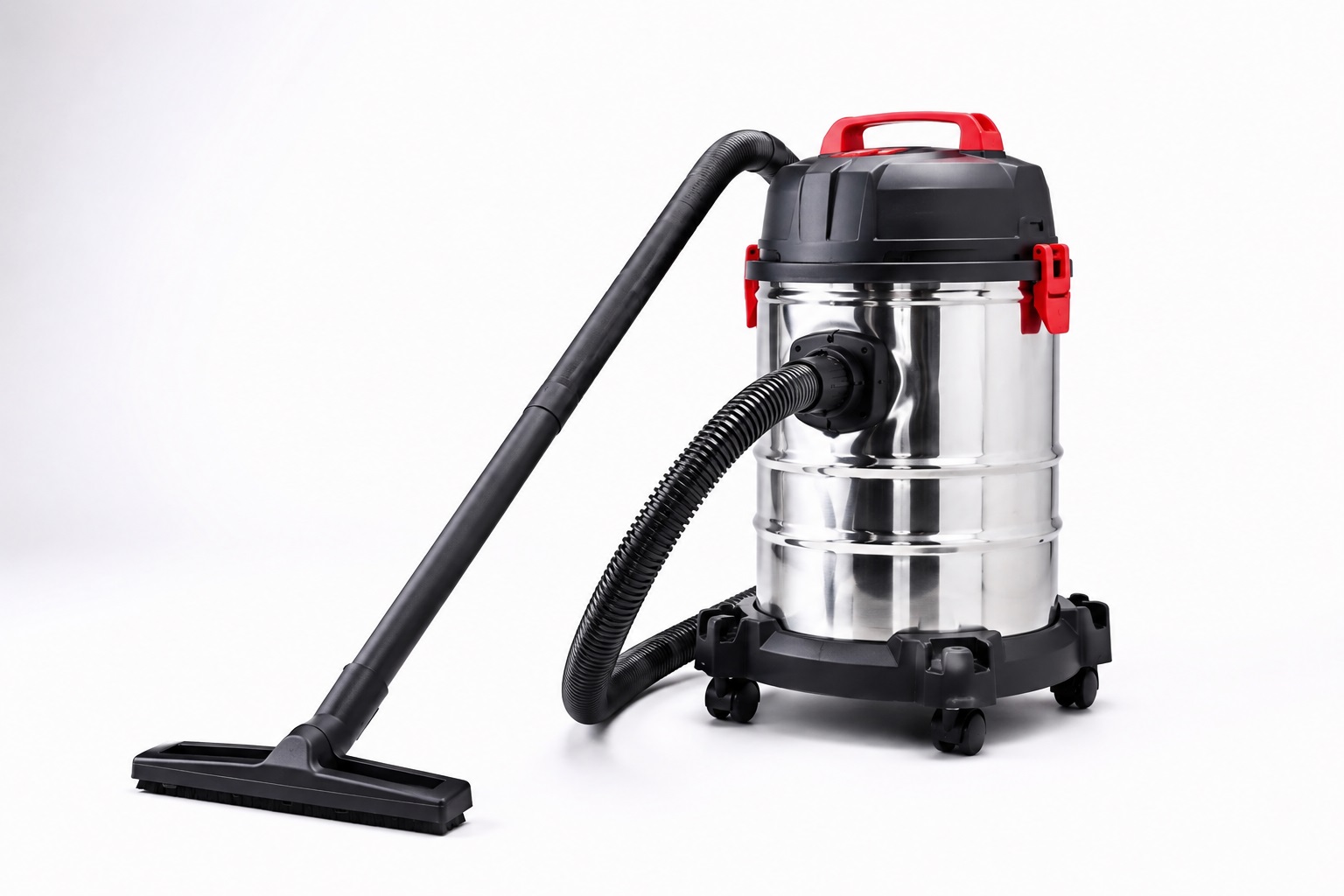
1. What Is a Wet and Dry Vacuum Cleaner?
A wet and dry vacuum cleaner is a cleaning machine designed to collect both dry materials and non-hazardous liquids. Unlike many conventional household vacuums primarily intended for dry dust, a wet/dry machine uses a collection tank and airflow system designed for a broader range of cleaning tasks.
You may also see this equipment described as a wet dry vacuum cleaner, shop vacuum, commercial wet/dry vacuum, or industrial wet/dry vacuum, depending on its construction and intended application.
Its versatility makes it particularly valuable in professional environments where cleaning conditions can change quickly.
For example, a warehouse operator may need to remove packaging debris in the morning and collect a liquid spill later in the day. Instead of using separate machines, an appropriately configured wet/dry vacuum can perform both jobs.
That versatility explains why wet/dry machines have become an important category of industrial cleaning equipment and commercial cleaning equipment.
💡 Simple definition: A wet/dry vacuum creates negative pressure and airflow to pull debris or liquid through a hose and separate the collected material into a tank.
2. How Does a Wet and Dry Vacuum Cleaner Work?
Although designs vary among manufacturers, the fundamental operating principle is relatively straightforward.
When the motor starts, a fan generates airflow and creates a pressure difference inside the machine. Air from the surrounding environment is drawn through the floor tool, nozzle or hose.
The incoming airflow carries dust, debris or liquid into the collection system.
The basic process can be summarized as:
Motor and fan → pressure difference → suction at the nozzle → material enters the hose → debris/liquid enters the tank → air passes through the filtration system → cleaned exhaust air exits the machine.
🌪️ This explains why motor wattage alone cannot accurately describe vacuum performance.
A High Suction Vacuum Cleaner depends on the interaction between motor design, fan efficiency, airflow, vacuum pressure, hose diameter, seals, filtration resistance and nozzle configuration.
For B2B buyers and R&D engineers, understanding this system is much more useful than comparing wattage numbers alone.
3. The Motor: The Power Source Behind the Suction System
The motor is at the heart of a wet dry vacuum cleaner.
It drives a fan or turbine that moves air through the machine. As the fan operates, pressure inside the suction path decreases relative to the surrounding atmosphere. This pressure difference causes air to enter through the cleaning nozzle.
Manufacturers may use different motor configurations depending on product positioning.
A compact Fast Lightweight Vacuum Cleaner, for example, may use a single motor optimized for portability and general-purpose cleaning.
A heavy duty vacuum cleaner may use a larger motor system or multiple motors to support demanding cleaning requirements.
A dual motor vacuum cleaner can provide additional performance or operating flexibility in some commercial and industrial designs. However, more motors can also mean greater power consumption, higher noise and increased product weight.
⚙️ For procurement teams, the right question is not simply:
“How many watts does it have?”
Instead, ask:
“What usable suction performance does this motor and airflow system deliver for my application?”
4. Understanding Airflow and Vacuum Pressure
Two important concepts help explain vacuum cleaner performance: airflow and vacuum pressure.
Airflow describes the volume of air moving through the vacuum system. It is particularly important for transporting dust and lightweight debris.
Vacuum pressure—or sealed suction—relates to the machine's ability to create a pressure difference. This can matter when collecting heavier debris or liquids.
A high suction power vacuum cleaner needs a sensible balance between these factors.
Hose diameter also influences performance. A larger hose may accommodate larger debris, while a narrower configuration may create different airflow characteristics.
Filter loading matters too. As filters become clogged, resistance can increase and effective suction may decline.
📌 B2B Tip: When comparing products from an industrial vacuum cleaner supplier, request standardized performance data measured under comparable conditions.
5. What Happens During Dry Vacuuming?
In dry mode, the machine collects materials such as dust, sand, sawdust, small fragments and general floor debris, provided the vacuum is designed for those materials.
Debris enters through the nozzle and moves along the hose into the tank.
The filtration system then helps prevent fine particles from continuing through the airflow path toward the motor and exhaust.
Depending on the machine, dry filtration may involve cartridge filters, bags, cloth filters or other filter configurations.
A HEPA filter vacuum cleaner may provide higher-efficiency particle filtration when a correctly specified HEPA system is used.
However, B2B buyers should verify filtration claims carefully.
“HEPA” should not be treated simply as a marketing word. Ask the vacuum cleaner manufacturer about the filter specification, filtration efficiency, testing method, replacement interval and whether the entire system is designed to achieve the claimed filtration performance.
6. What Happens When the Vacuum Collects Liquid?
Liquid collection is where the design of a wet/dry machine becomes especially interesting.
When operating in wet mode, liquid is drawn through the hose and deposited into the collection tank. The machine must prevent collected liquid from reaching areas where it could damage the motor.
Many wet/dry designs therefore use a float mechanism.
As the liquid level rises, the float rises with it. When the tank approaches its safe maximum level, the float can restrict the suction pathway.
The user then needs to stop the machine and empty the tank.
Larger Large-Capacity Wet Dry Vacuum Cleaner models may include a drainage outlet, allowing collected liquid to be discharged without lifting and tipping the entire machine.
💧 This is particularly valuable for factory floor cleaning, workshops and large commercial facilities where substantial quantities of liquid may need to be collected.
The precise operating procedure depends on the model, so users should always follow the manufacturer's instructions when changing between dry and wet applications.
7. How the Filtration System Changes Between Wet and Dry Cleaning
A common misunderstanding is that wet and dry vacuuming always uses exactly the same filter configuration.
It does not necessarily.
Some machines require a specific dry filter for dust collection and a different foam or wet-use configuration for liquid pickup. Other designs use different filter architectures.
Using an incorrect configuration can reduce performance or potentially damage components.
This is especially important when companies buy machines for employees rather than individual consumers. Facility management teams need a straightforward operating procedure that workers can follow consistently.
For this reason, a good Multi-Functional Durable Vacuum Cleaner should combine versatility with intuitive operation.
🛠️ For commercial procurement, simpler maintenance can translate directly into fewer operating mistakes.
8. Why Wet/Dry Vacuums Usually Use a Tank
Many wet/dry machines use a rigid collection tank rather than relying exclusively on a conventional dust bag.
The tank provides space for both solid debris and liquids.
Common materials include engineered plastics and stainless steel.
A stainless steel vacuum tank can offer a professional appearance and good durability for many applications. High-quality plastic tanks can provide lower weight and good corrosion resistance.
Tank capacity is another important design decision.
A compact machine is easier to carry between locations, making it suitable as a Portable Quiet Vacuum Cleaner for certain commercial tasks.
Larger tanks reduce emptying frequency and may be better for warehouses, factories and construction sites.
This is why professional buyers should avoid automatically assuming that “larger capacity” means “better.”
9. Wet/Dry Vacuum Cleaner vs Regular Household Vacuum
The two categories can overlap, but their typical design priorities differ.
| Feature | Regular Household Vacuum | Wet & Dry Vacuum Cleaner |
|---|---|---|
| Dry dust | Yes | Yes |
| Liquid pickup | Usually no | Yes, when designed/configured for it |
| Rigid collection tank | Less common | Common |
| Coarse debris | Limited by model | Often better suited |
| Commercial use | Limited | Available |
| Industrial configurations | Rare | Available |
| Large tank options | Less common | Common |
| Drain outlet | Rare | Available on some models |
| Dual motors | Uncommon | Available on some professional models |
A household vacuum may provide excellent carpet and floor cleaning in a home.
A commercial vacuum cleaner, meanwhile, can be designed for longer operating periods and professional environments.
An industrial vacuum cleaner may go further with rugged construction, specialized filtration or collection capabilities.
The terminology is not universally standardized, however. Buyers should always evaluate specifications rather than relying solely on product names.
10. Where Are Wet and Dry Vacuum Cleaners Used?
The versatility of a wet and dry suction system makes these machines useful across many industries.
Construction Sites 🏗️
A wet dry vacuum cleaner for construction site applications can help collect suitable dust, small debris and liquid spills.
Construction environments are demanding, so buyers should prioritize rugged wheels, durable tanks, reliable hoses and practical filtration.
Specialized hazardous construction dust may require appropriately rated extraction equipment rather than a general-purpose vacuum.
Warehouses 📦
A warehouse may encounter cardboard particles, packaging debris, floor dust and occasional spills.
An industrial wet and dry vacuum cleaner for warehouse cleaning supplier program may therefore emphasize large capacity, mobility, long cables, strong suction and easy tank emptying.
Hotels 🏨
A commercial vacuum cleaner for hotel use may be needed for maintenance areas, entrances, kitchens or back-of-house operations.
Noise can be especially important here, making a low noise vacuum cleaner attractive.
Factories 🏭
Manufacturing facilities may require machines for factory floor cleaning, depending on the materials involved.
Durability, tank capacity and appropriate filtration become important selection factors.
Automotive Businesses 🚗
A car detailing vacuum cleaner needs practical hoses and accessories for seats, carpets, footwells and tight spaces. Wet pickup can also increase versatility for certain detailing tasks.
11. Case Study: Wet/Dry Vacuum for a Logistics Warehouse
Consider a hypothetical logistics company operating a 20,000-square-meter distribution facility.
Its cleaning team deals with dust, cardboard fragments, packaging material and occasional water spills around loading areas.
The procurement department initially considers a small, inexpensive vacuum because its purchase price looks attractive.
After testing, however, the team identifies several problems: the tank requires frequent emptying, the power cable is too short, small wheels struggle over floor transitions and the hose is inconvenient for larger debris.
The company subsequently evaluates a commercial grade vacuum cleaner with a larger tank, stronger caster system, suitable hose diameter and convenient drainage.
Although the purchase price is higher, operators spend less time emptying and repositioning the machine.
📈 Case lesson: Equipment productivity depends on the complete system—not simply suction power.
12. Are Wet/Dry Vacuum Cleaners Energy Efficient?
Energy efficiency depends on the design and intended performance level.
An Energy-Saving Efficient Powerful Vacuum Cleaner should provide useful cleaning performance without unnecessary energy consumption.
For commercial buyers, this matters because a machine may operate for hundreds of hours over its service life.
An energy efficient vacuum cleaner can potentially reduce operating costs, but buyers should avoid evaluating efficiency solely by choosing the lowest-wattage model.
A low-power machine that requires substantially more cleaning time may not deliver better overall efficiency.
Instead, evaluate energy use relative to cleaning productivity.
⚡ Efficiency = useful cleaning performance per unit of energy and operating time.
13. How B2B Buyers Should Evaluate Wet/Dry Vacuum Cleaners
If you are a distributor, importer or wholesaler, consider the complete product architecture.
Evaluate:
Suction performance
Airflow and vacuum pressure
Motor configuration
Tank capacity
Tank material
Wet-mode protection
Filter system
Noise level
Power consumption
Hose diameter and length
Cable length
Wheels and mobility
Accessories
Drainage system
Spare parts
Packaging dimensions
Product certifications
Warranty arrangements
Buyers searching for the best industrial vacuum cleaner should create a specification sheet before requesting quotations.
This makes supplier comparisons much more objective.
14. OEM and ODM Opportunities for B2B Buyers
Importers often need more than an off-the-shelf product.
An OEM vacuum cleaner project may include customized branding, product colors, cartons, manuals, labels and accessory combinations.
An ODM vacuum cleaner program may allow more substantial configuration or development based on the manufacturer's available platform and engineering capabilities.
For a private label vacuum cleaner range, buyers should discuss MOQ, tooling, sample development, certification, packaging and quality standards before placing production orders.
An experienced OEM industrial vacuum cleaner manufacturer should also be able to communicate technical limitations clearly.
🎨 Customization should improve market fit without unnecessarily increasing product complexity.
15. Case Study: Developing a Private-Label Commercial Vacuum
Consider a distributor planning to introduce a private-label wet/dry range for hotels, workshops and small commercial facilities.
The initial request focuses on a best affordable vacuum with a competitive wholesale price.
After interviewing customers, the distributor discovers that users care about four additional factors: lower noise, easy movement, accessory storage and readily available replacement filters.
The sourcing team therefore changes the specification.
Instead of pursuing the absolute best budget vacuum based only on purchase price, it develops a good budget vacuum cleaner positioned around practical value.
This approach supports a stronger best value for money hoover proposition because product value is based on the entire ownership experience.
💡 For retailers, “affordable” should describe the price-to-performance relationship—not merely a low manufacturing cost.
16. Choosing a Wet and Dry Vacuum Cleaner Manufacturer
Finding a suitable vacuum cleaner manufacturer in China requires more than comparing quotation spreadsheets.
B2B buyers should investigate:
Manufacturing capability: Can the supplier consistently produce the required models and quantities?
Quality control: Are motors, electrical components and finished machines inspected?
Testing: What performance, electrical and durability tests are conducted?
OEM/ODM support: Can logos, colors, packaging and accessories be customized?
Compliance: Can the supplier support applicable requirements in the buyer's destination market?
Spare parts: Are filters, hoses, wheels, motors and accessories available?
Communication: Can engineers and sales teams respond accurately to technical questions?
Production capacity: Can the factory support future volume growth?
Buyers seeking a vacuum cleaner supplier China or heavy duty vacuum cleaner supplier China should consider factory audits and sample testing before a substantial order.
For companies looking to import vacuum cleaner from China, this supplier-validation process can reduce long-term sourcing risk.
17. How Does Supplier Selection Affect Wholesale Cost?
A search for vacuum cleaner price wholesale may produce many different quotations for apparently similar machines.
Those differences can result from motors, plastics, metal thickness, filtration, electrical components, accessories, quality-control standards, packaging and order volume.
Therefore, industrial vacuum cleaner cost should be considered alongside expected product life and warranty exposure.
A factory direct vacuum cleaner arrangement may provide purchasing advantages, but buyers still need to verify whether the company is actually a manufacturer and what production processes it controls.
Before a bulk vacuum cleaner purchase, request samples and confirm:
Product specification → approved sample → packaging → quality standard → inspection method → production → pre-shipment inspection.
This is particularly important for a large bulk order vacuum cleaner program.
18. What Should Engineers Pay Attention To?
For product engineers, wet/dry vacuum design involves balancing multiple parameters.
Increasing suction may influence noise and power consumption. Increasing tank capacity can affect weight, stability and shipping volume. A larger hose may improve coarse-debris handling but influence airflow characteristics.
Engineers may therefore evaluate:
Motor thermal performance
Airflow path
Sealing
Filter resistance
Float-valve response
Tank strength
Caster durability
Acoustic performance
Cable safety
Hose fatigue
Accessory interfaces
Serviceability
🔬 A successful industrial vacuum cleaner is a system of interconnected components rather than a collection of isolated specifications.
19. Important Safety Considerations
Wet/dry capability does not mean a vacuum can safely collect every liquid, dust or material.
Users should follow manufacturer instructions and applicable workplace requirements. Standard machines should not be used for flammable liquids, explosive materials, hot debris or hazardous substances unless they are specifically designed and certified for those applications.
Similarly, an ordinary wet/dry vacuum should not automatically be marketed as an industrial dust extractor for hazardous fine dust.
B2B buyers should verify application-specific requirements and destination-market standards before procurement.
⚠️ Correct machine selection is part of safe equipment use.
20. Final Thoughts: Why Wet and Dry Vacuum Technology Is Valuable
A wet and dry vacuum cleaner works by generating airflow and negative pressure that draws debris or liquid through a hose and into a collection tank. Its filtration, tank, motor, float protection and airflow system work together to make both dry and wet cleaning possible.
For end users, the main advantage is versatility.
For commercial operators, it can mean fewer machines and more flexible cleaning.
For distributors and wholesalers, wet/dry vacuums can address multiple markets—from hotels and automotive detailing to warehouses, workshops and construction.
And for B2B procurement teams, the key is to look beyond headline specifications.
Whether selecting a Portable Quiet Vacuum Cleaner, Large-Capacity Wet Dry Vacuum Cleaner, high suction power vacuum cleaner, or Multi-Functional Durable Vacuum Cleaner, the product should match the real working environment.
Brands and sourcing teams evaluating Lanxstar or another vacuum manufacturing partner should compare engineering capability, quality consistency, OEM/ODM support, compliance documentation, spare parts and total procurement value alongside price.
For additional information about wet and dry vacuum cleaners, industrial cleaning solutions and OEM/ODM sourcing, visit www.lxvacuum.com.
If you are interested, please feel free to contact us.
50 Related SEO Keywords
wet and dry vacuum cleaner, wet dry vacuum cleaner, industrial vacuum cleaner, commercial vacuum cleaner, industrial vacuum cleaner supplier, vacuum cleaner manufacturer, Lanxstar, vacuum manufacturer, vacuum cleaner maker, industrial cleaning equipment, commercial cleaning equipment, vacuum cleaner supplier, vacuum cleaner manufacturer in China, industrial vacuum cleaner factory, wholesale vacuum cleaner, bulk vacuum cleaner purchase, OEM vacuum cleaner, ODM vacuum cleaner, private label vacuum cleaner, cleaning equipment supplier, industrial equipment supplier, construction site cleaning equipment, warehouse cleaning solution, hotel cleaning equipment, factory floor cleaning, logistics warehouse cleaning, car detailing vacuum cleaner, facility management cleaning equipment, HEPA filter vacuum cleaner, high suction power vacuum cleaner, heavy duty vacuum cleaner, dual motor vacuum cleaner, stainless steel vacuum tank, low noise vacuum cleaner, energy efficient vacuum cleaner, wet and dry suction system, industrial dust extractor, commercial grade vacuum cleaner, buy industrial vacuum cleaner, best industrial vacuum cleaner, vacuum cleaner price wholesale, industrial vacuum cleaner cost, vacuum cleaner supplier China, commercial vacuum cleaner for sale, bulk order vacuum cleaner, factory direct vacuum cleaner, import vacuum cleaner from China, commercial vacuum cleaner for hotel use, industrial wet and dry vacuum cleaner, OEM industrial vacuum cleaner manufacturer