Hi, message us with any questions.
We're happy to help!





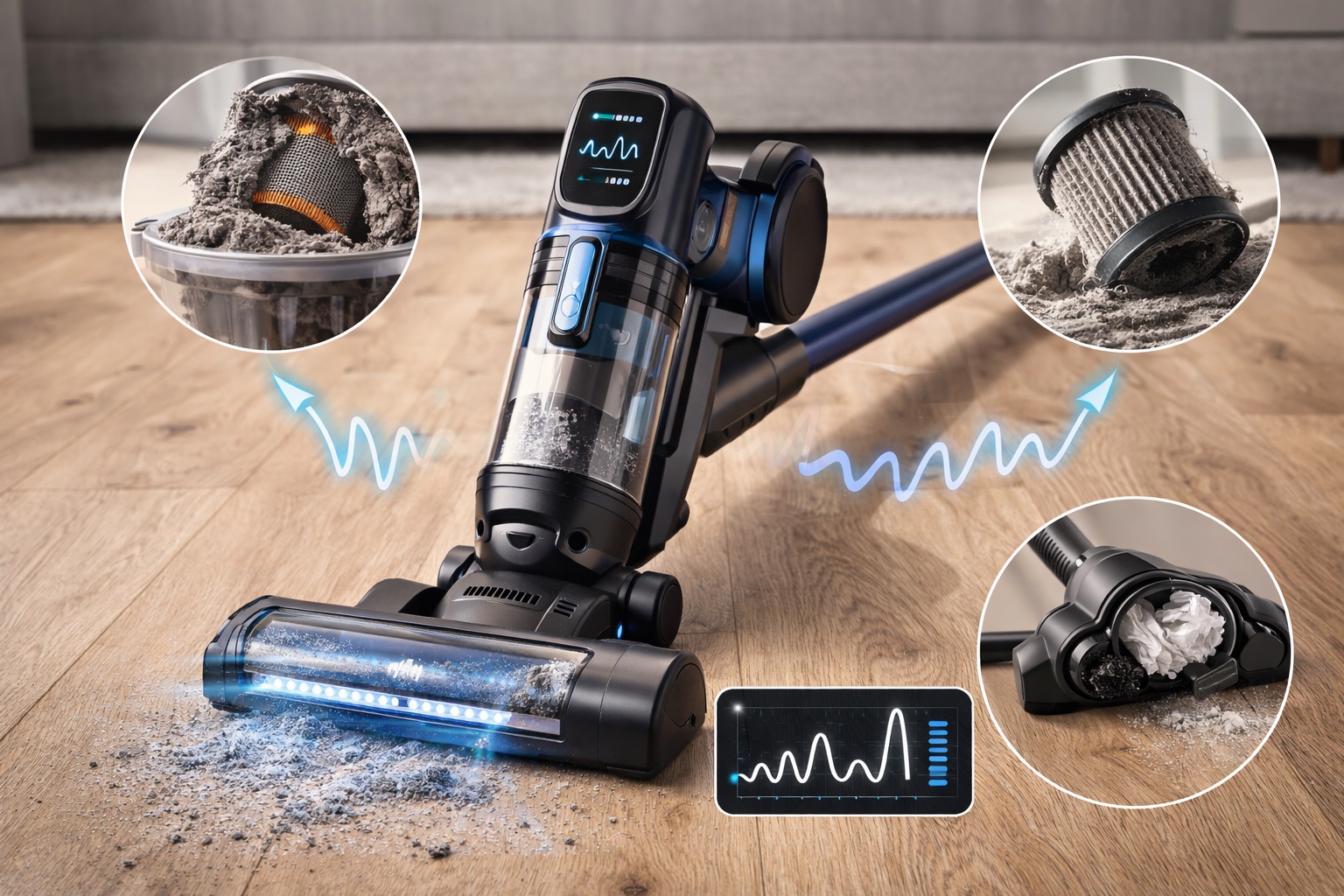
A Technical & Commercial Explanation for European & Middle Eastern B2B Buyers
Suction fluctuation is one of the most common yet least clearly explained problems in the vacuum cleaner industry.
For consumers, it feels like inconvenience.
For B2B buyers, distributors, and product managers, it becomes a serious issue that leads to:
After-sales complaints
Warranty claims
Negative distributor feedback
Loss of trust in product lines
This article is written for European & Middle Eastern B2B vacuum cleaner buyers, not end users. Its goal is to explain why suction fluctuates, which causes are structural, and how to prevent these issues at the sourcing and product-selection stage.
No marketing language.
No surface-level advice.
Only engineering logic + procurement reality.
🧭 Who This Article Is For
European & Middle Eastern B2B vacuum cleaner buyers
Importers and distributors managing after-sales risk
Product managers and sourcing teams
Cleaning equipment entrepreneurs and quality leaders
🧠 What “Suction Fluctuation” Actually Means
Suction fluctuation does not automatically indicate motor failure.
In real-world usage, it usually appears as:
Strong suction at startup, weaker after minutes
Inconsistent performance across surfaces
Reduced airflow when accessories are attached
Noticeable drops during extended operation
The key point for B2B buyers is this:
👉 Most suction problems are predictable design outcomes, not random defects.
🧩 Root Cause 1: Airflow Path Disruption
In both dry-only models and wet and dry vacuum cleaner designs, suction depends on stable airflow, not just motor power.
Common structural problems include:
Narrow or overly complex air channels
Sharp internal turns increasing resistance
Excessive filtration layers blocking airflow
These issues are especially common in products marketed as Multi-Functional Durable Vacuum Cleaner units, where multiple features compete for internal space.
Procurement insight:
A vacuum with moderate suction but clean airflow often performs better long-term than one with high peak ratings and poor airflow geometry.
🔋 Root Cause 2: Power Delivery Instability in Cordless Models
A Cordless Vacuum Cleaner introduces variables that corded models avoid.
What happens in real use:
Battery voltage drops under load
Motor speed becomes inconsistent
Suction weakens as temperature rises
Many low- and mid-range cordless products perform well only in short demonstrations. For B2B buyers, this creates a gap between tested performance and actual customer experience.
What to verify at sourcing stage:
Battery discharge curves
Motor controller stability
Thermal protection behavior
Cordless convenience is valuable—but only when power regulation is engineered, not assumed.
🧼 Root Cause 3: Filter Saturation & “Self-Cleaning” Misunderstandings
Filtration is responsible for a large percentage of suction complaints.
A Portable Self-Cleaning Vacuum Cleaner often promises maintenance-free performance, but in practice:
“Self-cleaning” usually means vibration or airflow reversal
Fine dust still blocks filter pores
Airflow resistance rises quickly
This issue is amplified in:
Dust-heavy Middle Eastern environments
Allergy-focused applications
For any Vacuum Cleaner for Allergies, filtration must balance:
High particle capture efficiency
Low airflow resistance
Easy, repeatable cleaning
Otherwise, suction fluctuation is unavoidable.
🌫️ Root Cause 4: Environmental Load (The Hidden Variable)
Most vacuum cleaners are tested in controlled environments. Real usage includes:
Fine sand and dust
Pet hair mixed with humidity
Carpet density changes
Wet debris in mixed-use scenarios
This is why many wet and dry vacuum cleaner models perform well in labs but fail in field use when wet and dry debris are mixed without proper internal separation.
B2B takeaway:
Vacuum cleaners must be engineered for contamination tolerance, not ideal conditions.
🌙 Root Cause 5: Noise Optimization Trade-Offs
Demand for Quiet Vacuum for Night Use models is growing rapidly in Europe and premium Middle Eastern developments.
However, poor designs reduce noise by:
Restricting airflow
Reducing exhaust efficiency
This lowers noise—but destabilizes suction.
High-quality quiet models instead rely on:
Optimized airflow geometry
Vibration damping
Balanced motor rotation
Quiet performance should come from engineering refinement, not airflow restriction.
🧠 Why Suction Fluctuation Is a B2B Selection Problem
Many suppliers blame:
User error
Maintenance habits
But experienced distributors know:
If suction fluctuates across many users, it’s a design limitation, not misuse.
Suction stability is determined before mass production, not after complaints begin.
🧩 How Professional Buyers Prevent Suction Issues
Instead of asking only:
“How strong is the suction?”
Ask:
How stable is airflow after 15–20 minutes?
What happens when filters reach partial saturation?
Is performance consistent across accessories and surfaces?
How does the unit behave under thermal stress?
This approach applies to:
Cordless Vacuum Cleaner sourcing
Multi-Functional Durable Vacuum Cleaner portfolios
Portable Self-Cleaning Vacuum Cleaner evaluations
🔍 A Practical Portfolio Strategy
To reduce suction-related complaints, experienced B2B buyers often structure portfolios like this:
One wet and dry vacuum cleaner focused on durability
One Multi-Functional Durable Vacuum Cleaner with simplified airflow
One Cordless Vacuum Cleaner with stable power control
One Quiet Vacuum for Night Use for regulated environments
Optional Portable Self-Cleaning Vacuum Cleaner for niche demand
This avoids forcing one model to solve incompatible requirements.
✅ Final Takeaway
Suction fluctuation is not mysterious.
It results from:
Airflow compromise
Power instability
Filtration resistance
Environmental mismatch
Design trade-offs
For B2B buyers, the solution is not stronger motors—but better engineering logic and smarter product positioning.
Vacuum cleaners that maintain stable suction under real conditions always outperform those optimized only for specifications.
📌 Hashtags
wet and dry vacuum cleaner, multi-functional durable vacuum cleaner, cordless vacuum cleaner, portable self-cleaning vacuum cleaner, vacuum cleaner for allergies, quiet vacuum for night use, commercial vacuum cleaner, b2b vacuum cleaner, vacuum suction stability, vacuum airflow design, vacuum motor engineering, vacuum filtration system, low noise vacuum cleaner, durable vacuum cleaner, professional cleaning equipment, industrial vacuum solutions, europe vacuum market, middle east vacuum market, vacuum cleaner distributor, vacuum cleaner importer, private label vacuum cleaner, oem vacuum cleaner, vacuum cleaner quality control, vacuum cleaner testing standards, cordless vacuum performance, battery powered vacuum cleaner, dust management solutions, allergy cleaning equipment, hospital vacuum cleaner, hotel vacuum cleaner, night use cleaning equipment, quiet commercial vacuum, vacuum cleaner design flaws, vacuum cleaner troubleshooting, airflow optimization, vacuum cleaner engineering, cleaning equipment supplier, vacuum cleaner manufacturer, vacuum cleaner wholesale, global vacuum supply, eu cleaning equipment, gcc cleaning market, commercial hygiene solutions, professional vacuum systems, industrial cleaning tools, Lanxstar