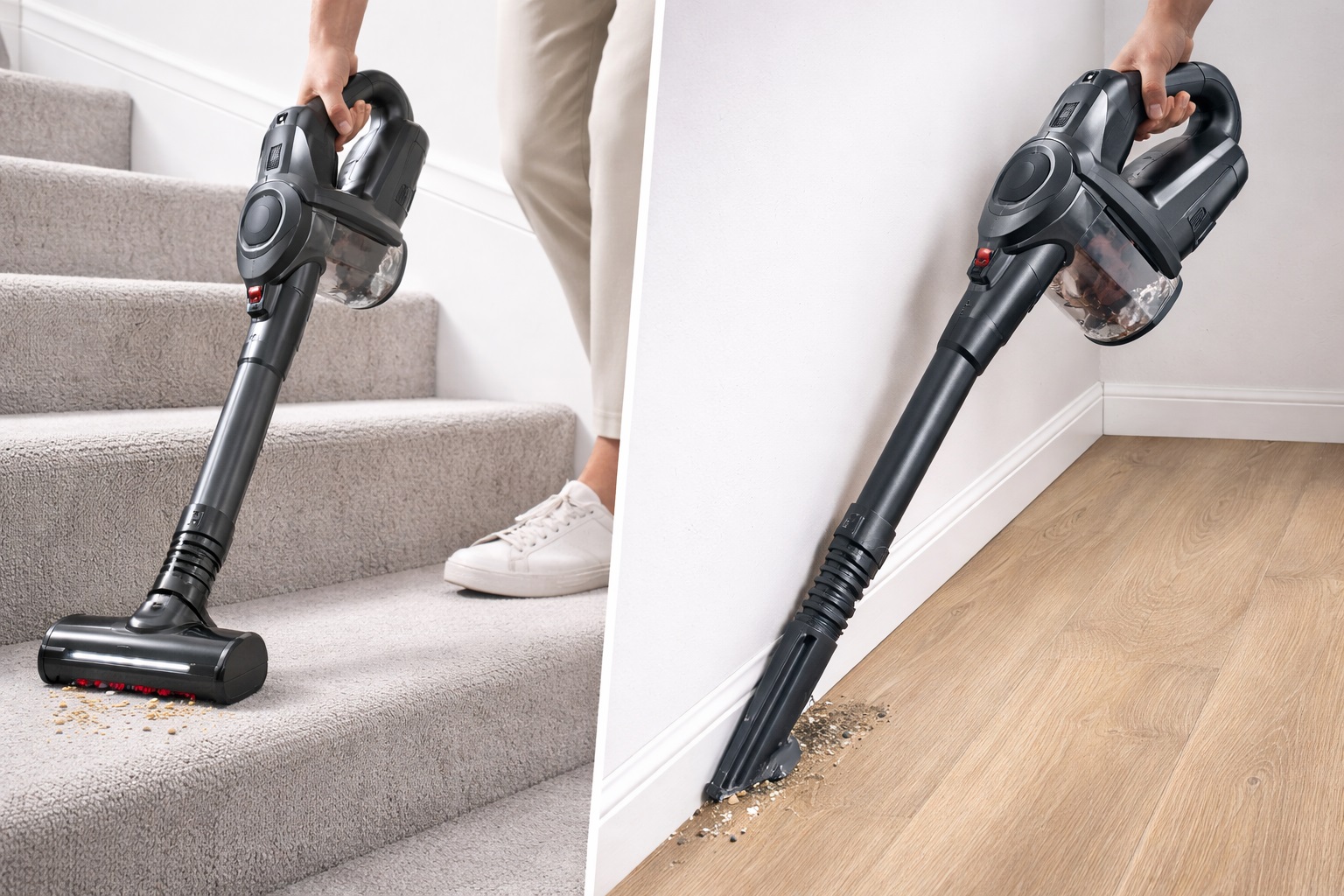
A Professional Performance Guide for B2B Vacuum Buyers, Distributors & Product Engineers
Stairs, corners, and tight angles represent one of the highest failure rates in real-world vacuum cleaner usage. These areas concentrate dust, pet hair, debris buildup, and moisture residue—yet they are precisely where many vacuum cleaners lose suction, stability, and user trust.
For EU & Middle East vacuum cleaner buyers, performance in these “difficult zones” directly affects:
Customer satisfaction and product reviews
Return and complaint rates
Long-term distributor confidence
This guide explains how stairs and hard-to-reach corners should be vacuumed, and more importantly, what these scenarios reveal about vacuum cleaner design quality.
🧭 Step 1: Understand Why Stairs & Corners Are a Design Stress Test
From an engineering and sourcing perspective, stairs and corners expose multiple weaknesses at once:
A Multi-Functional Durable Vacuum Cleaner performs well here not because it is powerful, but because it maintains stable airflow under changing angles.
Buyer insight:
Products that perform well on flat floors but fail on stairs often suffer from poor hose diameter design or inconsistent pressure distribution.
🌀 Step 2: Start with Dry Extraction — Control Before Power
Whether in residential or semi-commercial environments, stairs must always be vacuumed dry first.
A wet and dry vacuum cleaner should be used in dry mode initially to:
Lift embedded dust from carpet edges
Remove pet hair trapped along stair risers
Prevent moisture from spreading debris
Key performance indicators:
🐾 Step 3: Pet Hair on Stairs — Where Most Vacuums Fail
Stairs are a pet hair accumulation hotspot, especially in EU and Middle East apartment households.
A true Vacuum Cleaner for Pet Hair must handle:
Rotating brush tools often fail here due to:
Engineering insight:
Airflow-driven pet hair removal tools outperform motorized brushes on stairs due to reduced friction and clog risk.
📍 Case Snapshot 1: High Return Rates Linked to Stair Pet Hair Performance
Market: EU distributors (pet-owning households)
Initial Issue: High return rate despite strong floor-cleaning reviews
Root Cause:
Pet hair not effectively removed from stairs and corners
Correction:
Added specialized airflow-focused stair tools + improved hose airflow design
Outcome:
Lower return rates and improved online product ratings
B2B takeaway:
Stair performance disproportionately influences customer perception.
⚡ Step 4: Use Lightweight & Handheld Modes for Control
Stairs are not about raw power—they are about control and safety.
A Cordless Handheld Vacuum Cleaner or detachable handheld mode:
In multi-level living environments, buyers increasingly prefer:
Detachable handheld units
Balanced weight distribution
One-hand operation capability
🚗 Step 5: Corners, Edges & Multi-Use Logic — Why Car Tools Matter
Hard-to-reach corners inside homes share the same geometry as vehicle interiors.
That’s why a Car Vacuum Cleaner attachment ecosystem often excels in:
From a sourcing standpoint, multi-use tooling:
💧 Step 6: When Moisture Is Required — Controlled Wet Cleaning Only
For spills or sticky residues on stair edges, wet cleaning must be minimal and controlled.
A Wet and Dry Vacuum Cleaner should:
Over-wetting stairs leads to:
📍 Case Snapshot 2: Odor Complaints After Wet Stair Cleaning
Market: Middle East apartment cleaning services
Issue: Persistent odor after stair cleaning
Root Cause:
Moisture penetrated stair padding due to poor recovery airflow
Solution:
Upgraded to wet and dry systems with faster extraction and better sealing
Result:
Reduced odor complaints and improved service reliability
Strategic insight:
Moisture control is critical in high-humidity regions.
🔍 Step 7: Stability, Noise & User Confidence on Stairs
Noise levels increase noticeably on stairs due to:
Restricted airflow
Hose bending resistance
Motor strain
A stable Multi-Functional Durable Vacuum Cleaner maintains:
Consistent suction
Acceptable noise levels
Operator confidence
Excessive noise on stairs often signals airflow inefficiency, not motor weakness.
📈 Strategic Takeaways for EU & Middle East Buyers
Stairs and corners reveal true vacuum performance
Airflow stability matters more than peak suction
Lightweight and handheld modes improve safety
Pet hair performance strongly affects returns
Multi-use tools reduce sourcing risk
📌 Hashtags
wet and dry vacuum cleaner, Multi-Functional Durable Vacuum Cleaner, Cordless Handheld Vacuum Cleaner, Car Vacuum Cleaner, Vacuum Cleaner for Pet Hair, Wet and Dry Vacuum Cleaner, commercial vacuum cleaner, stair cleaning equipment
hard-to-reach cleaning tools, B2B vacuum sourcing, vacuum cleaner distributor, vacuum cleaner importer, vacuum cleaner OEM, vacuum cleaner ODM, cleaning equipment business, EU vacuum market
Middle East vacuum market, vacuum product engineering, airflow design vacuum, lightweight vacuum systems, portable cleaning tools, multi-surface vacuum, compact vacuum design, pet hair removal solutions
vacuum hose optimization, durable vacuum systems, vacuum after-sales strategy, professional cleaning tools, urban apartment cleaning, multi-level home cleaning, vacuum innovation trends, cleaning efficiency tools
vacuum buyer guide, commercial cleaning strategy, vacuum market insights, B2B cleaning solutions, product reliability strategy, stair safety cleaning, corner cleaning solutions, edge cleaning vacuum
vacuum tool accessories, facility cleaning solutions, professional maintenance guide, vacuum sourcing guide, Lanxstar