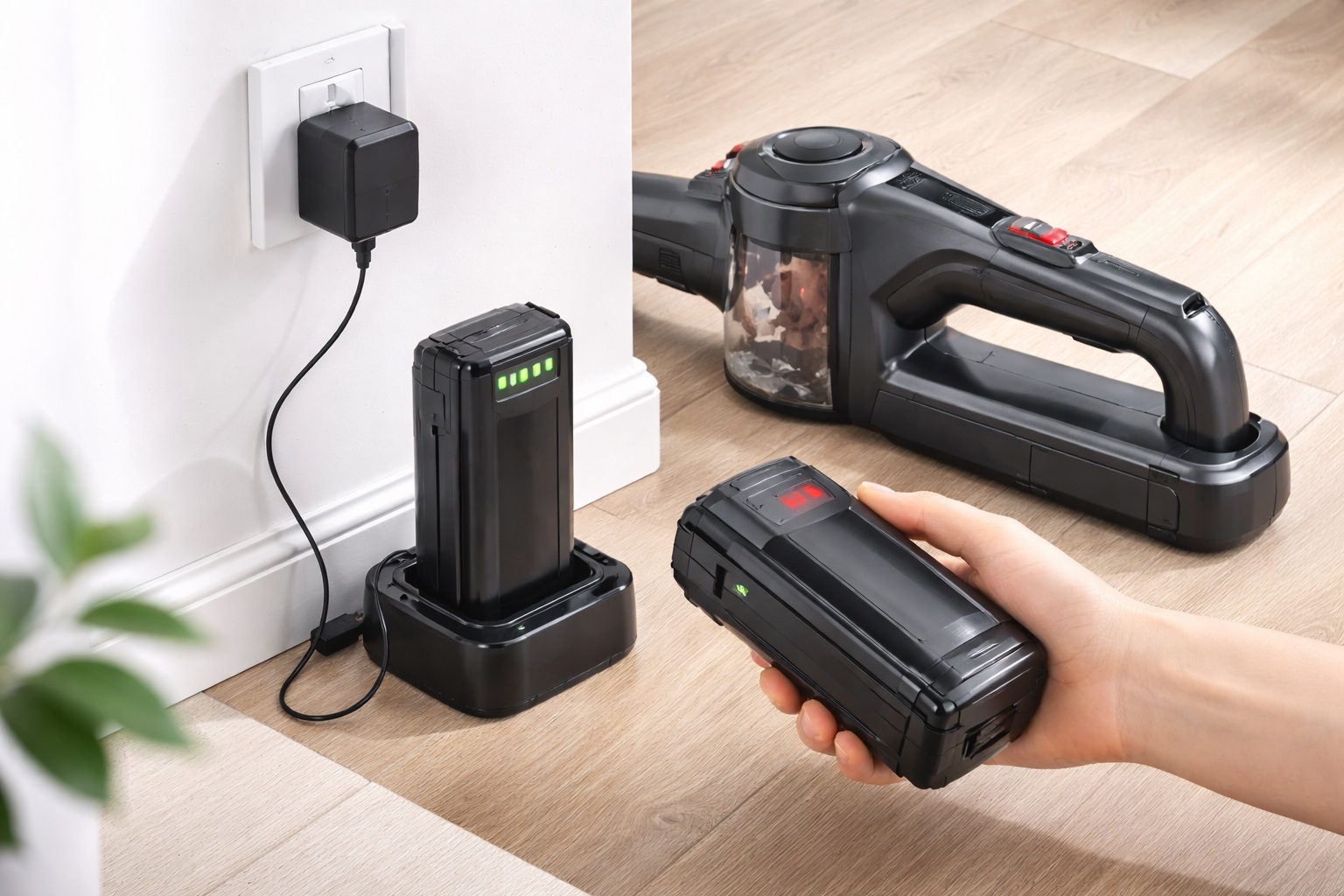
A B2B Diagnostic & Decision Guide for Cordless Vacuum Performance
Battery complaints are now one of the top three reasons for cordless vacuum returns in EU and Middle East markets. What makes this issue complex is that “battery runs out too fast” is rarely caused by the battery alone.
For B2B buyers, distributors, and product engineers, battery runtime problems directly affect:
Return and exchange rates
Brand credibility
After-sales support costs
Long-term distributor confidence
This guide explains why cordless vacuums lose runtime faster than expected, how to diagnose the real causes, and what buyers should evaluate before sourcing or scaling a cordless model.
🧭 Step 1: Separate Battery Capacity from Real Runtime
Many sourcing decisions start with battery specs:
But real-world performance depends on system efficiency, not numbers on paper.
A Cordless Vacuum Cleaner with a large battery can still underperform if:
Buyer insight:
Runtime claims are often measured at the lowest power mode, not under real cleaning load.
🌀 Step 2: Check Airflow Resistance — The Silent Battery Killer
Restricted airflow forces the motor to work harder, draining the battery faster.
Common causes:
A HEPA Filter Vacuum Cleaner must balance filtration with airflow.
If the system is not properly sealed and optimized, battery consumption increases without improving cleaning results.
Engineering reality:
High filtration resistance = higher energy draw.
⚡ Step 3: Lightweight Design Is About Energy Efficiency, Not Just Comfort
A Fast Lightweight Vacuum Cleaner is not only easier to use—it is more energy efficient.
Why?
In apartment-focused markets, lightweight cordless units consistently show better real-world runtime satisfaction, even with smaller batteries.
📍 Case Snapshot 1: Battery Complaints Linked to “Heavy-Duty” Design
Market: EU urban apartment segment
Initial Feedback: “Battery drains too fast”
Assumed Cause: Battery cell quality
Actual Root Cause:
Heavy housing + airflow resistance increased power draw
Correction:
Switched to a lighter structural design with improved airflow
Outcome:
Fewer battery complaints and higher repeat orders
B2B takeaway:
Energy efficiency is a system-level design issue.
🔄 Step 4: Multi-Functionality Can Either Help or Hurt Runtime
A Multi-Functional Durable Vacuum Cleaner can reduce SKU complexity—but only if functions are energy-aware.
Battery drains faster when:
Wet and dry modes share inefficient airflow paths
Motors are over-sized for light tasks
Accessories trigger unnecessary power boosts
Smart multi-function design:
Uses adaptive power management
Separates airflow paths where needed
Avoids “always-on high power” logic
💧 Step 5: Wet Cleaning Mode — Why Runtime Drops Faster Than Expected
In a wet and dry vacuum cleaner, wet mode is naturally more energy-intensive due to:
However, excessive runtime loss signals:
Procurement insight:
Wet runtime should be evaluated separately, not averaged into total runtime claims.
🏠 Step 6: Apartment Usage Patterns Change Battery Expectations
The Apartment Vacuum Cleaner category has unique runtime dynamics:
Short, frequent cleaning sessions
High sensitivity to recharge downtime
Limited storage and charging space
Buyers increasingly prefer:
Battery complaints often arise when products are designed for houses but sold into apartments.
📍 Case Snapshot 2: Distributor Repositioning Solved Battery Dissatisfaction
Market: Middle East apartment-focused distributors
Issue: Battery dissatisfaction despite adequate specs
Root Cause:
Product marketed for “whole-house deep cleaning”
Adjustment:
Repositioned as fast, lightweight apartment cleaning solution
Result:
Improved customer expectations and lower return rates
Strategic insight:
Expectation management is as important as hardware.
🔋 Step 7: Filtration Maintenance Directly Affects Battery Life
As filters clog, motors compensate by increasing power output.
In a HEPA Filter Vacuum Cleaner, poor maintenance leads to:
Buyers should evaluate:
Battery performance and filtration design are inseparable.
📈 Strategic Takeaways for EU & Middle East Buyers
Battery complaints are rarely battery-only issues
Airflow resistance drains energy faster than expected
Lightweight systems improve real runtime satisfaction
Wet mode should be evaluated independently
Apartment usage patterns redefine “good battery life”
📌 Hashtags
wet and dry vacuum cleaner, Multi-Functional Durable Vacuum Cleaner, Fast Lightweight Vacuum Cleaner, Cordless Vacuum Cleaner, Apartment Vacuum Cleaner, HEPA Filter Vacuum Cleaner, battery runtime optimization, cordless vacuum performance
B2B vacuum sourcing, vacuum cleaner distributor, vacuum cleaner importer, vacuum cleaner OEM, vacuum cleaner ODM, cleaning equipment business, EU vacuum market, Middle East vacuum market
vacuum product engineering, airflow efficiency vacuum, lightweight vacuum design, energy-efficient vacuum, battery management systems, filtration resistance control, HEPA system design
apartment cleaning equipment, cordless cleaning solutions, vacuum after-sales strategy, product reliability strategy, battery complaint reduction, vacuum market insights
professional cleaning tools, B2B cleaning solutions, vacuum buyer guide, vacuum sourcing guide, indoor cleaning technology, Lanxstar