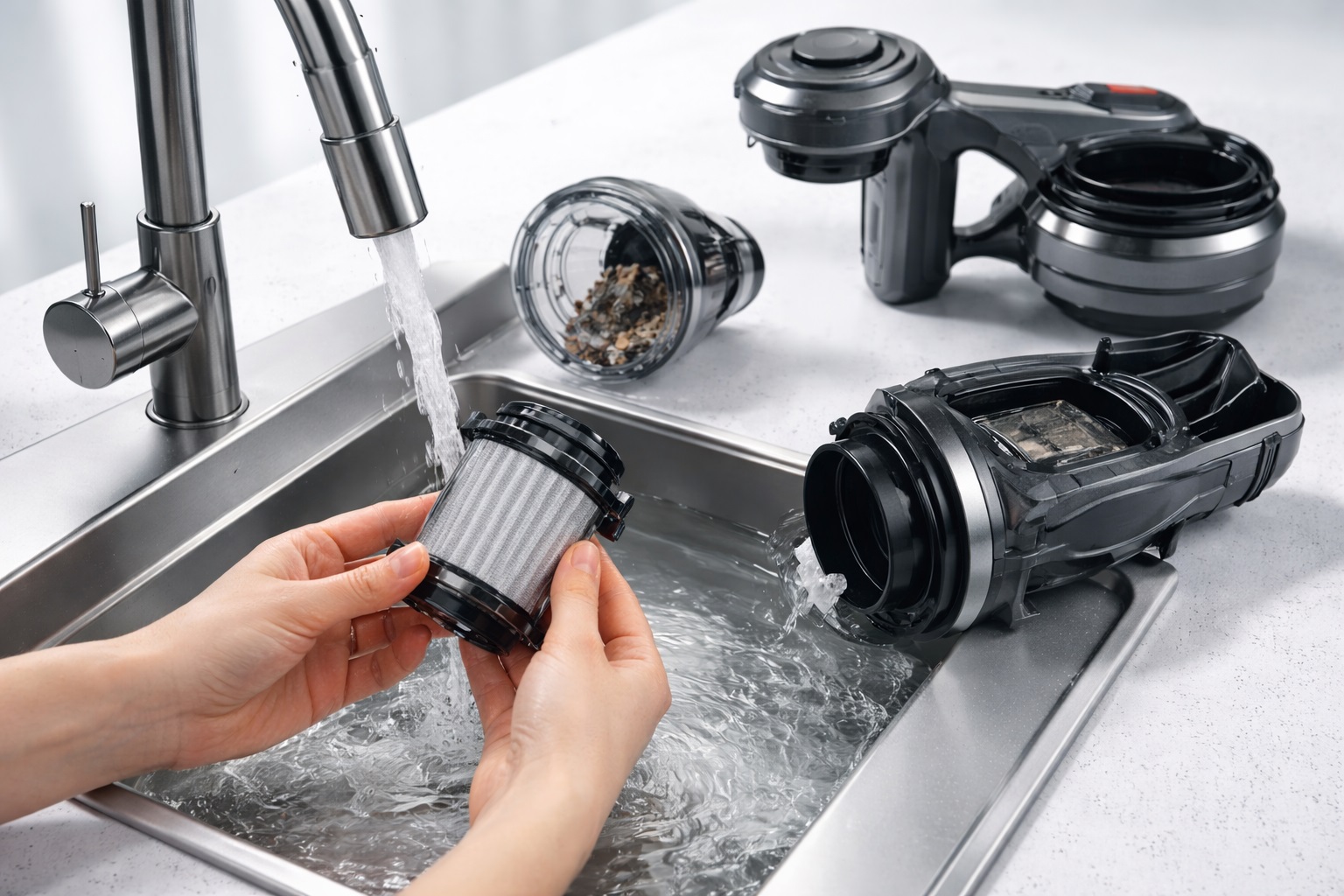
A Professional Maintenance Framework for B2B Vacuum Buyers, Distributors & Product Engineers
Vacuum filter cleaning is often treated as a basic maintenance task, yet in professional markets it is one of the most decisive factors behind suction loss, noise complaints, motor failure, and warranty disputes.
For EU and Middle East vacuum cleaner buyers, filter design and cleaning logic directly affect:
This guide is not written for end users. It is a step-by-step, B2B-level framework explaining how filters should be cleaned, why certain designs fail, and what buyers and engineers should evaluate before sourcing.
🧭 Step 1: Identify the Filter System — Not All “Filters” Behave the Same
Before cleaning, the first critical step is system identification, not action.
From a B2B standpoint, vacuum cleaners typically use:
A Multi-Functional Durable Vacuum Cleaner usually combines at least two of these layers. Cleaning methods that work for pre-filters can irreversibly damage HEPA media.
Procurement insight:
Many performance complaints originate from distributors or end users cleaning the wrong filter in the wrong way—a documentation and design issue, not misuse.
🌀 Step 2: Power-Off & Pressure Release — The Most Ignored Safety Step
Filter cleaning should never begin immediately after operation.
In both wet and dry vacuum cleaner systems and dry-only models, residual negative pressure remains inside the airflow path. Removing a filter too early can:
Professional guidelines recommend:
This is especially relevant for Apartment Vacuum Cleaner usage, where indoor air recirculation is limited.
🧹 Step 3: Dry Cleaning First — Why Washing Too Early Reduces Filter Life
Across EU service data, one pattern is consistent:
Over-washing filters shortens usable lifespan.
Dry cleaning methods should always be attempted first:
For a Quiet Vacuum Cleaner, this step is critical. Dust accumulation on filters is one of the primary causes of rising noise levels, as motors compensate for restricted airflow.
📍 Case Snapshot 1: Noise Complaints Traced to Improper Filter Washing
Market: EU residential distributors
Initial Issue: Increased noise complaints after 3–4 months
Assumed Cause: Motor quality
Actual Root Cause:
HEPA filters repeatedly washed instead of dry-cleaned, damaging fiber structure
Correction:
Clear dry-clean-first maintenance protocol + filter labeling
Result:
Noticeable reduction in noise complaints and warranty claims
B2B takeaway:
Noise issues are often maintenance-induced, not design-related.
💧 Step 4: Wet Cleaning — Only When the Filter Design Allows It
Not all filters are washable, even if marketing implies otherwise.
A wet and dry vacuum cleaner may support washable pre-filters, but HEPA Filter Vacuum Cleaner systems often do not unless explicitly engineered for it.
Correct wet-cleaning procedure:
Use only cold or lukewarm water
No detergents or chemicals
Rinse from clean side to dirty side
Complete air-drying (24–48 hours minimum)
Failure here leads to:
📍 Case Snapshot 2: Odor & Air Quality Issues After “Clean” Filters
Market: Middle East apartment cleaning services
Problem: Odor and allergy complaints post-maintenance
Root Cause:
Filters reinstalled before complete drying in high-humidity conditions
Solution:
Portable Self-Cleaning Vacuum Cleaner systems with automated filter drying cycles
Outcome:
Improved indoor air quality perception and service reliability
Strategic insight:
Humidity-aware filter management is essential in Middle East markets.
🌬️ Step 5: HEPA Filter Handling — Precision Matters More Than Frequency
HEPA filters are not about how often you clean them, but how well the system protects them.
Key points buyers should evaluate:
Seal integrity around the HEPA housing
Ease of removal without fiber damage
Clear replacement vs cleaning guidance
In compact living environments, the Apartment Vacuum Cleaner category increasingly demands sealed HEPA systems to prevent allergen leakage.
⚙️ Step 6: Reinstallation & System Check — Where Performance Is Won or Lost
Improper reinstallation negates all previous steps.
Checklist:
A properly reinstalled filter restores:
Suction stability
Noise control
Energy efficiency
For a Multi-Functional Durable Vacuum Cleaner, this step ensures that performance consistency matches marketing claims over time.
🔍 Why Portable & Self-Cleaning Designs Are Gaining B2B Attention
A Portable Self-Cleaning Vacuum Cleaner reduces:
From a sourcing perspective, these systems:
📈 Strategic Takeaways for EU & Middle East Buyers
Filter maintenance is a performance issue, not a minor detail
Dry cleaning extends filter lifespan
Improper washing causes noise and odor complaints
HEPA integrity defines air quality trust
Self-cleaning systems reduce after-sales risk
📌 Hashtags
wet and dry vacuum cleaner, Multi-Functional Durable Vacuum Cleaner, Quiet Vacuum Cleaner, Portable Self-Cleaning Vacuum Cleaner, Apartment Vacuum Cleaner, HEPA Filter Vacuum Cleaner, commercial vacuum cleaner, vacuum filter maintenance
B2B vacuum sourcing, vacuum cleaner distributor, vacuum cleaner importer, vacuum cleaner OEM, vacuum cleaner ODM, cleaning equipment business, indoor air quality equipment, sealed filtration system
vacuum motor protection, dust filtration technology, professional cleaning tools, EU vacuum market, Middle East vacuum market, vacuum product engineering, airflow optimization vacuum, quiet motor design
durable vacuum systems, vacuum after-sales strategy, maintenance-driven performance, filter lifespan optimization, commercial cleaning solutions, apartment cleaning equipment, compact vacuum design
portable cleaning tools, vacuum innovation trends, HEPA system design, allergy control solutions, vacuum quality standards, cleaning efficiency tools, vacuum buyer guide
professional maintenance guide, facility cleaning solutions, B2B cleaning solutions, vacuum market insights, product reliability strategy, vacuum sourcing guide, Lanxstar