Hi, message us with any questions.
We're happy to help!





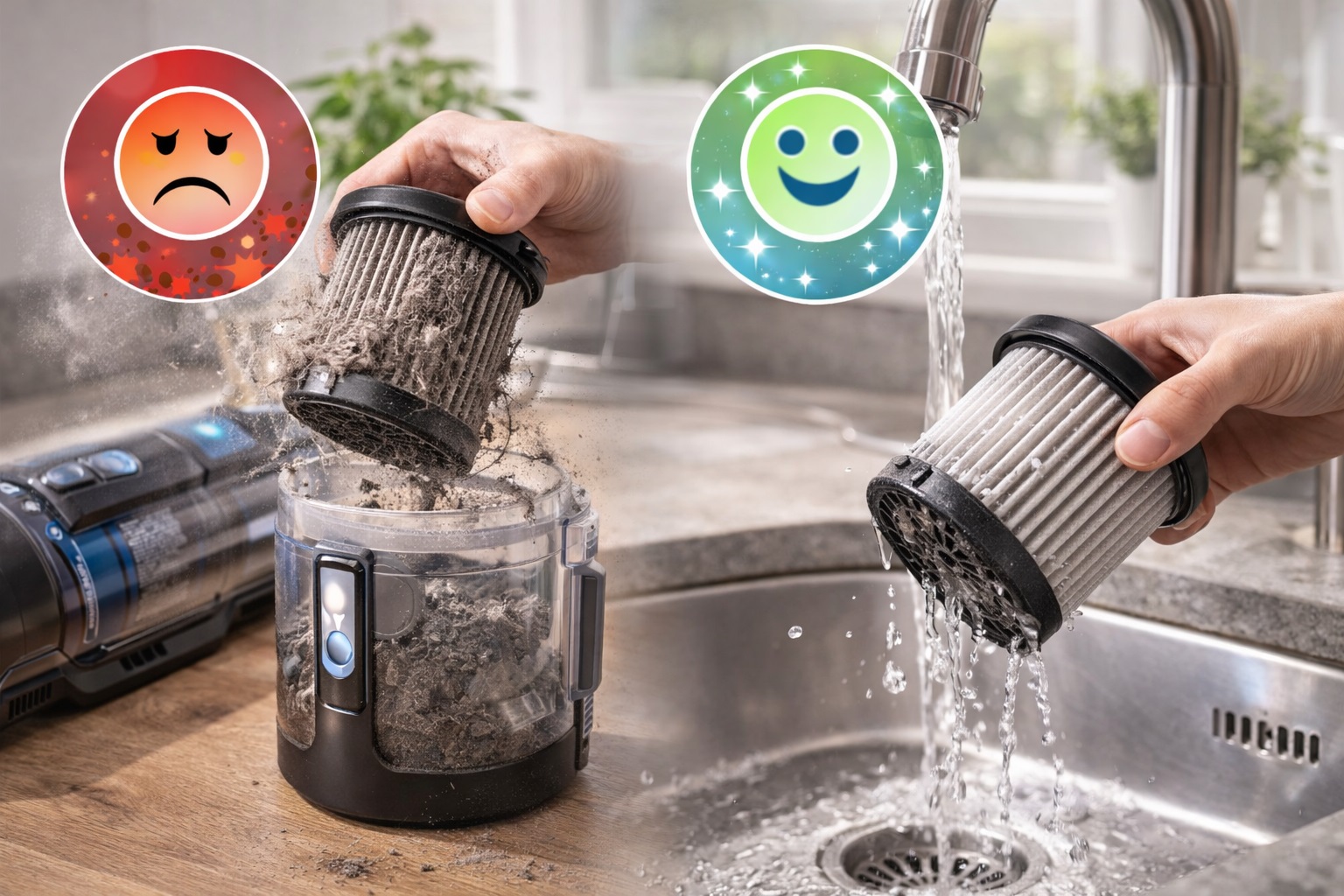
An Engineering & After-Sales Reality Check for European & Middle Eastern B2B Buyers
Vacuum filter cleaning is one of the most underestimated factors affecting product performance, battery life, energy efficiency, and customer satisfaction.
For consumers, a dirty filter means weaker suction.
For European & Middle Eastern B2B buyers, it means something far more serious:
Rising after-sales complaints
Shortened product lifespan
Energy-efficiency claims questioned
Allergy-related disputes
Brand trust erosion
This article is written not for end users, but for B2B vacuum cleaner buyers, distributors, product managers, and industry decision-makers who need to understand why filter maintenance is a structural product issue—not just a user habit.
No marketing language.
No generic “clean it regularly” advice.
Only engineering logic + sourcing-level solutions.
🧭 Who This Article Is For
European & Middle Eastern B2B vacuum cleaner buyers
Importers and distributors managing warranty risk
Product managers and R&D engineers
Cleaning equipment entrepreneurs and quality leaders
🧠 What a Vacuum Filter Actually Does (Beyond Dust Collection)
A vacuum filter is not a passive accessory. It is an active airflow regulator.
In real-world operation, the filter directly controls:
Airflow resistance
Motor load
Heat accumulation
Energy consumption
Suction stability
Once a filter begins to clog, every other system is affected, regardless of how powerful the motor is.
This applies across:
Dry-only models
wet and dry vacuum cleaner designs
Cordless and corded platforms
🧩 Impact 1: Suction Loss Is a Filter Problem First
Most suction complaints are blamed on motors—but in reality, filters are the first failure point.
As dust accumulates:
Airflow resistance increases
Motors compensate by drawing more power
Suction becomes unstable
This is especially common in Multi-Functional Durable Vacuum Cleaner models, where a single filter must handle:
Different surfaces
Dry debris
Moist particles
B2B insight:
A vacuum that depends on “rare filter cleaning” will always generate more complaints than one designed for easy, frequent maintenance.
🔋 Impact 2: Dirty Filters Destroy Energy Efficiency Claims
An Energy-Saving Efficient Powerful Vacuum Cleaner only stays energy-efficient when airflow remains unobstructed.
When filters clog:
Motors work harder to maintain suction
Power consumption rises
Heat increases
Efficiency ratings lose real-world relevance
This creates a disconnect between:
Tested energy performance
Actual customer experience
For distributors in Europe and the Middle East—where energy standards and labeling matter—filter condition directly affects compliance credibility.
🧼 Impact 3: Wet, Mixed, and Smart Systems Are Even More Sensitive
Advanced platforms such as the 4 in 1 Cordless Smart Wet & Dry Vacuum Cleaner combine:
Wet pickup
Dry dust
Smart sensing
Cordless operation
These systems are highly sensitive to filter condition.
Common problems include:
Moist debris accelerating clogging
Smart sensors misreading airflow resistance
Battery drain increasing due to motor strain
In these designs, filter neglect does not just reduce suction—it destabilizes the entire system logic.
🚗 Impact 4: Car Vacuum Cleaner Usage Accelerates Filter Saturation
A Car Vacuum Cleaner operates in environments with:
Fine dust
Sand
Fabric fibers
Confined airflow
Short, high-intensity usage cycles cause filters to clog faster than in household environments.
For B2B buyers, this matters because:
Car vacuums are often entry-level products
Early failures damage brand perception
Designs that allow tool-free filter access and quick cleaning dramatically reduce negative feedback in this category.
🌬️ Impact 5: Allergy Performance Depends on Filter Hygiene
For any Vacuum Cleaner for Allergies, filtration performance is non-negotiable.
However, even high-grade filters lose effectiveness when:
Dust layers block airflow
Moisture traps allergens
Users delay cleaning
As filters clog:
Fine particles bypass compromised areas
Airflow turbulence increases
Allergen containment weakens
Procurement reality:
Allergy-focused claims are only sustainable when filter cleaning is simple, intuitive, and repeatable.
🧠 Why Filter Cleaning Is a Product Design Problem, Not a User Problem
Many suppliers blame:
User negligence
Improper maintenance
But experienced distributors know:
If most users fail to clean filters properly, the product design has failed—not the user.
Filter-related issues are determined by:
Filter placement
Access difficulty
Cleaning complexity
Replacement availability
These factors are locked in before mass production.
🧩 How Professional Buyers Reduce Filter-Related Complaints
Instead of asking:
“What type of filter does it use?”
Ask:
How long before airflow drops by 30%?
Can the filter be cleaned without tools?
How does wet debris affect filter lifespan?
Is replacement globally available and affordable?
This evaluation applies to:
wet and dry vacuum cleaner sourcing
Multi-Functional Durable Vacuum Cleaner platforms
Smart cordless wet & dry systems
🔍 A Practical Portfolio Strategy Used by Experienced Buyers
To minimize filter-related failures, many B2B buyers structure portfolios as:
One wet and dry vacuum cleaner with separated filtration paths
One Multi-Functional Durable Vacuum Cleaner with simplified filter access
One 4 in 1 Cordless Smart Wet & Dry Vacuum Cleaner for advanced users
One Energy-Saving Efficient Powerful Vacuum Cleaner optimized for airflow
One Car Vacuum Cleaner with fast-clean filters
One Vacuum Cleaner for Allergies with user-friendly maintenance
This segmentation avoids forcing a single filter system to handle incompatible demands.
✅ Final Takeaway
Cleaning the vacuum filter matters because the filter controls everything:
Suction stability
Energy efficiency
Battery health
Noise behavior
Allergy performance
For European and Middle Eastern B2B buyers, the real solution is not user education—but filter-centric product design and smarter sourcing decisions.
Vacuum cleaners that respect airflow will always outperform those that rely only on motor power.
📌 Hashtags
wet and dry vacuum cleaner, Multi-Functional Durable Vacuum Cleaner, 4 in 1 Cordless Smart Wet & Dry Vacuum Cleaner, Energy-Saving Efficient Powerful Vacuum Cleaner, Car Vacuum Cleaner, Vacuum Cleaner for Allergies, vacuum filter cleaning, vacuum filtration system, vacuum airflow efficiency, vacuum maintenance design, professional cleaning equipment, industrial vacuum solutions, europe vacuum market, middle east vacuum market, vacuum cleaner distributor, vacuum cleaner importer, private label vacuum cleaner, oem vacuum cleaner, vacuum cleaner quality control, vacuum cleaner testing standards, cordless wet dry vacuum, smart vacuum cleaner system, allergy cleaning equipment, hospital vacuum cleaner, hotel vacuum cleaner, energy efficient vacuum, low noise vacuum cleaner, durable vacuum cleaner, vacuum cleaner engineering, vacuum cleaner design, cleaning equipment supplier, vacuum cleaner manufacturer, vacuum cleaner wholesale, global vacuum supply, eu cleaning equipment, gcc cleaning market, commercial hygiene solutions, professional vacuum systems, industrial cleaning tools, filter replacement strategy, after sales risk management, product durability strategy, Lanxstar