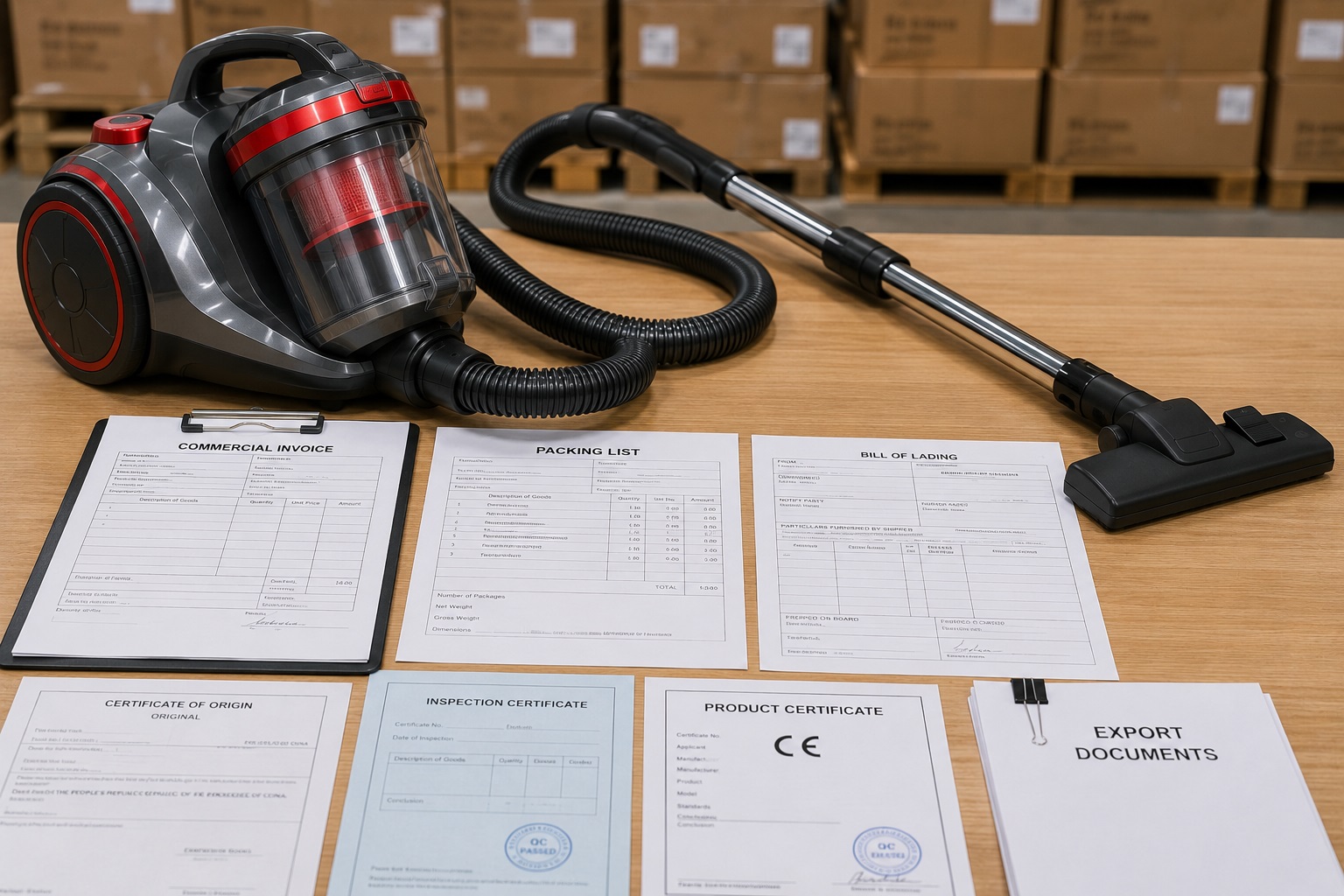
International trade in home appliances, particularly vacuum cleaners, requires more than just production and packaging. To ensure smooth delivery, every shipment must be accompanied by the correct vacuum cleaner export documents. Mistakes or missing paperwork can result in customs delays, fines, or rejected shipments.
For European, American, and other international distributors, understanding export documents vacuum and shipping compliance is crucial when working with vacuum exporters or vacuum suppliers in China.
This guide provides a detailed overview of essential documentation, tips to avoid common mistakes, and best practices for customs clearance vacuum.
📄 1. Commercial Invoice
The commercial invoice is the primary document used by customs to determine:
Product value
Import duties
Taxes
Key elements include:
Tip: Ensure the description matches the packing list and the bill of lading.
📦 2. Packing List
The packing list details how products are packaged and shipped.
Includes:
Number of cartons/pallets
Dimensions and weight of each package
Product contents
Marks and numbers for easy identification
Importance: Customs officers use the packing list to verify shipment contents and check against the invoice.
🚢 3. Bill of Lading (B/L) or Airway Bill (AWB)
The bill of lading or airway bill serves as:
Key Tip: Always verify that the consignee information matches the commercial invoice and packing list.
🏷️ 4. Certificate of Origin (CO)
Some countries require a CO to:
Best Practice: Obtain this document from local chambers of commerce in China or your export agent.
🧾 5. CE Certificate or Product Certification
For vacuum cleaner shipments to Europe, CE certification is mandatory. Other regions may require:
Tip: Always include the certification copies with your shipment documentation to prevent customs delays.
💳 6. Proforma Invoice (Optional but Recommended)
A proforma invoice is often used during:
It is a preliminary invoice and helps buyers arrange payment and financing.
📑 7. Insurance Certificate
For shipments with FOB, CIF, or other international terms, insurance is essential.
Covers:
Transit damages
Lost goods
Fire or natural disaster
Tip: Include the certificate number in your commercial invoice for transparency.
🛃 8. Import/Export Licenses
Depending on the destination, specific licenses may be required:
Procurement Insight: Your vacuum supplier China should guide you on required licenses.
⚠️ Common Mistakes in Vacuum Cleaner Export Documentation
Inconsistent product descriptions across documents
Missing or incorrect certification copies
Incorrect Incoterms or consignee information
Mismatched quantities or weight between packing list and invoice
Not providing required licenses or permits
Consequence: Delays, fines, or even seizure of goods at customs.
📈 Best Practices for Smooth Customs Clearance
Double-check all details on commercial invoices and packing lists
Ensure all certifications are valid and up-to-date
Use experienced freight forwarders familiar with vacuum cleaner shipments
Keep copies of all documents in digital and physical form
Communicate proactively with buyers about required paperwork
🏭 Role of a Vacuum Exporter in Documentation Management
Professional vacuum exporters or OEM vacuum manufacturers help buyers by:
Preparing complete export documentation
Ensuring compliance with local and international regulations
Advising on customs duties and tariffs
Coordinating with freight forwarders
Preventing delays and additional costs
Strategic Insight: Partnering with an experienced exporter reduces risk and ensures faster customs clearance vacuum.
🔮 Future Trends in Vacuum Cleaner Export Compliance
Digitalization of export documents and electronic customs clearance
Integration with blockchain for traceability
Automated compliance checks for certifications and tariffs
Increasing emphasis on environmental and safety standards
Companies adopting these technologies are more likely to maintain consistent supply and faster delivery.
✅ Conclusion
Proper vacuum cleaner export documents are critical for international trade. Distributors and importers must ensure:
Accurate commercial invoices
Detailed packing lists
Correct bills of lading
Product certifications (CE, RoHS, UL, etc.)
Certificates of origin
Insurance and licenses
Partnering with a reliable vacuum exporter or vacuum supplier China reduces errors, prevents delays, and ensures smooth customs clearance vacuum, protecting both profitability and reputation.
📌 Suitable Audience
Vacuum Cleaner Distributors
Importers and Exporters
Retailers of Home Appliances
Private Label Vacuum Brands
Freight Forwarders
OEM Vacuum Manufacturers
Procurement Managers
Supply Chain Managers
E-commerce Appliance Sellers
Regulatory Compliance Teams
📌 Hashtags
Vacuum Cleaner Export Documents, Export Documents Vacuum, Vacuum Exporter, Vacuum Supplier China, Shipping Paperwork, Customs Clearance Vacuum, OEM Vacuum Manufacturer, B2B Export, Vacuum International Shipping, Vacuum Export Compliance, Vacuum Certification, CE Certification Vacuum, RoHS Vacuum, UL Certification Vacuum, Airway Bill Vacuum, Bill of Lading Vacuum, Packing List Vacuum, Commercial Invoice Vacuum, Export License Vacuum, Import License Vacuum, Vacuum Freight Documentation, Vacuum Shipping Checklist, Vacuum Export Process, Vacuum Shipment Paperwork, Vacuum Trade Compliance, Vacuum Product Export, Vacuum Appliance Export, Vacuum Logistics Documentation, Vacuum Shipping Compliance, Vacuum Export Management, Vacuum Supply Chain, Vacuum International Trade, Vacuum Shipping Documentation, Vacuum E-commerce Export, Vacuum Appliance Supplier, Vacuum Export Safety, Vacuum Customs Compliance, Vacuum Shipping Standards, Vacuum Freight Forwarding, Vacuum Export Tips, Trusted Vacuum Supplier, Vacuum Shipping Requirements, Vacuum Export Efficiency, Vacuum Global Trade, Vacuum Shipment Accuracy, Lanxstar, Vacuum OEM Export, Vacuum Export Best Practices, Vacuum Documentation Guide, Vacuum Supplier Export, Vacuum Export Process Optimization