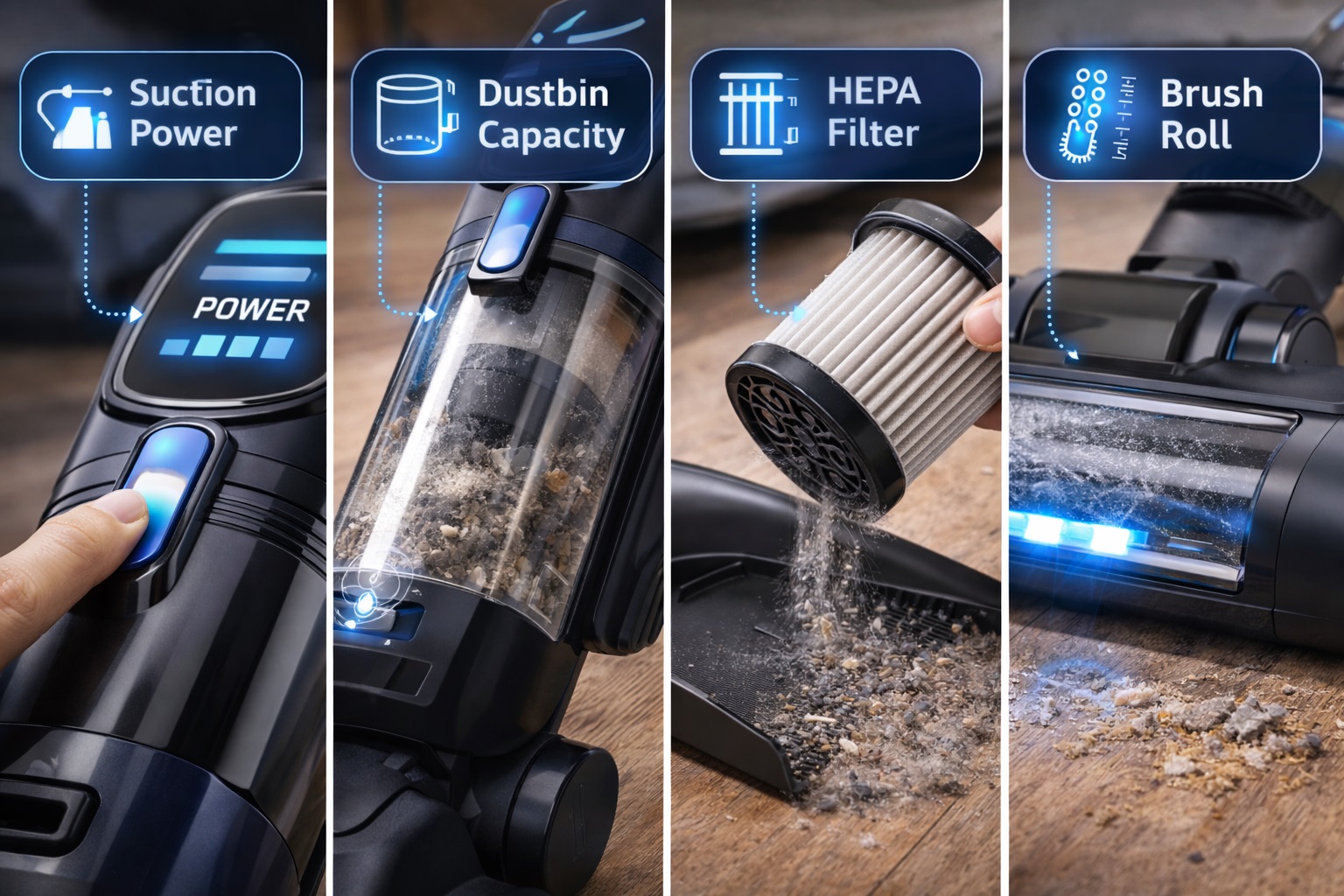
A Clear Vocabulary Guide for Smarter Vacuum Buying Decisions
The vacuum cleaner industry uses too many terms—and too few explanations.
For beginners, this creates confusion.
For European & Middle Eastern B2B buyers, it creates something worse:
misaligned expectations, wrong positioning, and unnecessary after-sales issues.
This article explains the most common vacuum cleaner terms in plain language, not from a consumer angle, but from a practical buying and usage perspective.
No marketing buzzwords.
No engineering overload.
Only terms that actually affect performance, efficiency, and user satisfaction.
Who This Article Is For
New B2B vacuum cleaner buyers and sourcing managers
Importers and distributors entering the cleaning equipment category
Sales teams needing clear, consistent explanations
Cleaning industry beginners and entrepreneurs
Why Understanding Basic Terms Matters
Most product complaints don’t come from defects.
They come from misunderstood terms.
When buyers don’t clearly understand what a term means:
Clear terminology reduces:
Returns
Training costs
Support workload
Term 1: Wet and Dry Vacuum Cleaner
A wet and dry vacuum cleaner is designed to handle:
Dry dust and debris
Light liquid spills
What it does not mean:
For beginners, the key value is:
One machine for mixed messes, fewer cleaning steps.
For B2B buyers, the key check is separation design—how well wet and dry airflow paths are isolated.
Term 2: Multi-Functional Durable Vacuum Cleaner
This term combines two ideas:
A Multi-Functional Durable Vacuum Cleaner usually:
Works across rooms and surfaces
Supports multiple attachments
Maintains performance over time
What beginners should know:
More functions only help if durability is designed in.
Term 3: Fast Lightweight Vacuum Cleaner
“Lightweight” does not just mean lower weight.
A Fast Lightweight Vacuum Cleaner is designed to:
Start quickly
Move easily
Reduce user fatigue
Efficiency comes from:
For buyers, lightweight design often improves real-world usage rates, not just comfort.
Term 4: Energy-Saving Efficient Powerful Vacuum Cleaner
This term sounds contradictory—but it isn’t.
An Energy-Saving Efficient Powerful Vacuum Cleaner focuses on:
Airflow efficiency
Motor optimization
Reducing wasted energy
It does not mean:
Weak suction
Compromised cleaning
For beginners:
Power is about how effectively air moves dirt—not how much electricity is used.
Term 5: Quiet Vacuum for Night Use
A Quiet Vacuum for Night Use is not simply “less loud.”
It is designed to:
This allows:
Cleaning during off-hours
Use in apartments, hotels, and shared spaces
For buyers, quiet design increases time flexibility, not just comfort.
Term 6: Vacuum for Multi-Surface
A Vacuum for Multi-Surface is built to clean:
Hard floors
Rugs
Carpets
Mixed environments
Key concept for beginners:
Multi-surface is about adaptability, not maximum suction.
These vacuums adjust airflow or brush behavior to deliver consistent results across different floor types.
Common Beginner Misunderstandings to Avoid
“Higher suction always cleans better” → Not always true
“Multi-functional means no compromises” → Usually compromises exist
“Quiet means weak” → Poor design, not low noise, causes weakness
“Energy-saving means less power” → Efficiency is not the same as limitation
Understanding terms prevents wrong expectations.
How B2B Buyers Can Use These Terms Correctly
Instead of listing terms as features:
Explain what problem each term solves
Clarify what it does not do
Match terms to real usage scenarios
This approach:
A Beginner-Friendly Portfolio Structure
To avoid confusion, many B2B buyers structure entry-level offerings as:
One wet and dry vacuum cleaner for mixed messes
One Multi-Functional Durable Vacuum Cleaner for daily use
One Fast Lightweight Vacuum Cleaner for quick cleaning
One Energy-Saving Efficient Powerful Vacuum Cleaner for cost-conscious users
One Quiet Vacuum for Night Use for apartments and hotels
One Vacuum for Multi-Surface for varied flooring
Clear roles reduce misunderstanding.
Final Takeaway
Vacuum basics are not about memorizing terms.
They are about understanding what each term actually changes in daily cleaning.
For beginners—and for B2B buyers serving them—clear explanations:
Reduce friction
Prevent disappointment
Improve buying decisions
A well-explained product is often more successful than a more powerful one.
Hashtags
wet and dry vacuum cleaner, Multi-Functional Durable Vacuum Cleaner, Fast Lightweight Vacuum Cleaner, Energy-Saving Efficient Powerful Vacuum Cleaner, Quiet Vacuum for Night Use, Vacuum for Multi-Surface, vacuum basics explained, vacuum terminology guide
professional cleaning equipment, industrial vacuum solutions, b2b vacuum cleaner, europe vacuum market, middle east vacuum market, vacuum cleaner distributor, vacuum cleaner importer, private label vacuum cleaner, oem vacuum cleaner
vacuum buying basics, beginner vacuum guide, cleaning equipment education, entry level vacuum selection
vacuum cleaner engineering, vacuum cleaner design, cleaning equipment supplier, vacuum cleaner manufacturer, vacuum cleaner wholesale, global vacuum supply, eu cleaning equipment, gcc cleaning market
commercial hygiene solutions, professional vacuum systems, industrial cleaning tools, buyer education strategy, product explanation framework, Lanxstar