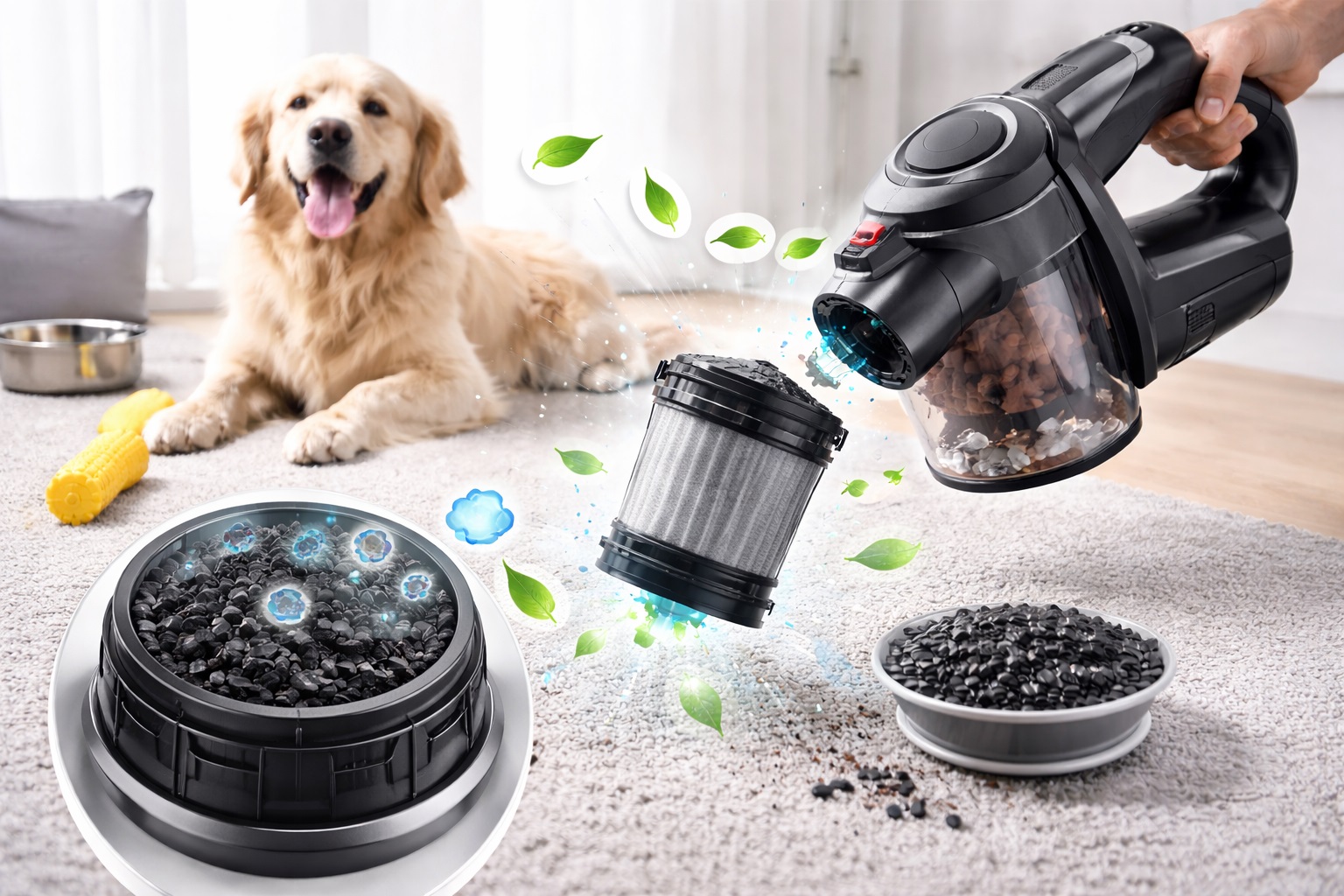
A B2B Odor-Control Framework for Vacuum Cleaner Buyers & Product Engineers
Pet odor is one of the most misunderstood performance indicators in the vacuum cleaner industry. Many products remove visible pet hair effectively, yet odor complaints continue weeks or months after purchase—leading to poor reviews, returns, and distributor distrust.
For EU & Middle East vacuum cleaner buyers, pet odor issues are not cosmetic. They directly affect:
This article explains why pet odors persist, why suction and HEPA filtration alone are insufficient, and how a vacuum + activated carbon system provides a scalable, market-proven solution.
🧭 Step 1: Understand Why Pet Odors Survive Traditional Vacuuming
Pet odors are not caused by hair alone. The main contributors include:
A Vacuum Cleaner for Pet Hair can remove fur effectively, but odor-causing molecules often:
Bind to dust particles
Embed in carpets, upholstery, and car interiors
Pass through standard filtration systems
Key insight:
Odor is a chemical problem, not just a debris problem.
🌀 Step 2: Why High Suction Alone Cannot Eliminate Odor
Stronger suction improves debris removal but has limited impact on odor control.
In fact, without proper filtration:
This is where many Multi-Functional Durable Vacuum Cleaner designs fail—by prioritizing power over air treatment.
Buyer takeaway:
Odor complaints often increase after “deep cleaning” if air treatment is ignored.
🧠 Step 3: HEPA Filtration Solves Part of the Problem—Not All of It
A HEPA Filter Vacuum Cleaner is highly effective at capturing:
Pet dander
Fine dust
Allergen particles
However, HEPA filters are particle filters, not odor neutralizers.
They do not:
This explains why homes can feel “clean” but still smell unpleasant after vacuuming.
🌫️ Step 4: Activated Carbon — The Missing Layer in Pet Odor Control
Activated carbon works through adsorption, trapping odor molecules within its porous structure.
When integrated into a vacuum system:
Odor molecules are captured before exhaust
Smell intensity decreases immediately
Long-term odor buildup is reduced
The vacuum + activated carbon combo transforms the vacuum from a cleaning tool into an air treatment device.
Engineering note:
Carbon placement matters—post-HEPA positioning maximizes efficiency and extends carbon lifespan.
📍 Case Snapshot 1: Persistent Pet Odor Despite Strong Cleaning Performance
Market: EU pet-owning households
Initial Issue:
Strong suction, excellent pet hair removal, ongoing odor complaints
Root Cause:
No odor adsorption layer in airflow system
Correction:
Added activated carbon module after HEPA stage
Outcome:
Improved customer reviews and lower odor-related returns
B2B takeaway:
Pet hair performance does not equal pet odor control.
🔇 Step 5: Why Quiet Operation Improves Odor Perception
A Quiet Vacuum Cleaner contributes indirectly to odor control.
Why?
Loud motors intensify airflow turbulence
Turbulence spreads odor molecules more aggressively
Users perceive smell more strongly during noisy operation
Lower noise levels signal:
Smoother airflow
Reduced leakage
Better system sealing
Quiet operation enhances both actual and perceived air quality.
🚗 Step 6: Cars Reveal the Real Value of Carbon Filtration
Car interiors are a worst-case scenario for pet odors:
Confined space
Fabric-heavy surfaces
Limited air circulation
A Car Vacuum Cleaner equipped with activated carbon:
Buyers consistently report higher satisfaction with odor control in cars before homes, making automotive use a strong validation scenario.
📍 Case Snapshot 2: Carbon Filtration Reduced Complaints in Car Cleaning Segment
Market: Middle East car detailing distributors
Problem:
Pet odor complaints after interior cleaning
Solution:
Vacuum systems with integrated activated carbon filtration
Result:
Faster odor neutralization and higher service repeat rates
Strategic insight:
If it works in cars, it works in apartments.
💧 Step 7: Moisture Management Matters in Pet Odor Control
Pet odor intensifies in humid environments.
In a wet and dry vacuum cleaner, improper moisture recovery:
Effective odor-focused systems ensure:
📈 Strategic Takeaways for EU & Middle East Buyers
Pet odor is a chemical + airflow problem
Suction and HEPA alone are insufficient
Activated carbon is the missing layer
Quiet, sealed systems improve odor perception
Car cleaning scenarios validate odor-control performance
📌 Hashtags
wet and dry vacuum cleaner, Multi-Functional Durable Vacuum Cleaner, Car Vacuum Cleaner, Quiet Vacuum Cleaner, HEPA Filter Vacuum Cleaner, Vacuum Cleaner for Pet Hair, activated carbon filtration, pet odor control
B2B vacuum sourcing, vacuum cleaner distributor, vacuum cleaner importer, vacuum cleaner OEM, vacuum cleaner ODM, cleaning equipment business, EU vacuum market, Middle East vacuum market
vacuum product engineering, airflow sealing system, odor adsorption technology, indoor air quality equipment, allergy control solutions, filtration system design
pet hair removal solutions, car interior cleaning equipment, apartment pet cleaning, vacuum after-sales strategy, product differentiation strategy
professional cleaning tools, B2B cleaning solutions, vacuum buyer guide, vacuum sourcing guide, indoor odor management, Lanxstar