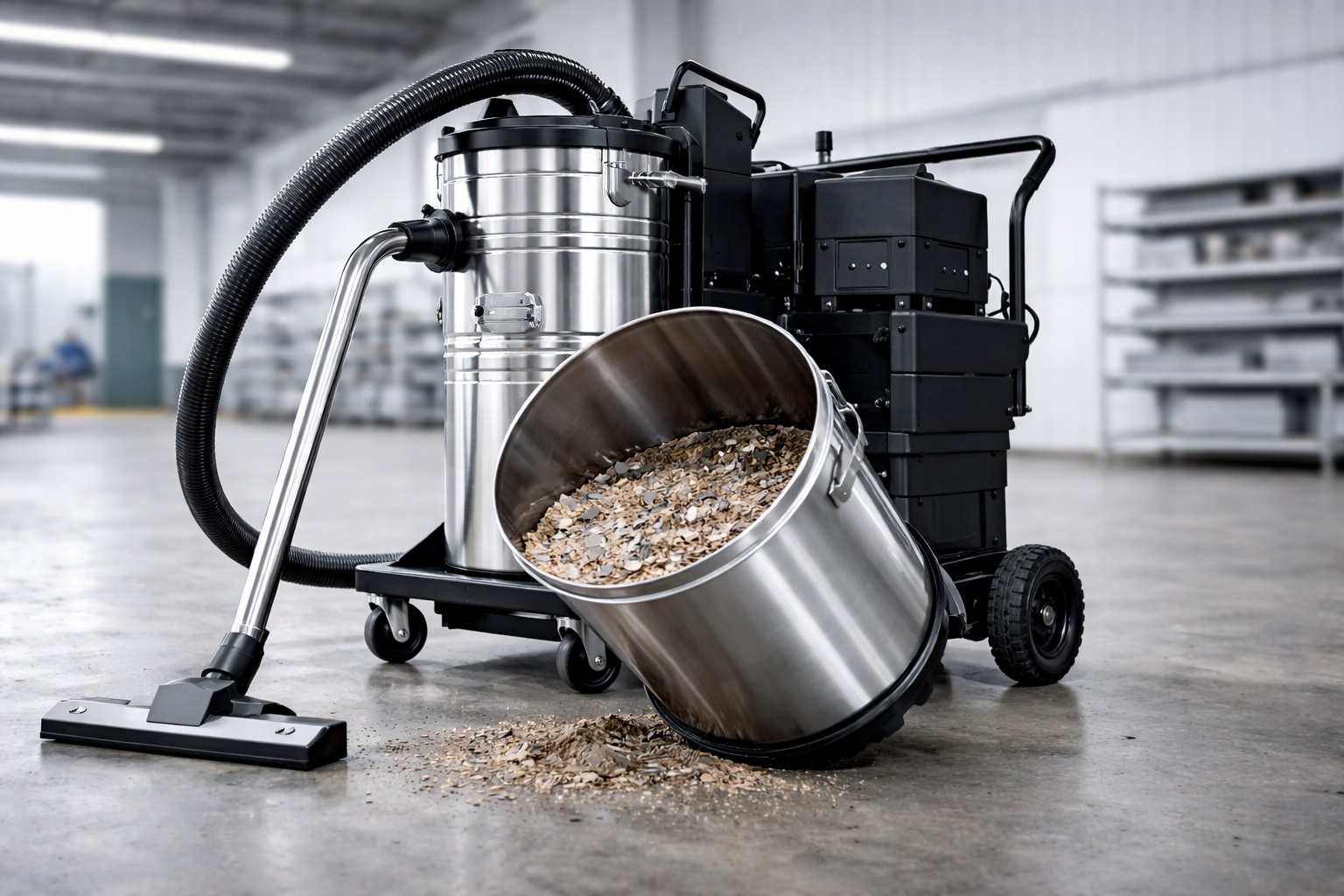
Most industrial buyers focus on suction power—but ignore tank capacity, which actually determines real cleaning efficiency, labor cost, and workflow continuity.
Choosing the wrong tank size is one of the most expensive mistakes in industrial vacuum sourcing.
For European and American distributors, selecting the right industrial vacuum capacity is not just a specification decision—it’s a business efficiency strategy.
⚙️ 1. What Is Tank Capacity in Industrial Vacuums?
Tank capacity refers to how much debris or liquid a vacuum can store before requiring emptying.
Typical Capacity Ranges:
10–20L → Light commercial
20–40L → Standard commercial
40–80L+ → Large capacity vacuum (industrial use)
👉 Key Insight:
Tank capacity determines how long a machine can operate without interruption.
💨 2. Why Tank Capacity Directly Impacts Efficiency
Tank size is not just about volume—it directly affects operational performance.
Real Impact Areas:
Cleaning Efficiency: Larger tanks = fewer stops
Labor Cost: Reduced emptying frequency
Workflow Continuity: Less downtime
User Satisfaction: Smoother operation
👉 In industrial environments, optimizing tank size vacuum selection can improve efficiency by 20–40%.
⚖️ 3. Small vs Large Tank: Practical Comparison
| Factor | Small Tank Vacuum | Large Capacity Vacuum |
|---|
| Weight | Light | Heavy |
| Mobility | High | Moderate |
| Emptying Frequency | High | Low |
| Cleaning Efficiency | Lower | Higher |
| Best Use Case | Offices / Retail | Warehouses / Factories |
👉 Structured comparisons like this help rank for industrial vacuum capacity searches.
💡 4. Why Oversized Tanks Can Reduce Efficiency
Here’s a critical but often ignored reality:
Bigger tank does NOT always mean better performance.
Hidden Downsides of Oversized Tanks:
Increased weight → harder to move
Slower handling and dumping
Inefficient for small or medium spaces
Higher transport and storage cost
👉 A poorly matched large capacity vacuum can actually reduce productivity.
⚠️ 5. Common Buyer Mistakes (Costing Time & Money)
❌ Choosing tank size based on “bigger is better”
❌ Ignoring workspace constraints
❌ Underestimating debris volume
❌ Not matching tank size with motor system
❌ Selecting low-cost OEMs without engineering validation
👉 Result:
Operational inefficiency + higher labor cost + customer dissatisfaction
📊 6. Real Case Insight: When Tank Size Was Too Small
A US warehouse cleaning contractor used 20L wet dry vacuum units for large-scale debris removal.
🔍 Problem:
Tanks filled every 10–15 minutes
Frequent workflow interruptions
Workers lost time emptying units
🧪 Root Cause:
Tank capacity too small for debris volume (~50L/hour)
Continuous operation environment
Poor initial product selection
🔄 Solution:
They upgraded to a 60L large capacity vacuum from a certified wet dry vacuum factory China, featuring:
📈 Results:
🔻 Emptying frequency reduced by over 60%
🔻 Cleaning interruptions significantly reduced
🔺 Overall efficiency increased by ~35%
🧠 Key Takeaway:
Tank capacity directly determines how efficiently a job gets done—not just how much it holds.
📐 7. How to Estimate the Right Tank Capacity (Critical for Buyers)
This is where most buyers lack a clear method.
Basic Calculation Logic:
Tank Capacity ≈ Hourly Debris Volume × Desired Cleaning Time
Example:
👉 Recommended tank size:
→ 40 × 1.5 = 60L capacity
Key Variables to Consider:
👉 This approach helps distributors select the right industrial vacuum capacity with confidence.
📋 8. Practical Selection Framework
When working with a OEM wet dry vacuum supplier, follow this:
✅ Choose Smaller Tank If:
Limited workspace
Light-duty cleaning
High mobility required
Short cleaning cycles
✅ Choose Large Capacity Vacuum If:
Industrial environments
High debris/liquid volume
Continuous operation required
Labor efficiency is critical
🔍 Always Verify:
🏭 9. OEM Strategy: Turn Capacity Into Profit
Tank size is not just technical—it’s a pricing and positioning tool.
Smart Product Structuring:
💰 Business Insight:
Tank capacity is one of the easiest ways to differentiate SKUs and increase pricing flexibility.
👉 Leading wet dry vacuum manufacturers and OEM wet dry vacuum suppliers support custom capacity configurations.
🚀 10. Future Trend: Smarter Capacity Design
👉 Future industrial vacuum capacity solutions will focus on efficiency, not just size.
🧠 Conclusion: Capacity Drives Real Performance
Choosing the right tank size vacuum is not about maximizing size—it’s about optimizing efficiency.
For B2B buyers, success comes from:
Matching tank capacity to real applications
Using calculation-based selection
Avoiding over- or under-specification
Partnering with a reliable wet dry vacuum manufacturer
In industrial cleaning, productivity is defined by how long you can work without stopping—not just how strong your vacuum is.
📌 Target Audience
📌 Hashtags
industrial vacuum capacity, tank size vacuum, large capacity vacuum, wet dry vacuum manufacturer, OEM wet dry vacuum supplier, wet dry vacuum factory China, industrial vacuum cleaner, commercial vacuum cleaner, vacuum tank size, high capacity vacuum cleaner, industrial cleaning equipment, vacuum supplier Europe, vacuum distributor USA, B2B vacuum solutions, OEM cleaning equipment, vacuum machine factory, professional vacuum cleaner, industrial dust extractor, wet vacuum system, dry vacuum cleaner industrial, high suction vacuum, vacuum cleaner OEM service, private label vacuum cleaner, industrial cleaning solutions, factory direct vacuum supplier, commercial cleaning machines, vacuum equipment wholesale, industrial vacuum tank, stainless steel vacuum tank, heavy duty cleaning tools, vacuum system manufacturer, cleaning equipment supplier, industrial maintenance tools, vacuum cleaner distributor, bulk vacuum purchase, industrial cleaning systems, powerful vacuum motor, vacuum filtration system, dust collection vacuum, industrial wet vacuum, cleaning machine OEM, vacuum technology solutions, professional cleaning tools, vacuum industry supplier, industrial equipment distributor, smart vacuum systems, energy efficient vacuum, Lanxstar