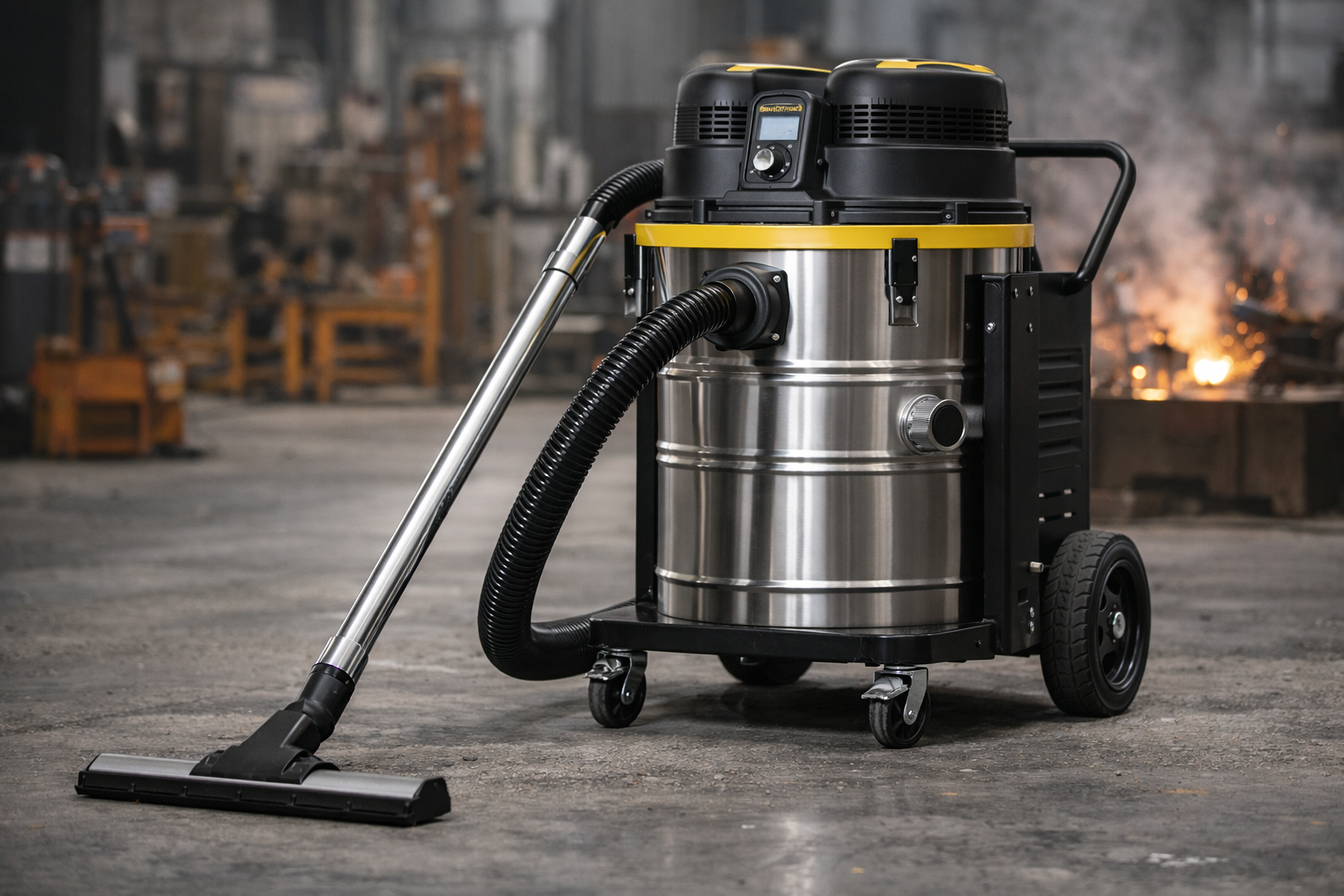
In industrial environments, vacuum cleaners are often required to run non-stop for hours—or even 24/7. However, most standard machines are not designed for this level of demand, leading to overheating, motor failure, and frequent downtime.
For European and US B2B buyers, choosing the right continuous operation vacuum is not just about power—it’s about system design, durability, and thermal stability.
💡 A vacuum designed for continuous operation is not stronger—it is smarter.
This guide explores engineering principles, real-world applications, and sourcing strategies to help you select the right wet dry vacuum manufacturer for long-running industrial use.
⚙️ 🔍 1. Why Most Vacuums Fail in Continuous Operation
⚠️ Over 80% of vacuums used in continuous environments fail due to design limitations—not usage intensity.
🔥 Heat Accumulation
Motors generate constant heat
Poor cooling leads to thermal buildup
Internal components degrade rapidly
⚡ Duty Cycle Limitations
Most vacuums are designed for:
🌡️ Weak System Integration
👉 Common issue in low-end wet dry vacuum factory China products.
🧊 🧠 2. Core Design Principles for Continuous Operation Vacuum
💨 Independent Cooling Airflow System
📊 Can reduce internal temperature by 20°C+ during long operation
⚙️ Industrial Motor Design
Copper windings
High thermal tolerance
Stable output under load
👉 A must-have from any serious OEM wet dry vacuum supplier.
🔄 Continuous Duty Cycle Engineering
💡 Continuous operation is not about endurance—it’s about balance between heat, airflow, and load.
📊 📍 3. Real Case Study #1 (Germany – Automotive Factory)
🚨 Problem:
🔧 Solution:
Dual cooling airflow
High-performance motor
📈 Results:
📊 📍 4. Real Case Study #2 (USA – Logistics Warehouse)
🚨 Problem:
🔧 Solution:
📈 Results:
💡 Key Insight:
Continuous operation requires system-level engineering—not just stronger motors.
🔧 🛠️ 5. Quick Fix Guide for Long Running Vacuum Issues
🚨 Overheating During Operation
Check airflow system
Clean filters
Reduce load
🚨 Sudden Shutdown
🚨 Performance Drop
Filter clogging
Airflow blockage
💡 If a vacuum cannot run continuously, it is not an industrial-grade machine.
⚖️ 📊 6. Standard vs Continuous Operation Vacuum
| Factor | Standard Vacuum | Continuous Operation Vacuum |
|---|
| Runtime | 30–60 min | 8–24 hours |
| Cooling System | Basic | Engineered |
| Motor Design | Consumer-grade | Industrial-grade |
| Failure Rate | High | Low |
| Maintenance | Frequent | Predictable |
💡 Long-running performance is designed—not upgraded later.
🧰 🛠️ 7. Maintenance Strategy for Continuous Operation
🧽 Filter Optimization
Multi-stage filtration
Regular cleaning cycles
🔄 Scheduled Downtime
🛢️ Load Management
🏭 📦 8. Supplier Strategy: How to Source the Right System
📋 Ask These Questions
Is the vacuum designed for continuous operation?
What is the tested runtime?
Can you provide thermal test data?
🧪 Testing Requirements
🌍 Compliance
CE / UL
Voltage compatibility
👉 Work with reliable wet dry vacuum manufacturers only.
🧠 🎯 9. B2B Buyer Checklist
✔ Continuous duty cycle verified?
✔ Independent cooling system?
✔ Industrial-grade motor?
✔ Thermal protection included?
✔ Real testing data available?
💡 A true industrial duty vacuum is built to run—not to rest.
🚀 🔮 10. Future Trends in Continuous Operation Vacuum Design
🤖 Smart Monitoring
⚡ Brushless Motors
Lower heat
Longer lifespan
🧠 Adaptive Systems
🎯 Conclusion: Continuous Operation Starts with Smart Design
💡 The ability to run continuously is the ultimate test of industrial vacuum quality.
To succeed:
Choose the right wet dry vacuum manufacturer
Focus on cooling, motor, and system integration
Validate with real testing data
👉 Result: maximum uptime, minimum failure, higher ROI
📌 Hashtags
wet dry vacuum manufacturer, OEM wet dry vacuum supplier, wet dry vacuum factory China, continuous operation vacuum, long running vacuum, industrial duty vacuum, heavy duty vacuum cleaner, industrial vacuum cleaner, vacuum cooling system, vacuum motor protection, industrial vacuum durability, vacuum airflow design, vacuum filtration system, HEPA industrial vacuum, vacuum maintenance system, industrial cleaning equipment, vacuum supplier Europe, vacuum supplier USA, industrial vacuum OEM, China vacuum factory, vacuum performance optimization, industrial vacuum testing, vacuum system reliability, vacuum engineering design, vacuum thermal management, industrial vacuum solutions, vacuum energy efficiency, smart vacuum system, brushless motor vacuum, vacuum system design, industrial vacuum customization, vacuum distributor Europe, vacuum wholesale supplier, industrial vacuum safety standards, vacuum CE certification, vacuum UL certification, vacuum system engineering, vacuum airflow optimization, vacuum cooling design, industrial vacuum innovation, vacuum lifecycle management, vacuum load management, industrial vacuum performance, vacuum system durability, vacuum continuous runtime, industrial vacuum technology, vacuum OEM customization, industrial vacuum market











