Hi, message us with any questions.
We're happy to help!





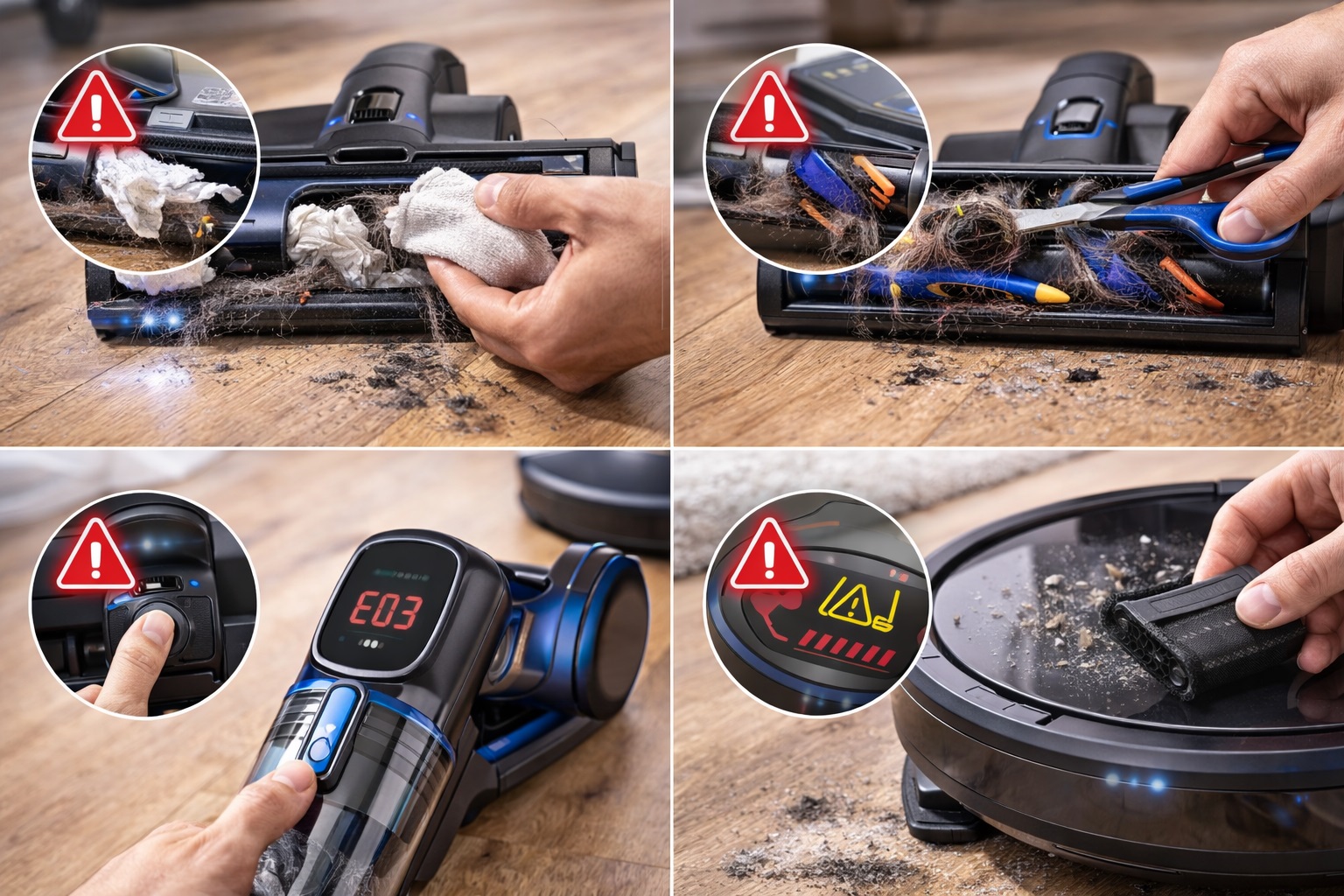
A Practical Troubleshooting Guide for European & Middle Eastern B2B Buyers
Vacuum cleaner issues are inevitable.
What separates successful B2B vacuum brands from failed ones is not perfection—but how predictable, controllable, and solvable those issues are.
For consumers, a vacuum problem is an inconvenience.
For European & Middle Eastern B2B buyers, distributors, and product managers, common vacuum issues translate into:
After-sales workload
Distributor dissatisfaction
Brand credibility loss
Margin erosion
This article is written for B2B decision-makers, not end users. It focuses on the most common vacuum cleaner issues seen in real markets, explains why they occur, and provides fast, realistic fixes—or sourcing-stage prevention strategies.
No generic advice.
No “reset the machine” clichés.
Only commercially useful solutions.
🧭 Who This Article Is For
European & Middle Eastern B2B vacuum cleaner buyers
Importers and distributors managing service claims
Product managers and sourcing teams
Cleaning equipment entrepreneurs and quality leaders
🧠 Why “Quick Fixes” Matter More in B2B Than in B2C
In B2B markets:
Problems scale fast
One defect affects thousands of units
Slow fixes damage entire channels
The goal is not to eliminate all issues—but to ensure that most common issues can be fixed quickly, cheaply, and consistently.
🧩 Issue 1: Sudden Suction Loss
Seen in:
wet and dry vacuum cleaner
Multi-Functional Durable Vacuum Cleaner
Vacuum for Multi-Surface
Root causes:
Filter saturation
Partial blockage in airflow path
Improper wet/dry mode switching
Quick fixes:
Clean or replace filters immediately
Inspect hose and nozzle junctions
Verify correct mode selection in wet/dry systems
B2B prevention tip:
Choose designs with:
Straight airflow paths
Tool-free filter access
Clear wet/dry separation
Most suction complaints are maintenance-driven, not motor failures.
🔋 Issue 2: Weak or Inconsistent Performance Across Surfaces
Seen in:
Vacuum for Multi-Surface models
Root causes:
Fixed suction levels
Brush roll resistance mismatch
Floor head sealing issues
Quick fixes:
Adjust surface mode manually
Clean brush rolls and floor heads
Reduce carpet resistance where possible
B2B prevention tip:
True multi-surface vacuums must adapt airflow and mechanical resistance, not just claim compatibility.
🌬️ Issue 3: Excessive Noise or Vibration
Seen in:
Quiet Vacuum Cleaner
Quiet Vacuum for Night Use
Root causes:
Imbalanced motors
Air turbulence from poor duct design
Loose internal components
Quick fixes:
Check filter and exhaust blockages
Tighten housing components
Replace worn seals
B2B reality:
Quiet models fail when noise reduction relies on airflow restriction, not engineering refinement.
🧼 Issue 4: “Self-Cleaning” Not Actually Working
Seen in:
Portable Self-Cleaning Vacuum Cleaner
Root causes:
Misleading self-cleaning mechanisms
Fine dust clogging filter pores
Overuse without manual maintenance
Quick fixes:
Manual filter rinse or replacement
Reset self-cleaning cycles
Reduce continuous operation time
B2B prevention tip:
Self-cleaning should reduce maintenance frequency, not eliminate it. Simpler systems outperform over-engineered ones.
🌙 Issue 5: Performance Drops During Night or Long Sessions
Seen in:
Quiet Vacuum for Night Use
Root causes:
Heat buildup
Reduced airflow from noise dampening
Motor protection throttling
Quick fixes:
Allow cooling intervals
Clean exhaust and filters
Lower sustained power mode
B2B insight:
Night-use models must balance thermal stability and acoustic control, not sacrifice one for the other.
🚗 Issue 6: Poor Performance in Confined or Car Environments
Seen in:
Car Vacuum Cleaner
Root causes:
Restricted airflow
Rapid filter saturation
Overheating from short, intense cycles
Quick fixes:
Frequent filter cleaning
Shorter operation intervals
Ensure ventilation around exhaust ports
B2B prevention tip:
Car vacuums need fast-access filters and controlled peak power, not maximum suction marketing.
🧠 Why Most Common Issues Are Design-Related
Suppliers often blame:
User misuse
Lack of maintenance
But experienced distributors know:
If an issue appears repeatedly, it is a design or positioning problem.
Common issues are determined by:
Airflow layout
Filter accessibility
Thermal design
Product positioning accuracy
These are locked in before mass production.
🧩 How Professional Buyers Reduce Issues Before They Happen
Instead of asking:
“Does it have this feature?”
Ask:
How fast can common issues be fixed?
Are filters accessible without tools?
Does one model try to cover too many scenarios?
Can distributors solve 80% of issues on-site?
This approach applies to:
wet and dry vacuum cleaner sourcing
Multi-Functional Durable Vacuum Cleaner portfolios
Quiet Vacuum Cleaner and night-use models
🔍 A Practical Portfolio Strategy
To minimize issue-related costs, experienced B2B buyers often structure product lines as:
One wet and dry vacuum cleaner for mixed environments
One Multi-Functional Durable Vacuum Cleaner with simplified internals
One Vacuum for Multi-Surface optimized for adaptability
One Quiet Vacuum Cleaner for regulated spaces
One Quiet Vacuum for Night Use for premium channels
Optional Portable Self-Cleaning Vacuum Cleaner for niche demand
This avoids overloading one model with incompatible requirements.
✅ Final Takeaway
Common vacuum issues are not random failures—they are predictable outcomes of design choices.
For European and Middle Eastern B2B buyers, success lies in selecting vacuum cleaners that:
Are easy to troubleshoot
Have fast, low-cost fixes
Fail gracefully instead of catastrophically
Vacuum cleaners designed for serviceability and realistic use will always outperform those optimized only for features.
📌 Hashtags
wet and dry vacuum cleaner, Multi-Functional Durable Vacuum Cleaner, Portable Self-Cleaning Vacuum Cleaner, Quiet Vacuum Cleaner, Vacuum for Multi-Surface, Quiet Vacuum for Night Use, common vacuum issues, vacuum troubleshooting guide, vacuum quick fixes, vacuum suction problems, vacuum noise issues, vacuum filter problems, professional cleaning equipment, industrial vacuum solutions, europe vacuum market, middle east vacuum market, vacuum cleaner distributor, vacuum cleaner importer, private label vacuum cleaner, oem vacuum cleaner, vacuum cleaner quality control, vacuum cleaner testing standards, after sales risk management, vacuum cleaner maintenance design, durable vacuum cleaner, low noise vacuum cleaner, night use cleaning equipment, multi-surface cleaning solution, vacuum cleaner engineering, vacuum cleaner design, cleaning equipment supplier, vacuum cleaner manufacturer, vacuum cleaner wholesale, global vacuum supply, eu cleaning equipment, gcc cleaning market, commercial hygiene solutions, professional vacuum systems, industrial cleaning tools, product durability strategy, serviceability design, Lanxstar