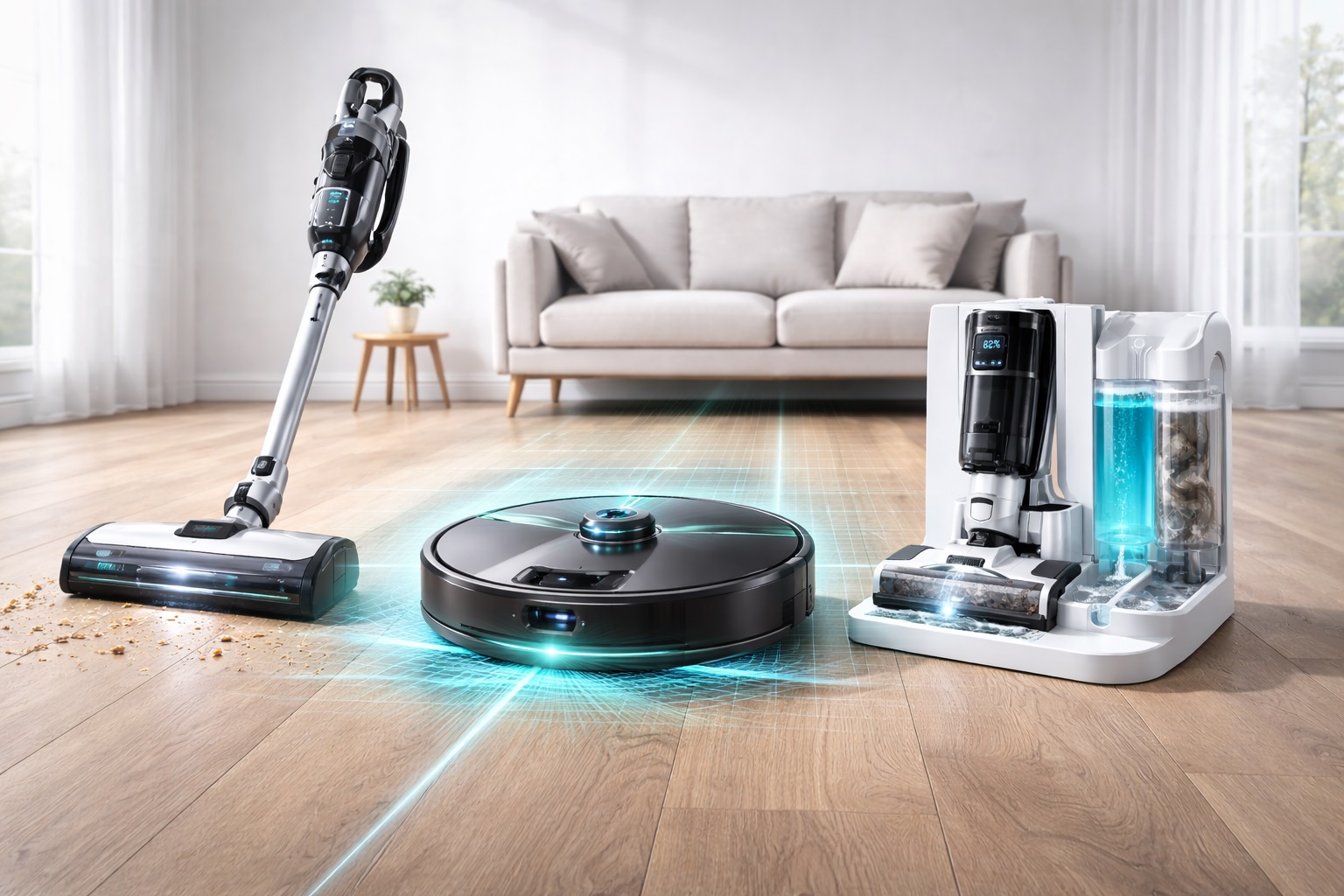
The smart vacuum cleaner market in 2026 is defined by three core technologies: Wireless (Cordless), Laser Navigation, and Self-Cleaning. 🧠🤖
While many products combine multiple features, understanding the core value and limitations of each technology is essential for making informed purchasing and product development decisions.
1. Overview of the Three Smart Vacuum Technologies
Wireless (Cordless) Vacuum Cleaners
Focus on mobility, flexibility, and convenience. Ideal for fast, manual cleaning across multiple scenarios.
Laser Navigation Vacuums
Emphasize automation, mapping accuracy, and efficient path planning—often used in smart or robotic platforms.
Self-Cleaning Vacuums
Target maintenance reduction and hygiene by automating internal cleaning processes.
Each technology addresses a different primary user pain point.
2. Performance Comparison: Cleaning Efficiency & Coverage
| Feature | Wireless Vacuum | Laser Navigation Vacuum | Self-Cleaning Vacuum |
|---|
| Cleaning speed | High (manual) | Very high (automated) | High (consistent) |
| Coverage accuracy | User-dependent | System-guided | Depends on base tech |
| Repeat efficiency | Medium | High | Very high |
A High Suction Vacuum Cleaner benefits all three, but laser navigation optimizes coverage, while self-cleaning maintains long-term performance.
3. Suction, Power & Energy Efficiency
Wireless vacuums in 2026 deliver impressive performance thanks to advanced motors and airflow design. ⚡
Wireless Vacuum Cleaner: Strong instant suction, flexible usage
Laser Navigation Vacuum: Optimized energy use through efficient movement
Self-Cleaning Vacuum Cleaner: Maintains suction stability over time
An Energy-Saving Efficient Powerful Vacuum Cleaner can be built on any of these platforms.
4. Noise Control & Living Environment Compatibility
Noise is a critical factor for urban and apartment users. 🌙
| Environment | Best Choice |
|---|
| Apartments | Quiet Wireless Vacuum |
| Night Use | Self-Cleaning + Quiet Vacuum |
| Large Homes | Laser Navigation Vacuum |
A Quiet Vacuum Cleaner design is essential across all smart vacuum categories.
5. Maintenance & Hygiene Comparison
Maintenance is where self-cleaning technology stands out.
Wireless Vacuum: Manual brush and filter cleaning
Laser Navigation Vacuum: Sensor and path system maintenance
Self-Cleaning Vacuum: Automated hair and debris removal
For pet households, a Vacuum Cleaner for Pet Hair with self-cleaning capability offers a clear advantage. 🐾
6. Wet & Dry Capability Across Technologies
Wet Dry Vacuum Cleaners are increasingly integrated into smart platforms.
Wireless models offer manual wet/dry flexibility
Laser navigation systems automate wet cleaning routes
Self-cleaning systems reduce residue buildup
A 4 in 1 Cordless Smart Wet & Dry Vacuum Cleaner often combines all three technologies.
7. Portability & Travel Use
Portability remains a strong differentiator.
Fast Lightweight Vacuum Cleaner: Best for travel and cars 🚗
Car Vacuum Cleaner: Typically wireless and compact
Laser navigation systems are less portable due to size and complexity
For Portable Vacuum for Travel, wireless remains the clear winner.
8. Cost & Market Positioning Analysis
| Segment | Best Technology |
|---|
| Entry-level | Wireless Vacuum |
| Mid-range | Wireless + Self-Cleaning |
| Premium | Laser Navigation + Self-Cleaning |
Buyers targeting the best vacuum on a budget often prioritize wireless models, while premium brands focus on automation and hygiene.
9. Manufacturing & Product Strategy Perspective
From a vacuums manufacturer or vacuum cleaner maker standpoint:
Wireless: High volume, fast market entry
Laser Navigation: High differentiation, higher R&D cost
Self-Cleaning: Long-term brand value, reduced returns
Brands like Lanxstar evaluate these technologies based on regional demand and portfolio balance.
10. Which Smart Vacuum Technology Is Right for You in 2026?
Choose Wireless if you value portability and price.
Choose Laser Navigation if automation and mapping matter most.
Choose Self-Cleaning if hygiene and low maintenance are priorities.
Many 2026 models integrate all three—but understanding the core technology helps avoid overpaying for unused features.
Conclusion
The 2026 smart vacuum market is not about choosing the “best” technology—but the right combination. Wireless, laser navigation, and self-cleaning each solve different problems. For buyers, engineers, and brands, success lies in aligning technology with real user needs and market positioning. 🌍
Discover next-generation smart vacuum solutions at www.lxvacuum.com
50 Related Keyword Groups
Smart Vacuum Cleaner, Wireless Vacuum Cleaner, Cordless Vacuum Cleaner, Laser Navigation Vacuum, Self-Cleaning Vacuum Cleaner, High Suction Vacuum Cleaner, Portable Quiet Vacuum Cleaner, Multi-Functional Durable Vacuum Cleaner, Fast Lightweight Vacuum Cleaner, Energy-Saving Efficient Powerful Vacuum Cleaner, Large-Capacity Wet Dry Vacuum Cleaner, Li-ion Cordless Handheld Vacuum Cleaner, Wet Dry Vacuum Cleaners, 4 in 1 Cordless Smart Wet & Dry Vacuum Cleaner, cordless handheld vacuums, quiet vacuum cleaner, HEPA Filter Vacuum Cleaner, Apartment Vacuum Cleaner, Vacuum Cleaner for Pet Hair, Quiet Vacuum for Night Use, wet dry vacuum, Portable Vacuum for Travel, best vacuum on a budget, best budget hoover, good budget vacuum, best affordable vacuum, best budget vacuum, best value hoover, best value for money hoover, smart laser vacuum, smart self-cleaning vacuum, low noise smart vacuum, rechargeable wireless vacuum, hygiene vacuum system, home cleaning technology, Lanxstar, vacuums manufacturer, vacuum cleaner maker